
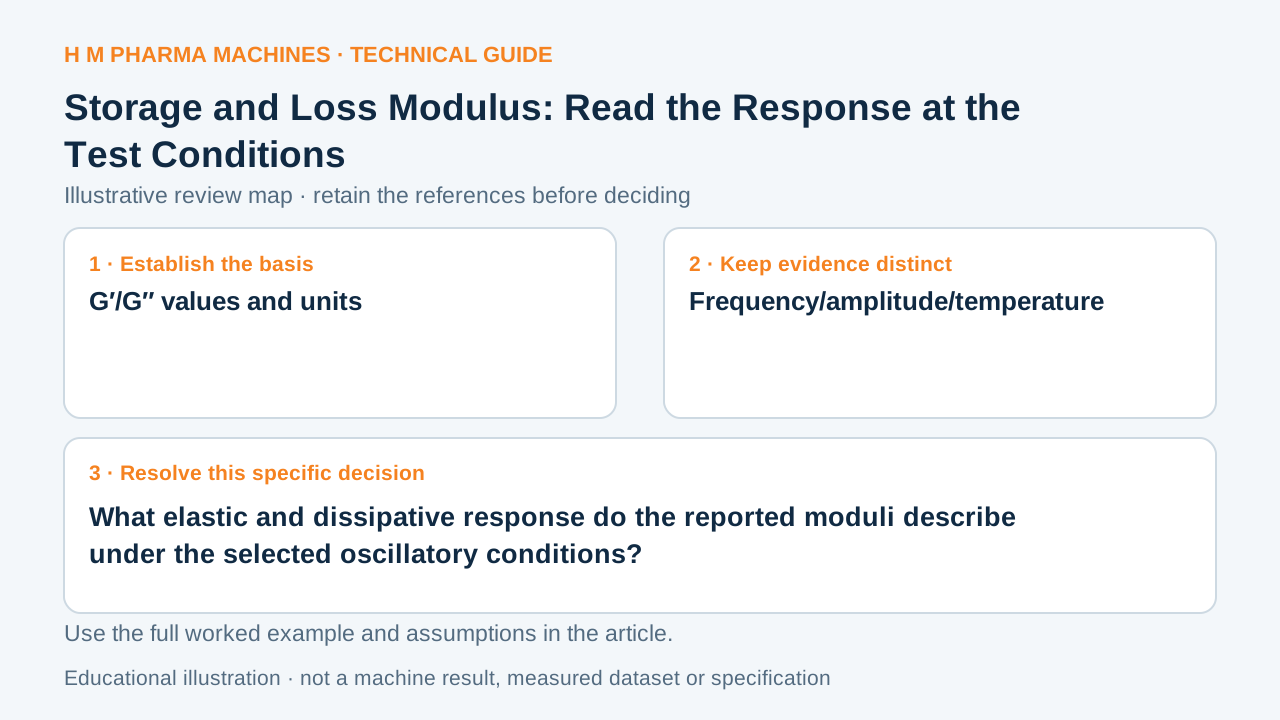
A modulus report describes a different response from a steady-shear viscosity number. Keep its oscillatory conditions in the interpretation.
Identify the Two Responses
Anton Paar explains storage modulus G′ as the stored deformation-energy contribution and loss modulus G″ as the dissipated contribution. These quantities describe viscoelastic response under the applied oscillatory conditions; they are not alternative units for steady-shear viscosity.
Read the frequency, amplitude, temperature and method reference beside the moduli. A statement that G′ exceeds G″ needs its measurement conditions. It should not become a timeless classification covering every rate, temperature and processing stage. Primary rheology reference.
Illustrative Condition-Dependent Result
An invented record gives G′ = 120 Pa and G″ = 80 Pa at one specified frequency and small amplitude. The storage response is larger there. Without another measured condition, the record cannot show whether that ordering persists at a lower frequency or after a processing history.
The figures are hypothetical, not HM gel or ointment data. They supply no dose, pump or mixing limit. A crossover in an actual frequency report would need its own method context rather than being interpreted through this single-point illustration.
Keep the Material Question Specific
Ask the formulation owner whether the intended comparison concerns small-deformation structure, longer-timescale response or another defined material behaviour. That question helps decide which report belongs in the equipment discussion and which additional evidence may be useful.
Complete the worksheet with moduli, conditions and the bounded conclusion. For ointment processing, an oscillatory characterization can help explain a formulation question while remaining separate from representative mixing, transfer and filling results on the proposed machine. HM application context: Ointment Manufacturing Plant.
Storage and Loss Modulus: Read the Response at the Test Conditions — blank interpretation record
This blank worksheet is for your own project. It contains no H M machine trial result.
| Comparison | Evidence/reference | Reviewer |
|---|---|---|
| G′/G″ values and units | To complete | To complete |
| Frequency/amplitude/temperature | To complete | To complete |
| Measurement region and method | To complete | To complete |
| Conclusion supported at those conditions | To complete | To complete |
Customer Questions
Is G′ a viscosity value?
No. It is a modulus describing the storage contribution to oscillatory response.
Does G′ greater than G″ hold at every frequency?
A statement applies to the measured conditions; other conditions need evidence.
Can modulus data prove machine output?
No. Equipment performance requires an application-specific assessment.
Related Equipment References
Review the actual offered equipment and application separately from this educational example.
Primary References
These references support the technical principles discussed in this guide. The worked examples and review questions are educational.
Discuss Your Machine Requirement
Share your product, container, required output and the evidence needed for your technical review.
Request a Technical Review