
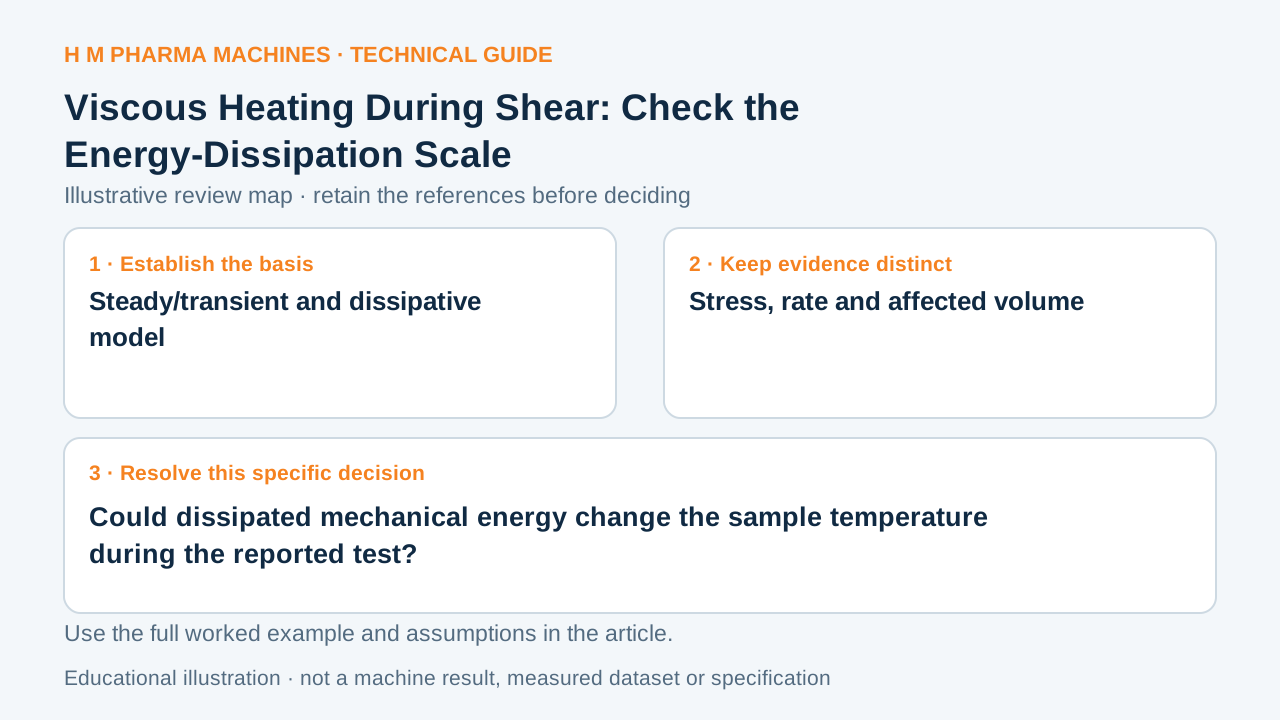
Check whether the mechanical work dissipated during shear could alter the test condition rather than assuming the requested temperature is the actual sample temperature.
Identify the Deformation and Model
TA Instruments notes that work associated with viscous deformation produces heat, which can cause local temperature rise if it is not removed. A thermal balance is separate from a nominal temperature setting. Primary reference: viscous heating.
Review a Hypothetical Comparison
In a hypothetical uniform, steady, purely dissipative simple-shear region, stress 100 Pa and shear rate 10 per second give power density τγ̇ = 1,000 W/m³. If that region occupies 0.001 m³, its dissipative power is 1 W. These invented values do not determine temperature rise without thermal capacity, heat removal and time.
Keep the Evidence with the Decision
Retain the actual stress and rate histories, spatial assumptions and sample-temperature evidence. Compare the energy timescale with the test duration and identify where cooling or conduction occurs. Separate instrument-set temperature from temperature measured at the material location relevant to the interpretation. Ask whether a trend changes when the thermal history is controlled.
In viscoelastic transients, total stress work can include stored energy as well as dissipation; the simple steady example must not be applied blindly to every oscillatory signal. No HM vessel load, temperature excursion or material damage is inferred. The useful decision is whether a thermal-condition check is missing before assigning a changing rheology curve solely to structure or rate dependence.
Could dissipated mechanical energy change the sample temperature during the reported test?
This blank worksheet is for your own project. It contains no H M machine trial result.
| Review field | Reference or result | Responsible person |
|---|---|---|
| Steady/transient and dissipative model | To complete | To complete |
| Stress, rate and affected volume | To complete | To complete |
| Duration, thermal capacity and heat removal | To complete | To complete |
| Actual sample-temperature evidence | To complete | To complete |
Customer Questions
What is the modeled power density?
1,000 W/m³ for the stated dissipative simple shear.
Does 1 W establish a temperature rise?
No. A thermal balance and duration are needed.
Is all transient stress work dissipated heat?
No. Elastic energy storage can contribute.
Primary References
These references support the technical principles discussed in this guide. The worked examples and review questions are educational.
Discuss Your Machine Requirement
Share your product, container, required output and the evidence needed for your technical review.
Request a Technical Review