
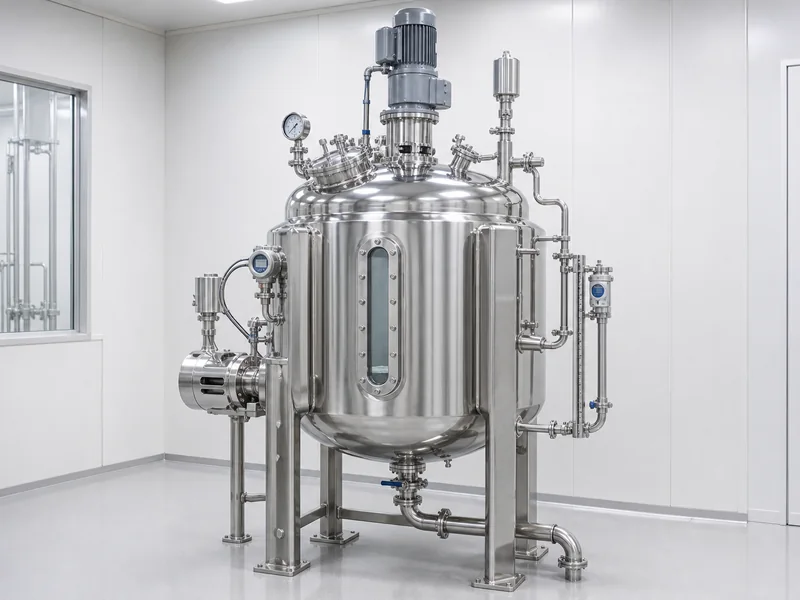
Describe the Result the Batch Must Reach
A vessel demonstration becomes useful when the buyer can explain what the process must achieve. A liquid visibly moving around a tank is not a complete mixing acceptance statement. Identify the intended duty: dissolving, blending, maintaining a suspension or another defined preparation step.
Describe how the buyer will assess the endpoint and which observations the supplier is expected to provide. Keep equipment operation separate from approval of the formulation. H M Pharma Machines publishes manufacturing-vessel and processing-tank arrangements with agitation and thermal functions selected for the specified duty; the ordered configuration must state what is included.
Make the Trial Material and Scale Explicit
Identify the trial material, its condition and why it represents the proposed application. If an alternative material is used, record which aspects it can demonstrate and which remain unresolved. A water trial, for example, may show a mechanical function without establishing performance for a different formulation.
Record the vessel used, fill level and the relationship between the demonstration and the proposed production batch. Do not treat a small demonstration as a guaranteed scale-up result. Ask the supplier to list the design assumptions and the additional evidence needed for the actual duty.
Record Charging and Agitation by Batch Phase
Provide the intended charging sequence and identify how materials enter the vessel. Review whether charging access, connections and operator tasks suit the process. The trial record should explain when each observed stage begins and ends.
Identify the agitation arrangement actually used, including any optional homogenization or other selected function. Record approved operating conditions with the observations rather than relying on a video of rotating equipment. Compare the outcome with the agreed endpoint; this guide does not prescribe speeds, shear settings or a manufacturing recipe.
Define How Thermal Duty Will Be Demonstrated
If heating or cooling is part of the requirement, agree what the trial needs to show. Identify the relevant product condition, measurement locations and the utility supply used for the demonstration. A displayed temperature at one point may not answer every question about the batch.
Record the thermal arrangement and its limits according to the approved test scope. Keep jacket services separate from the product-contact path. Ask which site-supplied conditions the quoted duty depends on, and which observations are still needed after installation. Do not borrow temperature or pressure values from an unrelated process.
Use a Phase-Based Trial Worksheet
A phase record connects the observed result with the conditions that produced it. Add rows for the buyer's actual stages and leave unused optional functions out of the acceptance statement. This blank structure is intended for planning; no performance result is implied.
| Field | Entry needed for the agreed trial |
|---|---|
| Duty and material | Process purpose, sample identity and limitations |
| Trial scale | Vessel identity, fill level and batch reference |
| Charging phase | Sequence, access and supplied arrangement |
| Agitation | Installed mechanism and recorded trial conditions |
| Thermal phase | Utility condition, measurement and observation |
| Endpoint | Agreed method and identified evidence |
| Open items | Unresolved duty, scale-up or site question |
Carry the Batch Review Through Discharge
A preparation stage ends when the product can move to the next operation under the agreed conditions. Include the outlet, transfer arrangement and receiving duty in the review. Identify whether the trial includes transfer or stops at the vessel endpoint.
Record any difference between the demonstrated path and the purchased arrangement. A suitable batch result does not establish that an unspecified pump, hose or storage step will preserve that result. Coordinate the manufacturing vessel, processing tank and downstream equipment as connected scope items.
Close the Trial with Accepted Scope and Open Questions
Keep the agreed protocol, observations, sample identity and deviations with the technical offer. Ask the supplier to state which equipment functions the demonstration supports and which process outcomes require further buyer assessment.
Attach the final drawing and document references to the purchase scope. Optional vacuum, homogenization, temperature or recipe controls should remain explicit inclusions, rather than assumptions arising from a vessel photograph. The result is a more useful decision record than an unqualified statement that the proposed vessel mixes the product.
Buyer Questions
Does visible circulation prove the required batch uniformity?
No. The buyer and supplier must agree the endpoint and an assessment method suited to the process. Visible movement is only one observation.
Can a substitute liquid establish every process result?
No. Record what the substitute can represent and what remains untested for the actual formulation, scale and conditions.
Are all thermal and homogenizing functions standard?
Their inclusion depends on the approved vessel configuration. Identify the ordered functions and trial scope explicitly.
Related Equipment and Guides
Primary References
Review these published machine and support pages alongside the approved configuration, actual samples and project documents.
Discuss Your Machine Requirement
Share the machine duty, actual samples, required result and relevant site information with H M Pharma Machines for a technical review.
Request a Technical Review