
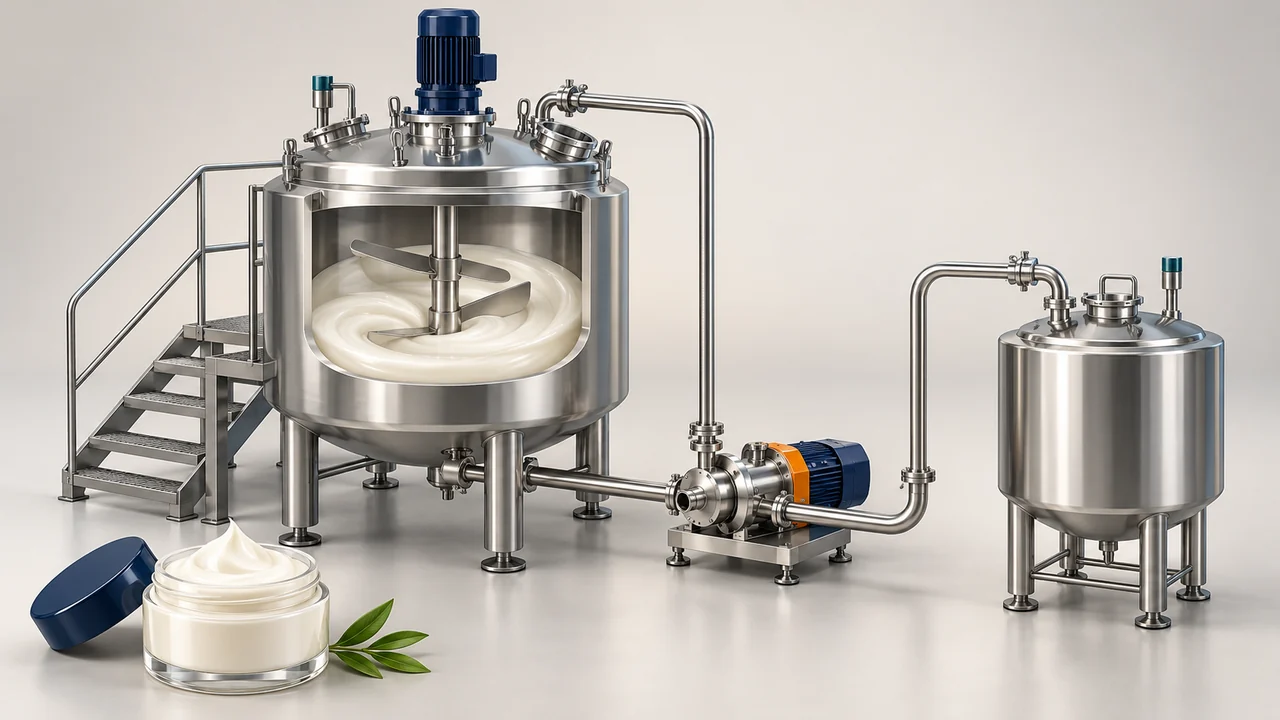
An ointment manufacturing plant should be reviewed as a batch route, not as a photograph of a main vessel. Ingredient preparation, combining the phases, mixing, cooling and transfer all influence what equipment is needed. The most useful enquiry explains how the formulation moves through that route and what observations will show that the required batch endpoint has been reached.
Define each phase, the smallest and largest working batches, the mixing and thermal steps, and the route to holding or filling. Select vessel capacity, agitation, homogenization, transfer and vacuum functions from those duties. Ask to review access and a representative batch sequence; nominal vessel volume alone does not describe the plant's usable process capacity.
Map the batch from preparation to filling
The listed ointment manufacturing plant prepares water and oil or wax phases separately, combines them in the main vessel and finishes the product through mixing and cooling before transfer. The exact vessel arrangement and optional functions are selected from the formula.
Write the proposed sequence with its charging, holding and transfer points. Identify ingredients added late, material that needs separate preparation and any wait before the filling line is ready. This reveals equipment and access requirements that a statement such as cream plant with mixer does not capture.
Size the phases as well as the main vessel
Give gross and working volumes separately, along with the minimum batch that must be processed. The water and oil or wax phases do not necessarily occupy the same share of every formulation. Their preparation vessels therefore need a duty review of their own, including heating, mixing and transfer requirements.
Consider the space needed for additions and the required operating level of the selected mixer. Ask which capacities refer to the vessel shell and which describe the intended batch. Review the smallest routine batch as well as the largest; buying from a nominal main-vessel capacity leaves those distinctions unresolved.
Describe the endpoint instead of asking only for a mixer
Provide the product characteristics and the required finished-batch observations. Anchor or scraper agitation, high-shear homogenization and vacuum are different functions, not interchangeable descriptions of a mixing motor. The product page identifies these as elements selected for the process.
Ask how the proposed agitation works during charging, phase combination and cooling. Identify which observations or tests define the endpoint for the formulation. Vacuum, where selected, should have a stated duty and operating scope. It should not be assumed to make every product uniform or to replace the buyer's formulation-specific quality assessment.
Follow the cooled product through the transfer path
A product that moves easily during preparation may behave differently at the planned transfer condition. Describe temperature and viscosity at discharge, the destination vessel or filler, and the route between them. Discuss the transfer pump, outlet, hoses or piping as part of that duty.
Review retained product, drainage, sampling and access for cleaning. Identify what happens if the filling line stops and a finished batch must wait. A processing tank or holding arrangement can serve a different function from the main manufacturing vessel; the batch route should explain why it is needed.
Review the plant with operators and maintenance access in mind
| Activity | Access to confirm |
|---|---|
| Ingredient charging | Ports, lids and space for the intended additions |
| Product sampling | Specified sampling point and safe access arrangement |
| Batch transfer | Outlet, pump and connection layout |
| Cleaning | Removal, drainage and cleaning-system interfaces |
| Maintenance | Space to service drives, seals and selected instruments |
CIP or SIP should be listed only when included in the supply. Ask which parts remain a manual cleaning task and what installation services the customer must provide.
Request a batch demonstration with a defined scope
When discussing an ointment manufacturing plant with a manufacturer in India, provide the formulation route, batch sizes and transfer requirements together. Ask H M Pharma Machines to identify the proposed preparation vessels, manufacturing vessel, mixing functions and thermal services in the quotation.
Agree which representative process steps the demonstration will cover and what the buyer will measure. Keep mixing, temperature, transfer and cleaning observations distinct. List controls, drawings, manuals, installation and any qualification documents explicitly; a general plant description does not establish that every requested function or service has been included.
Buyer Questions
Is main-vessel volume the same as usable batch capacity?
No. Gross volume, working volume and minimum process batch are different requirements. Review phase volumes, operating levels and mixing duty before selecting the plant capacity.
Does every ointment plant include vacuum and a homogenizer?
No. The listed plant offers process-selected functions. Identify each required mixing, vacuum and transfer function in the technical and commercial scope.
Why include the filling destination in a mixing-plant enquiry?
It determines transfer conditions, connections and holding needs. The finished product must reach the next process in a suitable condition, including when downstream production pauses.
Related Machine Guides
Product References and Further Details
These primary pages describe the published machine arrangements discussed in this guide. Use the actual product and component requirements when reviewing a configuration.
Discuss Your Machine Requirement
Share your product, container or closure samples, required output, process conditions and line layout with H M Pharma Machines for a technical review.
Request a Technical Review