
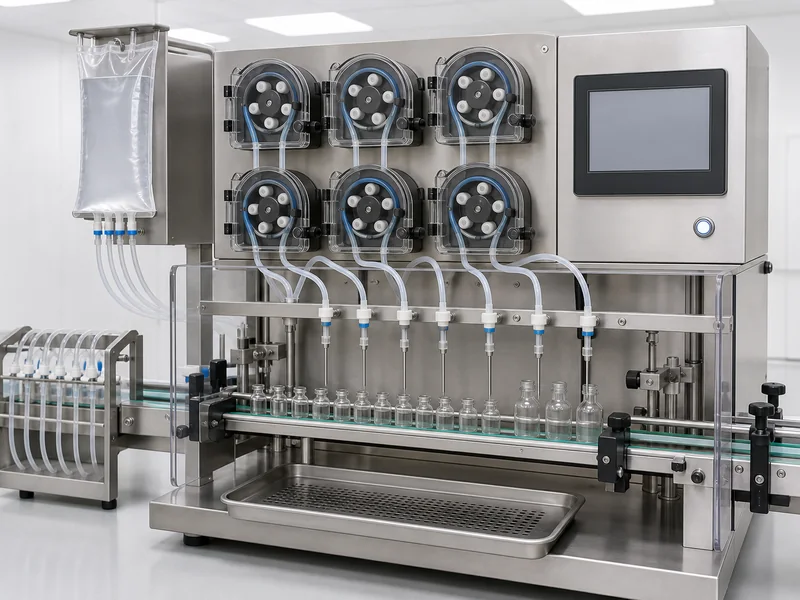
Specify the complete tubing set as an ordered item
For a peristaltic filler, tubing selection and replacement should be part of the purchase discussion. A phrase such as 'spare tube included' does not identify the full assembly or tell the buyer which replacement to order later. Ask for the tubing specification, supplier reference and the fittings that belong to the approved set.
The peristaltic filling machine moves liquid through tubing acted on by the pump mechanism. Review the complete path to the nozzle, rather than treating the tube within the pump head as the only contact item. Connectors, supply lines and nozzles also belong in the application review.
Review formulation and cleaning exposure together
Give the supplier the actual formulation information needed for a compatibility review, together with the intended temperature, contact conditions and cleaning approach. Where commercial confidentiality applies, agree a suitable way to exchange that information. A tube selected for one liquid should not automatically become the approved tube for every product in the range.
Clarify whether the supplied path is intended to be cleaned and reused or replaced after a defined task. Keep the cleaning or disposal instructions with the ordered assembly. This decision must be based on the approved materials and the buyer's process assessment; the name 'peristaltic' alone does not establish sterility, single-use suitability or a validated cleaning outcome.
Record routing, fittings and installation references
Request an approved routing or assembly reference that identifies the tube section used by the pump, the connection arrangement and the nozzle interface. Review how the replacement is identified and how an operator confirms that the correct assembly has been fitted. Follow the machine instructions for loading and securing the tube.
Keep that reference separate from informal photographs of a demonstration. A photo may help identify an assembly, but it should not replace the supplier's instructions or establish an alternative routing. Ask which checks belong to an operator and which require trained service personnel. Changing the tube set should not introduce an undocumented combination of components.
Agree replacement triggers without inventing a universal life
There is no useful universal replacement interval that can be selected from a generic article. Ask the supplier to describe the inspection and replacement approach for the specified tube, product and operating duty. Record the relevant usage information and the conditions that require removal from service.
The handover should identify what to do when wear, damage or a change in the filling result is observed, without encouraging continued use of a questionable assembly. Keep a traceable stock of approved replacements and instructions for storage and handling. Agree replenishment responsibilities and ordering references; do not assume a promised availability or lead time that is absent from the commercial offer.
Recheck the dose after replacement
Include a tube-replacement exercise in the agreed machine trial or training scope. Use the documented procedure, then verify the dose using the agreed independent method before releasing production. Keep the tube identity, relevant settings and first-off observations together. Do not assume that refitting a nominally similar tube preserves every filling result.
The following uncompleted worksheet supports that discussion. It contains no measured result or claimed service life.
| Record field | Information to complete |
|---|---|
| Tube material, bore and part reference | Supplier to confirm |
| Formulation and cleaning review | Buyer and supplier to record |
| Approved routing and fitting reference | Supplier to confirm |
| Inspection and replacement trigger | Supplier instructions to identify |
| Replacement assembly identity | To be recorded |
| Dose verification after replacement | To be measured during the agreed check |
Receive useful replacement information with the machine
Before closing the order, confirm the supplied spare quantities, identification, assembly instructions and training scope. Keep these records with the delivered machine revision. If an alternative tube is proposed later, request a fresh application review rather than accepting it solely because it fits the pump head.
The dosing-method comparison explains where peristaltic filling fits among other options. This worksheet addresses the tubing lifecycle after that choice. Share your liquid, dose, cleaning approach and replacement requirements for an application-specific machine and consumables discussion.
Buyer Questions
Can any tube with the same internal diameter be substituted?
Do not assume interchangeability. Material, dimensions, construction, routing and product exposure need review against the approved pump and process.
Does a disposable tube remove every cleaning responsibility?
No. Define which components are replaced and which remain in the product path. The complete assembly and handling procedure still require review.
Should the filling result be checked after changing the tube?
Agree a first-off dose verification and any required recalibration in the machine instructions and trial scope. Record the new assembly and the observed result.
Related Equipment and Guides
Primary References
Review these published machine and support pages alongside the approved configuration, actual samples and project documents.
Discuss Your Machine Requirement
Share the machine duty, actual samples, required result and relevant site information with H M Pharma Machines for a technical review.
Request a Technical Review