
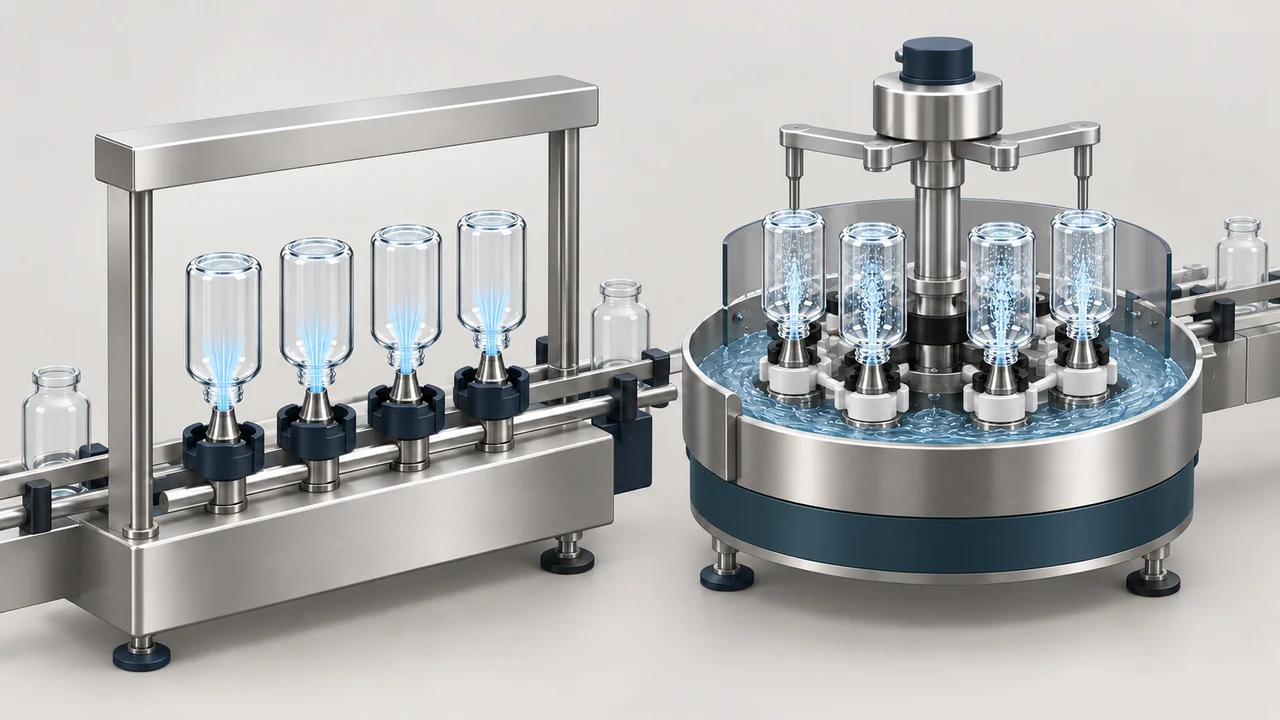
Air jet cleaning and semi-automatic rotary washing solve different container-cleaning tasks. Comparing them only by automation level can hide the more important question: what must be removed, and what condition should the bottle have before filling? This guide separates the published dry air-and-extraction process from operator-assisted wet rotary washing, then shows how to prepare a useful application review with H M Pharma Machines.
Describe the actual contamination and required bottle condition first. Air jet cleaning uses filtered compressed air and vacuum extraction without wash water. Semi-automatic rotary washing uses selected rinse, air and drain positions with manual loading and unloading. Trial the intended cleaning task, not just bottle movement.
Define what is present inside the incoming bottle
Describe the container supply route, packaging and incoming condition. Are you reviewing loose dry particles, visible residue or another defined concern? Supply representative bottles and explain how the condition will be assessed. Do not assume a dry air jet will remove an adherent film, or that a rinse sequence is suitable for every contamination.
State the required bottle condition before filling, including whether retained rinse liquid is acceptable. Define the acceptance method with the process owner. A bottle that looks clean in a demonstration is not automatically evidence of the required cleaning result.
Compare the actual cleaning processes
| Review point | Air jet cleaning | Semi-automatic rotary washing |
|---|---|---|
| Cleaning action | Air loosens loose particles; vacuum carries debris away | Selected rinse and air services act at rotary positions |
| Water use in the cycle | No wash water | Depends on the selected wet-wash sequence |
| Container handling | Automatic feed, inversion and upright release | Operator loads and unloads format-matched holders |
| Next operation | Conveyor transfer toward filling | Defined handling after manual removal |
The machines therefore need different process and layout discussions. Automation level is relevant to workflow, but it does not make one cleaning action an equivalent substitute for the other.
Review air delivery and debris removal together
The published air jet bottle cleaning machine turns bottles mouth-down and aligns the neck with the air-jet and extraction position. Filtered compressed air dislodges loose particles, while vacuum extraction removes released debris. Review both functions: blowing inside a bottle is not the same as establishing where the removed material goes.
Specify the available compressed-air service and discuss the required quality, pressure, flow and extraction arrangement for the application. Check access to the collection and filter components included in the design. Monitoring and alarm behavior should match the selected controls and the way the line responds to unavailable services.
Plan the operator’s wet-wash workflow
The semi-automatic rotary washing machine uses operator-assisted loading into bottle holders. The carrier advances through selected rinse, air-blow and drain positions, then returns bottles for manual unloading. Review holder fit and loading orientation using the actual containers, including the task of moving washed bottles to the next operation.
Map incoming bottles, washed bottles and rejected or interrupted-cycle bottles in the work area. Define how the operator distinguishes them and how draining is handled. The published platform excludes oval formats; manual loading does not make an otherwise unsuitable holder compatible with every bottle shape.
Include utilities and the post-cleaning transition
For dry cleaning, review air and extraction services with the planned filling-line interface. For wet rotary washing, identify rinse supply, any selected recirculation arrangement, drainage and compressed air. The final process choice should account for the required bottle condition and the site’s ability to provide and maintain those services.
A final air application or drain period is not an unconditional dryness guarantee. Decide how bottles will be held, inspected or transferred before filling. Neither method establishes sterility merely by being called a cleaning machine; any separate process objective needs its own specification and evidence.
Request a task-based trial instead of a generic demonstration
Agree the incoming bottle condition, samples, settings and assessment method before comparing results. Keep container-handling observations distinct from cleaning observations. A dry-particle trial cannot stand in for a wet-residue task, and running empty clean bottles demonstrates transport rather than removal of the stated contamination.
- Record container references and the condition of the incoming samples.
- Record air, extraction or rinse conditions used during the observation.
- Check the defined bottle condition at the actual handover to the next operation.
Use the outcome to discuss configuration and workflow. Do not convert a single demonstration into an unsupported removal percentage or a claim that the machine treats every contaminant.
Buyer Questions
Does the air jet cleaning cycle use wash water?
No. The published machine uses filtered compressed air and vacuum extraction for loose dry particles. Its application review should address the actual debris and the required condition before filling.
Is semi-automatic rotary washing fully operator-driven?
The operator loads and unloads bottles, while the rotary carrier advances them through the selected washing positions. Review both the machine cycle and the manual handling around it.
Can the two methods be compared using the same test bottles?
Use representative bottles for the actual task, but define the incoming condition and assessment method. Do not treat different contamination or different acceptance conditions as an equivalent comparison.
Related Machine Guides
Product References and Further Details
These primary pages describe the published machine arrangements discussed in this guide. Use the actual product and component requirements when reviewing a configuration.
Discuss Your Machine Requirement
Share your product, container or closure samples, required output, process conditions and line layout with H M Pharma Machines for a technical review.
Request a Technical Review