
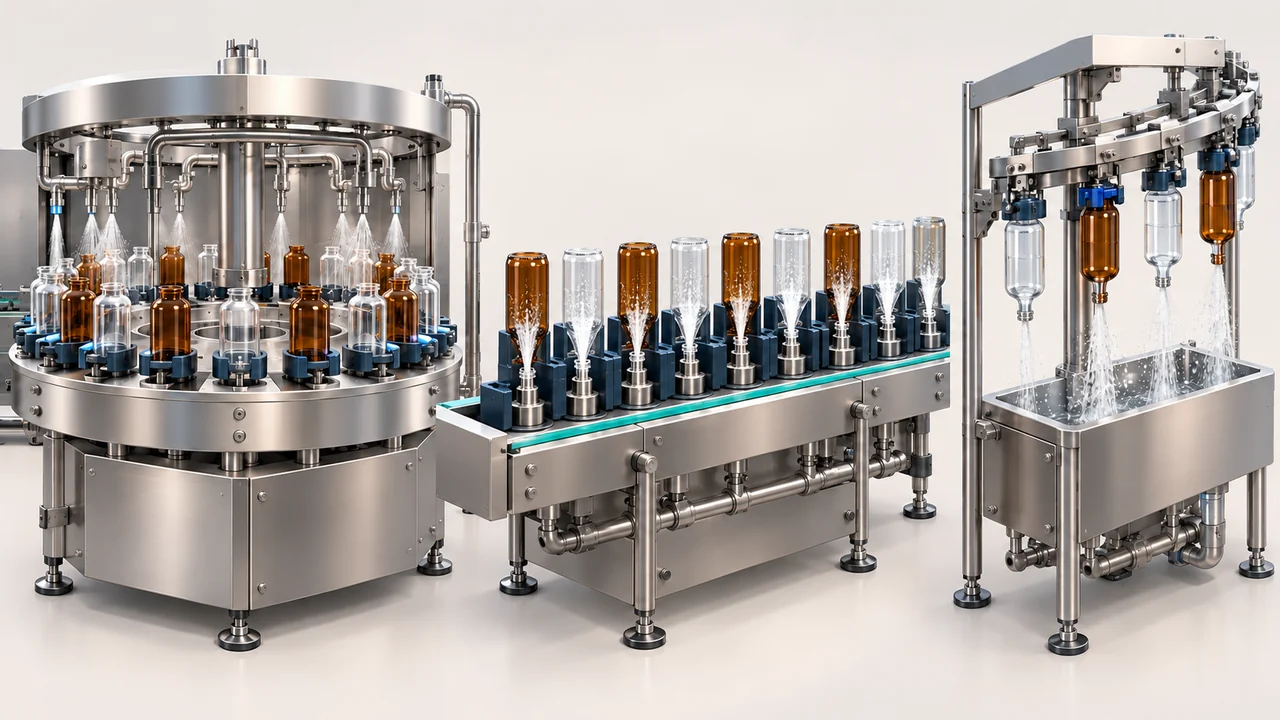
Bottle washer selection starts with how the container reaches, stays in and leaves the washing mechanism. Glass, PET, HDPE and PP are useful material descriptions, but they do not establish that a bottle shape suits a particular transfer system. This guide compares the published H M Pharma Machines handling arrangements and explains the format information needed to review infeed, container support and downstream transfer.
Compare the actual bottle geometry with the selected gripper, pocket or inversion arrangement. Review how support changes during entry, mouth-down washing and upright discharge. Confirm exclusions and format parts before treating a material or capacity range as proof of suitability.
Begin with a container drawing and physical samples
Provide the bottle body, base, neck finish and overall height, together with representative empty samples. Identify the material, supplier and drawing revision. Include all intended formats, not only the largest bottle, because a shorter or lighter container can present a different guide and transfer problem.
Explain any handle, shoulder, taper or other feature that affects support. Do not rely on a front-view photograph to establish fit. The engineering discussion should identify which surfaces will be guided or gripped and whether those surfaces remain suitable when the bottle is inverted.
Compare the handling paths without assuming equivalent fit
| Published platform | Handling arrangement | Format review focus |
|---|---|---|
| Rotary gripper bottle washer | Rotary gripping through the wash cycle | Gripping surfaces, entry and release |
| Linear tunnel bottle washer | Wire-woven infeed, cam loading and HDPE pockets | Pocket fit, loading and unloading alignment |
| Automatic inverting bottle washer | Conveyor feed, gripping, inversion and upright release | Inversion clearance and return transfer |
These paths describe how bottles are handled, not a universal ranking of wash quality. Compare the selected configuration with the intended container and process. The published rotary gripper, linear tunnel and automatic inverting bottle platforms all exclude oval formats; any oval-bottle requirement needs separate engineering review with actual samples.
Observe support changes at the infeed
Follow a bottle from the upstream conveyor into the washing mechanism. Identify where spacing is established, where a pocket or gripper takes control and when the previous guide releases it. Look for leaning, rubbing, missed pickup or unstable transfer rather than watching only the middle of the wash cycle.
For the linear platform, distinguish the wire-woven infeed belt from the HDPE pockets that carry bottles through washing. Discuss guide settings and loading parts together. For a gripping or inversion arrangement, confirm that the actual bottle can be held through the required motion without relying on a different sample shape.
Keep bottle support compatible with the wash path
A container can transfer smoothly yet be poorly aligned with an internal nozzle. Review mouth position, nozzle clearance, external access where specified and the route for draining rinse liquid. Ask how a format adjustment affects each of these, particularly when bottle height or neck geometry changes.
Do not copy the vial wash sequence into a bottle washer specification. The published rotary bottle reference uses air, RO or filtered water, PW and air stages; the linear bottle reference uses its own air, RC-water and fresh-PW sequence. The automatic inverting machine applies the selected rinse and air arrangement. Define the bottle cleaning task before selecting those services.
Review discharge against the filling-machine entry
Confirm the container returns upright and remains stable when support passes to the outfeed conveyor. The automatic inverting platform explicitly re-inverts bottles before discharge; other selected handling arrangements also need a defined receiving interface. Review transfer height, direction, guides and space for the next operation.
Ask what happens when the filling machine stops. Excess accumulation or an abrupt restart can expose transfer problems that a short demonstration misses. Agree the connected-machine signals where included and observe interrupted flow with the actual empty bottle, whose handling behavior may differ from a filled pack.
Make each format review repeatable
Use a separate setup record for each bottle drawing. Name the guides, grippers or pockets used, adjustment points, selected wash services and downstream transfer arrangement. Review any damaged, tipped or incorrectly discharged bottles by location and operating condition rather than reporting only an overall trial result.
- Observe startup, steady feeding, a planned stop and restart.
- Record which format parts change and which settings are adjusted.
- Keep handling observations separate from the defined cleaning acceptance checks.
Send this format list with the quotation request. It helps the supplier explain suitability and scope while giving the buyer a clear basis for reviewing the proposed machine, rather than assuming that a headline container range covers every pack design.
Buyer Questions
Does a listed bottle material guarantee shape compatibility?
No. Material and nominal volume do not define the handling geometry. The actual body, base, neck and height must suit the selected guides, grippers or pockets.
Are oval bottles included in every bottle washer range?
No. The published rotary gripper, linear tunnel and automatic inverting bottle platforms all exclude oval formats. Review any oval-bottle requirement separately with actual samples rather than assuming standard suitability.
Should washer outfeed be reviewed with the filling machine?
Yes. Compare height, direction, guides, accumulation and stop or restart behavior. A stable wash cycle alone does not demonstrate a reliable transfer into the next machine.
Related Machine Guides
Product References and Further Details
These primary pages describe the published machine arrangements discussed in this guide. Use the actual product and component requirements when reviewing a configuration.
Discuss Your Machine Requirement
Share your product, container or closure samples, required output, process conditions and line layout with H M Pharma Machines for a technical review.
Request a Technical Review