
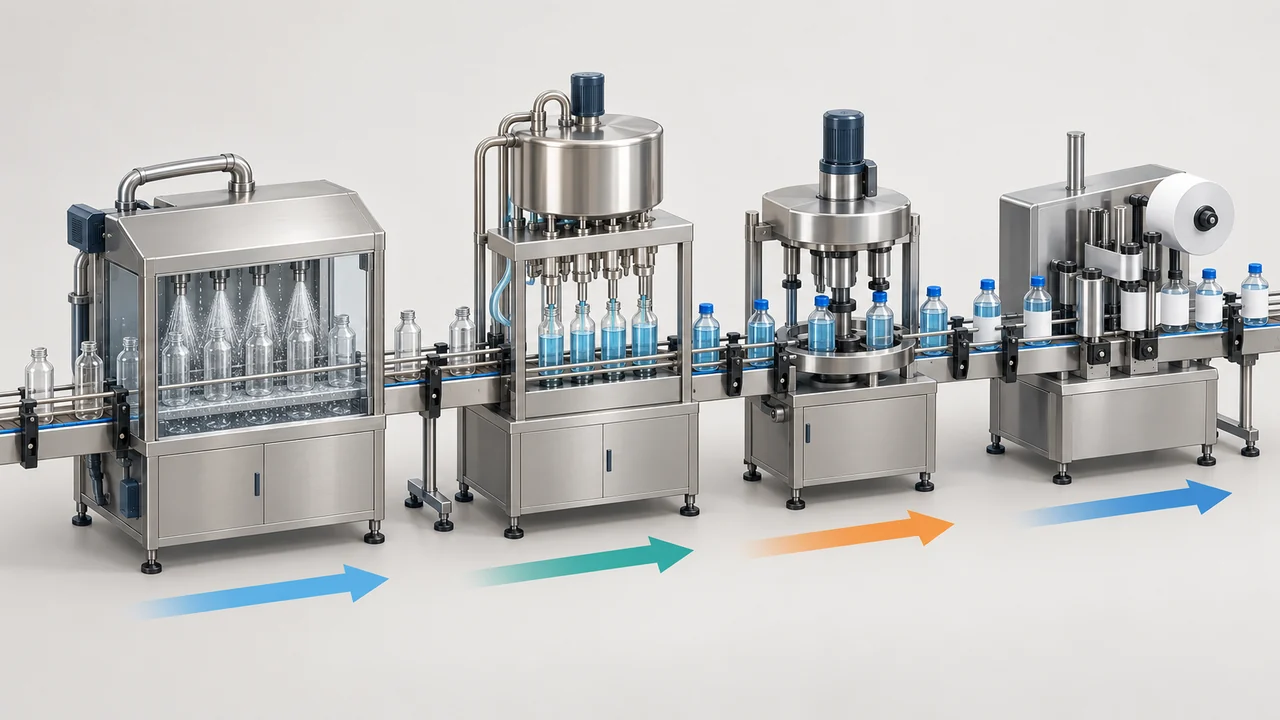
Selecting each machine from its headline output does not establish the output of the connected line. A washer, filler, capper or labeler can wait for incoming containers, pause behind accumulated packs or produce rejects that reduce useful delivery. This guide focuses on measuring those losses and locating the constraint. It complements equipment selection by turning a proposed bottle line into a format-specific output test.
Compare sustainable rates on the same production format, then measure acceptable finished packs over a defined elapsed period. Record starvation, blockage, faults, setup and rejects separately. Under steady running, the slowest sustainable stage constrains the line; short buffers can absorb interruptions but cannot remove a persistent capacity mismatch.
Define the Output You Actually Need
Specify the finished-pack condition at the measuring point: washed, filled, closed and labeled as applicable, with the required checks completed. Use consistent units across stages and identify the particular bottle, product, closure and label. A bottle count before capping is not automatically the count of acceptable finished packs.
Separate instantaneous running rate from output over the agreed production period. A practical elapsed-period measure is acceptable finished packs divided by elapsed time. State whether that period includes startup, planned replenishment or changeover so that competing results are comparable.
Record Sustainable Rates on the Same Format
Published references may use different samples and conditions. Compare bottle washing machines, filling machines and labeling machines only after their suitability for the required format is established. Include the selected multi head screw capping machine's bottle and closure combination rather than assuming head count alone determines the rate.
| Stage | Conditions to record |
|---|---|
| Washer | Container handling, wash sequence and transfer |
| Filler | Product, dose, fill result and refill conditions |
| Capper | Cap supply, engagement and closure acceptance |
| Labeler | Label roll, container presentation and application result |
| Packing | Workstation demand and finished-pack discharge |
Distinguish Starvation from Blockage
A starved machine lacks ready incoming containers or required materials. A blocked machine cannot discharge because the next stage or buffer is full. A faulted or stopped machine has its own interruption. Recording only a total downtime figure hides these different causes.
Observe several stations at the same time where possible. If the filler waits while the capper has no room to discharge, investigate downstream flow before concluding the filler is slow. Keep the stop cause, start time and recovery action so repeated interruptions can be traced to an interface or supply condition.
Include Material Supply and Routine Replenishment
Check how containers, product, closures and labels are supplied during the run. Record waiting for cap replenishment, roll replacement, product receiving or removal of completed packs. A short demonstration with every material prepared can conceal these operating demands.
Review the packing conveyor and manual workstations as part of the line. If finished packs cannot be removed or inspected at the incoming rate, upstream accumulation will eventually stop production. Define the staffing and material-handling conditions used in the trial instead of attributing every interruption to machine capacity.
Use Buffers to Manage Interruptions
Record the usable accumulation before and after the suspected constraint. A buffer can bridge a short pause when containers remain stable and controlled, but a continuously slower downstream machine will still fill it. Increasing conveyor length is therefore not always a capacity solution.
Test coordinated responses to full and empty conditions. Identify which upstream machine stops first and how the line restarts without a surge of containers. Confirm sensors and inter-machine signals in the supply scope; adjacent conveyors do not by themselves establish an integrated stop sequence.
Run a Test That Produces an Actionable Record
Agree the production format, observation period, quality checks, replenishment method and staffing. Count acceptable output and rejects at the defined end point while recording machine states. Include ordinary stops and recovery rather than excluding every interruption from the result.
- Compare stage rates and the finished-pack count.
- Locate repeated starvation or blockage.
- Record setup and replenishment losses separately.
- Identify whether the remedy is capacity, handling, supply or control.
- Repeat the relevant observation after a change.
This approach supports a specific improvement instead of replacing equipment solely because its headline rate is the lowest.
Buyer Questions
Will machines with the same published rate form a balanced line?
Not necessarily. Their references may use different formats and conditions. Compare sustainable operation and accepted output on the same pack, including transfers and routine interruptions.
Can a longer conveyor solve a bottleneck?
It may absorb a limited pause, but it cannot indefinitely balance a stage that consistently runs slower than incoming production. Determine whether the problem is interruption or sustained capacity.
Which count should be used for line acceptance?
Define the agreed measuring point and count acceptable packs meeting the required finished condition. Report rejects and the observation period separately.
Related Machine Guides
Product References and Further Details
These primary pages describe the published machine arrangements discussed in this guide. Use the actual product and component requirements when reviewing a configuration.
Discuss Your Machine Requirement
Share your product, container or closure samples, required output, process conditions and line layout with H M Pharma Machines for a technical review.
Request a Technical Review