
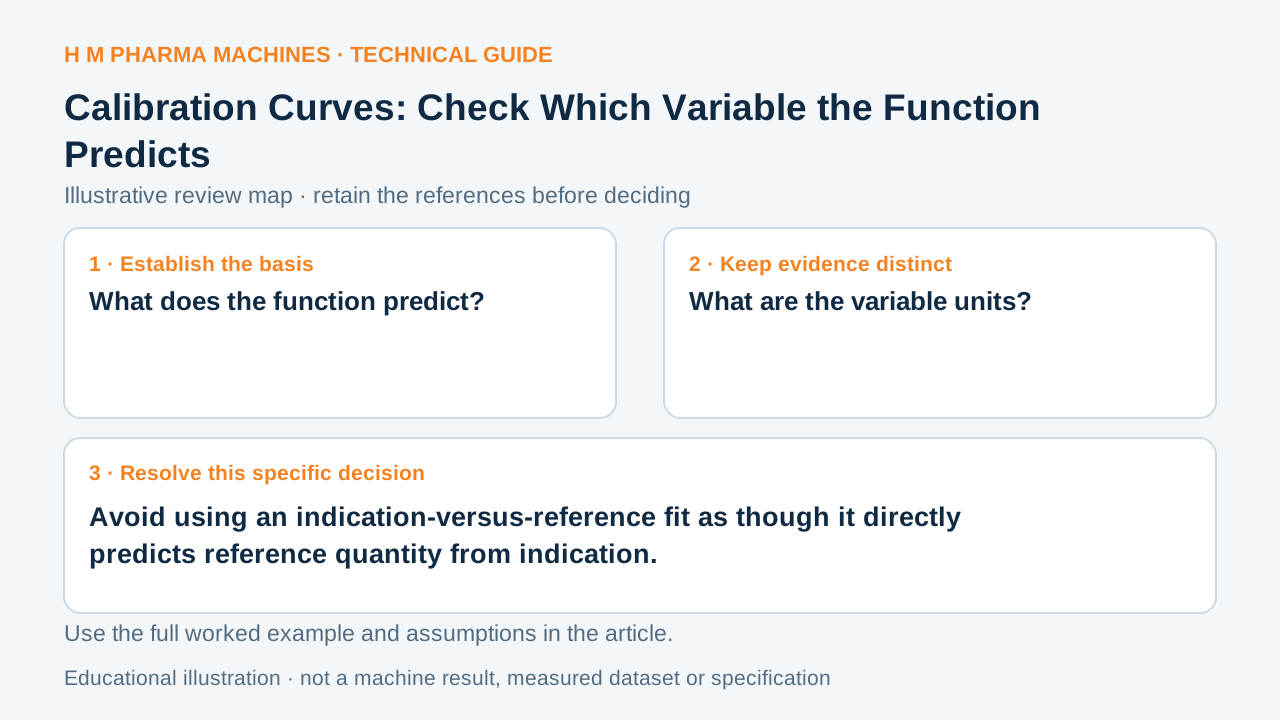
A calibration equation has a direction. Label the input and output before implementing it in a spreadsheet.
Read the variable definitions
A calibration curve expresses a relationship between indication and corresponding measured quantity value. Software needs the form appropriate to the desired conversion. Coefficients copied without knowing which variable is on each side can produce a dimensionally plausible but incorrect transformation.
An invented linear conversion
Suppose a hypothetical forward relationship is indication I=2+4Q. To infer Q from I, the algebraic inverse is Q=(I−2)/4. At I=42, this returns Q=10. Applying 2+4I would return 170 and use the wrong direction.
A real inverse-calibration evaluation can require attention to the fitted model and uncertainty; algebraic inversion does not by itself settle those statistical questions. The example is a simple equation check, not a supplier calibration algorithm.
Test the implemented transformation
Retain units, variable names, coefficient version and valid interval. Check known points from the applicable relationship before use. Ask the calibration owner about interpolation, extrapolation and uncertainty in the inferred quantity. Keep original indications alongside converted values.
Primary references: JCGM international vocabulary, NIST measurement handbook.
Measurement review worksheet
This blank worksheet is for your own project. It contains no H M machine trial result.
| Question | Evidence to retain |
|---|---|
| What does the function predict? | Indication or quantity |
| What are the variable units? | Definitions on both sides |
| Do known points reproduce correctly? | Independent equation check |
Customer Questions
Can variable names be omitted when copying coefficients?
No. Direction and units are essential.
Does algebraic inversion establish the full uncertainty?
No. The applicable calibration evaluation still matters.
Should original indications be retained?
Yes. They allow the transformation to be reviewed.
Primary References
These references support the technical principles discussed in this guide. The worked examples and review questions are educational.
Discuss Your Machine Requirement
Share your product, container, required output and the evidence needed for your technical review.
Request a Technical Review