
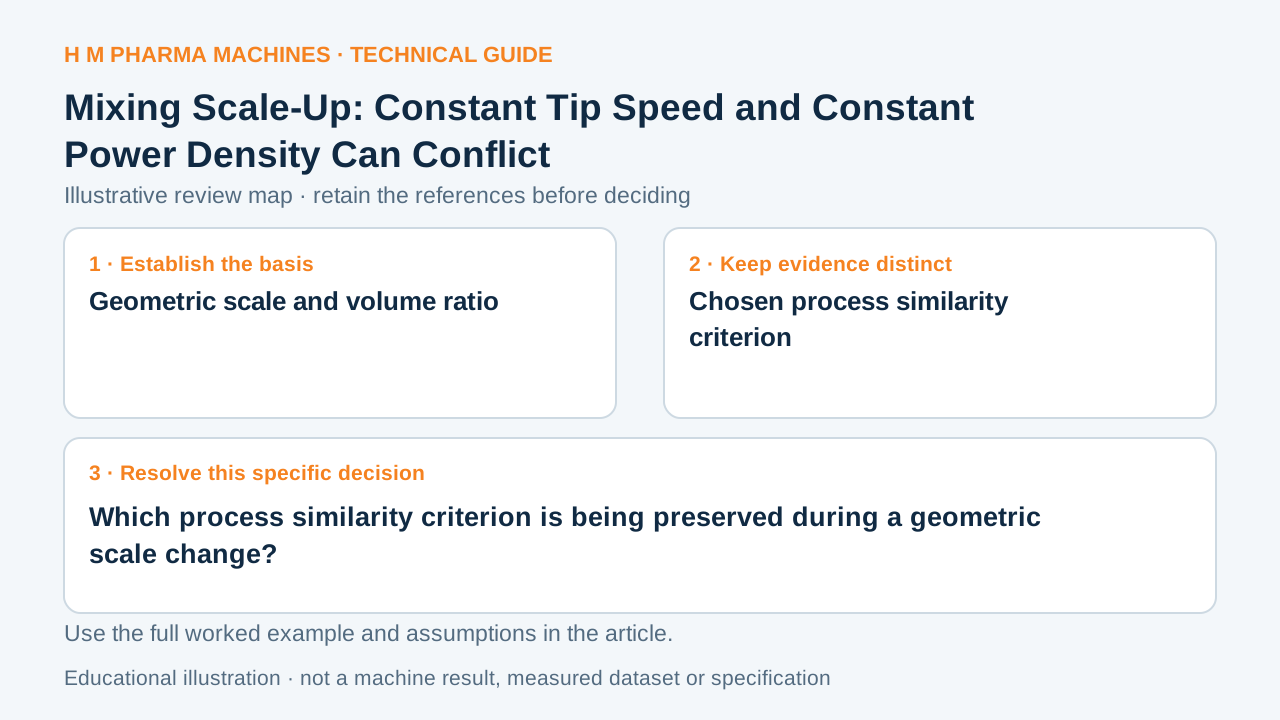
Geometric scale-up can preserve one mixing criterion while changing another. State which similarity condition is being chosen.
Define the Process Model
Under geometric similarity, V scales with D³. With fixed coefficients in ProQuip’s power relation, P/V scales with N³D². Ross’s scale-up discussion also distinguishes geometry, tip speed and power per volume. Preserving tip speed, ND, therefore need not preserve power density.
Compare a Hypothetical Case
Consider an invented scale change doubling every relevant length. Volume increases eightfold. Holding tip speed constant halves N, so modeled power increases fourfold and P/V halves. Holding P/V constant instead gives N₂/N₁ = 2⁻²⁄³ ≈ 0.630; tip speed then rises by a factor of about 1.260. The two conditions cannot both stay unchanged in this simple model.
Complete the Engineering Review
Name the process outcome that motivates the chosen invariant, then show the predicted changes in the other quantities. Reassess rheology, geometry and transfer conditions at the new scale rather than applying the arithmetic as a guaranteed product result. Keep testing evidence tied to the actual outcome, not solely to the fact that one ratio matches.
For an ointment-manufacturing enquiry, ask the selected supplier to justify its scale-up basis. This guide does not adopt Ross trial-size guidance or claim a particular HM scale path. It makes conflicting similarity choices visible for review.
Which process similarity criterion is being preserved during a geometric scale change?
This blank worksheet is for your own project. It contains no H M machine trial result.
| Review field | Reference or result | Responsible person |
|---|---|---|
| Geometric scale and volume ratio | To complete | To complete |
| Chosen process similarity criterion | To complete | To complete |
| Predicted changes in other quantities | To complete | To complete |
| Actual outcome and scale-up evidence | To complete | To complete |
Customer Questions
Can tip speed and P/V both remain fixed here?
The stated simple scaling model gives different required speeds.
Does constant P/V prove equivalent product?
The actual process still requires verification.
Can a non-Newtonian case reuse every coefficient?
Its rheological and regime basis must be justified.
Related Equipment References
Review the actual offered equipment and application separately from this educational example.
Primary References
These references support the technical principles discussed in this guide. The worked examples and review questions are educational.
Discuss Your Machine Requirement
Share your product, container, required output and the evidence needed for your technical review.
Request a Technical Review