
In This Guide
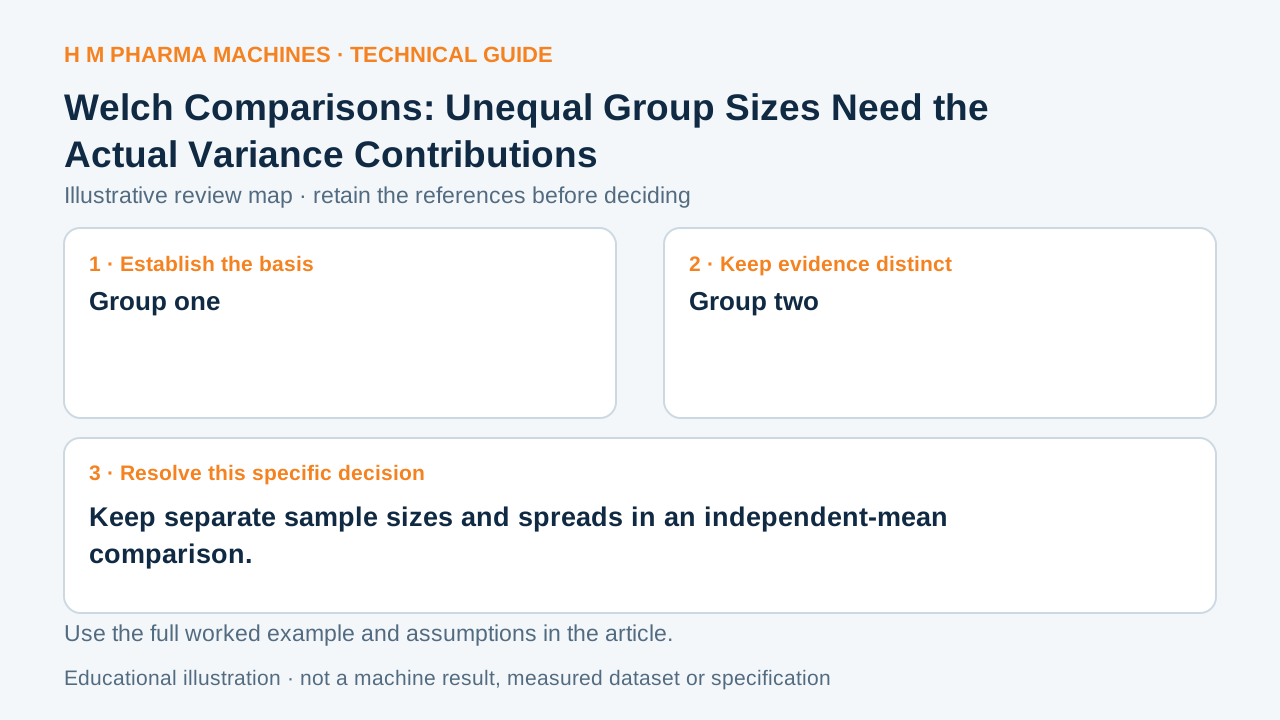
An independent-mean comparison with unequal spreads keeps each group variance contribution separate. One shared spread number can hide the intended method.
The statistical question
A Welch-style independent two-sample comparison uses each group sample variance divided by its own sample size in the standard error of the mean difference. Its effective degrees of freedom reflect those contributions and their estimation. The method differs from a pooled common-variance calculation. Group independence, the observation unit and the declared comparison remain essential to interpretation.
An illustrative review example
For invented groups with standard deviations 2 and 4 units and sample sizes 20 and 40, the variance contributions are 4/20=0.2 and 16/40=0.4 squared units. The difference standard error is the square root of 0.6, about 0.775 units. Averaging the two standard deviations and using a single group size would not reproduce that calculation. This example gives no mean difference, significance result or accepted process claim.
Prepare the evidence for discussion
Keep both group counts, means, spreads and collection designs in the review record. State the numerator direction and whether a difference, improvement or predeclared threshold is being assessed. Ask the analyst to supply the effective degrees of freedom and method version instead of assuming total count minus two. If the data are matched item pairs or repeated readings, resolve that structure before choosing an independent-sample analysis.
Keep both variance contributions visible
This blank worksheet is for your own project. It contains no H M machine trial result.
| Question to resolve | Evidence to retain |
|---|---|
| Group one | Mean, spread and count |
| Group two | Mean, spread and count |
| Difference uncertainty | Separate variance contributions |
| Method scope | Independence and degrees of freedom |
Customer Questions
Does Welch require one pooled sample variance?
Its standard-error calculation retains separate group variance-per-sample-size contributions.
Are total-count-minus-two degrees of freedom automatic?
The Welch-Satterthwaite calculation reflects the separate variance contributions and group sizes.
Can paired observations be treated as independent without review?
No. The physical sampling and pairing structure must determine the appropriate analysis.
Primary References
These references support the technical principles discussed in this guide. The worked examples and review questions are educational.
Discuss Your Machine Requirement
Share your product, container, required output and the evidence needed for your technical review.
Request a Technical Review