
In This Guide
- Why Precision Matters in Machine Change Parts
- 1. Star Wheels
- 2. Feed Worms
- 3. Gripper Sets
- 4. Filling Needles and Nozzles
- 5. Other Common Change Parts
- Material Selection for Change Parts
- Can Change Parts Be Made for Other Manufacturers’ Machines?
- Prepare the ordering and interface record
- Separate worn-sample measurements from the intended design
- Keep a register for the complete format set
- Separate receipt, fitting, format trial and release
- When Should Change Parts Be Replaced?
- Care and Maintenance Tips
- Frequently Asked Questions
- Related practical guides
- Scope and source notes
- Request a change-parts feasibility review
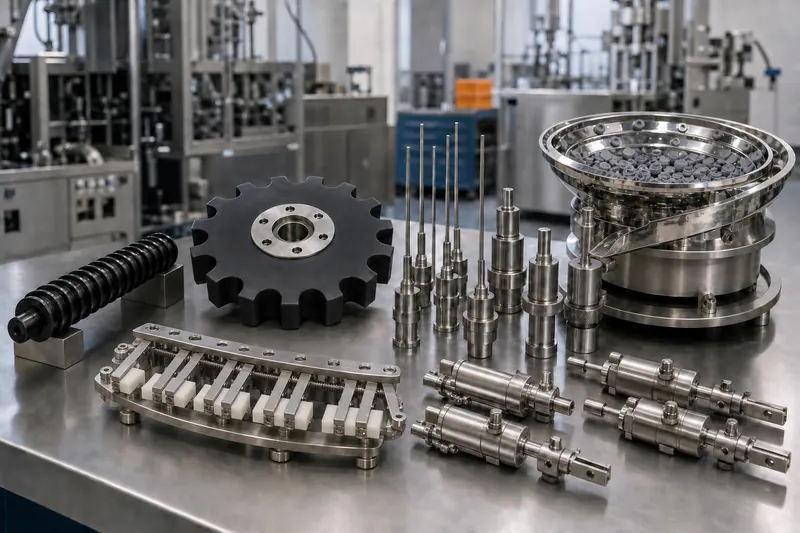
One pharmaceutical packaging machine may need to handle several bottle diameters, vial sizes, ampoule capacities or closure formats. The main machine remains the same, but the parts that directly control each container must match its geometry. These interchangeable components are commonly called change parts, format parts or size parts.
H M Pharma Machines supplies new machinery and can also develop selected pharmaceutical machine change parts for existing equipment, including machines from other manufacturers, after checking samples, dimensions and technical feasibility.
Why Precision Matters in Machine Change Parts
Change parts work in a synchronized path. The feed worm separates incoming containers, the star wheel receives them at the correct pitch, guides control their path, and downstream components position them for washing, filling, capping or labeling. A dimensional error in any one part can disturb the complete transfer sequence.
Correctly engineered parts should provide:
- Smooth container entry and exit without sudden impact.
- Accurate pitch matching between the conveyor, feed worm and star wheel.
- Stable handling without excessive pressure on glass or plastic containers.
- Repeatable positioning below filling needles, capping heads or inspection stations.
- Practical changeover and clear identification for each container size.
Star Wheels
Index and transfer containers between synchronized machine stations.
Feed Worms
Separate randomly spaced containers and establish the required pitch.
Gripper Sets
Hold ampoules, vials or bottles securely during controlled transfer or inversion.
Needles & Nozzles
Deliver liquid or cleaning media accurately for the intended process.
1. Star Wheels
A star wheel is a rotating indexing component with pockets shaped for a specific container diameter or profile. It receives bottles, vials or ampoules at a controlled pitch and transfers them to the next operation. Star wheels are used in washing, filling, capping, labeling and inspection machines.
Important star-wheel design points
- Pocket profile: must support the container without marking, tilting or excessive clearance.
- Pitch circle: must match the machine timing and adjoining transfer components.
- Height and thickness: should support the stable area of the container.
- Rotation direction: determines pocket entry and exit geometry.
- Hub and mounting: must match the shaft, key, fastener and reference position.
Black Delrin or another suitable engineering polymer is often selected for container-contact star wheels because it can be accurately machined and provides smooth, low-friction contact. Stainless-steel hubs or inserts may be used where additional mounting strength is required.
2. Feed Worms
A feed worm—also called an infeed screw—accepts containers from a conveyor and gradually separates them to the exact pitch required by the star wheel. Its helical profile is not simply a regular screw: the pitch may change along its length to accelerate and position containers smoothly.
Common feed-worm problems
- Containers hesitate or rotate at the entry.
- Bottles are pushed too tightly against the guide rail.
- The handover to the star wheel is early or late.
- Scuffing appears on the bottle body.
- Noise, vibration or repeated jamming increases at higher speed.
These symptoms may come from wear, incorrect synchronization, guide settings or a profile that does not match the container. Before replacing the part, the complete infeed arrangement should be checked. Confirm the material, profile and working range for the actual screw-and-container arrangement; a material name alone does not establish correct transfer.
3. Gripper Sets
Gripper sets are commonly used in rotary washing machines to pick, hold, invert and transfer ampoules, vials or bottles through washing stations. A typical assembly includes a stainless-steel carrier, pivots, springs, fasteners and matching Delrin or suitable engineered-polymer jaw blocks.
Each jaw pair in a gripper set should be aligned at the same working height and provide uniform contact. Unequal jaw length, weak springs, worn pivots or mismatched blocks can cause unstable holding, container drop, glass breakage or inconsistent positioning in front of the washing needles.
What to inspect in a gripper assembly
- Equal jaw-block dimensions and parallel alignment.
- Consistent spring force across all gripper stations.
- Free movement at each pivot without excessive play.
- No sharp edges or metal contact at the container holding point.
- Correct opening and closing timing during transfer.
For examples of machines that use controlled rotary handling, see our rotary gripper ampoule washing machine, rotary gripper vial washing machine and rotary gripper bottle washing machine.
4. Filling Needles and Nozzles
Needles and nozzles control the final delivery of liquid, cleaning water, compressed air or another process medium. Their bore, length, tip shape, outlet arrangement and material should match the product, container opening, flow rate and machine movement.
Common types and applications
- Filling nozzles: used for free-flowing, foaming or viscous liquids with a suitable shut-off or diving arrangement.
- Vial and ampoule filling needles: designed for small container openings and accurate positioning.
- Washing needles: deliver water and air in a defined washing sequence.
- Special outlet nozzles: may use angled, multi-hole or application-specific tips.
Product-contact parts are commonly manufactured in a suitable grade of stainless steel, selected according to process requirements. Surface finish, internal cleanability, seal compatibility and dead-volume control are especially important. The machine movement must also keep the needle centered to prevent contact with the container neck.
Related equipment includes vial liquid filling and stoppering machines, volumetric liquid filling machines and servo piston liquid filling machines.
5. Other Common Change Parts
A complete format change may require more than the four main components above. Depending on the machine and operation, it may also include:
- Infeed, center and outfeed guide rails.
- Volumetric syringe or piston-pump assemblies.
- Container neck guides and base supports.
- Cap chutes, stopper tracks and orienting-tool components for the approved capping equipment or stoppering machine.
- Timing-screw supports, spacers, bushes and mounting hubs.
- Labeling-machine wrap belts, pressing pads and guide assemblies.
- Vibratory bowl tooling for caps, plugs or rubber stoppers.
Every part should be assessed as part of the complete container path. Replacing only one worn component may not correct the problem if an adjoining guide, shaft, bearing or timing setting is also out of condition.
Material Selection for Change Parts
| Material / Component | Typical Use | Selection Consideration |
|---|---|---|
| Delrin / engineering polymer | Star wheels, feed worms, guide blocks and gripper jaws | Low friction, machinability, dimensional stability and container-friendly contact |
| UHMWPE or suitable polymer | Guide rails, wear strips and sliding supports | Wear resistance and smooth sliding contact |
| Stainless steel | Needles, nozzles, hubs, carriers, shafts and brackets | Strength, corrosion resistance, cleanability and application suitability |
| Application-compatible elastomer | Seals, O-rings and soft-contact elements | Product, temperature, cleaning chemical and regulatory requirements |
Can Change Parts Be Made for Other Manufacturers’ Machines?
In many cases, yes. A replacement or new-format part can be developed for an existing pharmaceutical or packaging machine, including machinery from another manufacturer, provided the required technical information is available and the design is feasible.
The safest approach is to inspect the existing part and machine interface rather than relying only on a product photograph. Machine model, shaft location, mounting method, timing, container path and sample dimensions all affect the final result. Where possible, a trial and verification plan should be agreed before regular production use.
Prepare the ordering and interface record
Start with a project reference and a list of formats. Give each drawing, sample and photograph a traceable identity. The site owner identifies the machine and intended use; the parts supplier states the measurements needed to assess feasibility and the revision proposed for manufacture.
| Input | Record to provide | Open question to close |
|---|---|---|
| Machine and assembly | Make/model/serial reference, assembly location, direction of travel and existing setup/manual reference | Which exact machine and installed position will receive the part? |
| Container and closure | Supplier drawing/revision, specified variation and identified normal-production samples | Which format and component revisions must the complete path handle? |
| Old part or drawing | Part ID, drawing/revision if available; photographs with orientation and observed wear or damage identified | Is a measured feature intended geometry, or a worn condition that must not be copied? |
| Mating interfaces | Referenced shaft/keyway, mounting pattern, center height, adjacent guides, pitch and timing relationship | Which installed measurements must be confirmed, by whom, before manufacture? |
| Process and material | Product/contact duty, cleaning method, temperature and mechanical requirements | What material and supporting evidence are required for this specific component? |
| Trial and delivery scope | Required formats/output, parts and setup work included, trial plan and acceptance criteria | Who provides samples, performs fitting, witnesses the trial and closes open actions? |
Separate worn-sample measurements from the intended design
A removed part does not fully describe its installed assembly. Mark the orientation and mating location on the evidence record. Retain the observed condition of the sample, the proposed design value or drawing reference, and the person responsible for confirming any difference. Do not silently treat a worn pocket, damaged tip or elongated mounting feature as the manufacturing requirement.
Where the original drawing is unavailable, list each unconfirmed interface and ask the supplier which installed measurements or inspection are required. An unknown dimension stays open until the agreed evidence exists. Do not supply a guessed value simply to complete the quotation form. Keep the approved revision and the assumptions explicitly accepted for design review with the resulting part record.
The Morrison timing-screw setup-sheet explanation is a useful manufacturer example of recording screw identity, rotation, timing references and centerline relationships. Its dimensions and settings belong to its own systems; obtain the corresponding references for the machine being reviewed here.
Keep a register for the complete format set
Create one set reference for each approved machine-and-container combination. List every required part, including any unchanged part whose revision is needed to reproduce the assembly. Record installed quantity and spare quantity separately. A similarly shaped spare or matching color is not sufficient evidence of interchangeability.
| Register field | Example of the information to enter | Reason to retain it |
|---|---|---|
| Set and format identity | Machine/assembly ID, container drawing revision, closure revision where relevant, set revision | Prevents mixing parts from nearby machines or similar bottle formats. |
| Part identity and quantity | Part number/drawing revision, installed location, required quantity and spare quantity | Allows the received set to be checked for completeness. |
| Mating partner | Adjacent guide, hub, shaft, paired jaw or transfer component reference | Makes the fit review an assembly check rather than a visual comparison of loose parts. |
| Setup reference | Approved orientation, timing reference and machine-specific setup sheet/manual revision | Retains the instructions needed to reproduce the tested arrangement. |
| Evidence and status | Receipt inspection, fitting and trial records; accepted scope or open action with owner | Shows whether the part is merely received, installed for trial or accepted for the stated format. |
For a paired gripper assembly, identify the pair and its installed station rather than recording only two loose jaw blocks. For a feed-worm/star-wheel transfer, link the adjoining guide and timing references. For a filling needle, retain the nozzle identity with the container and positioning arrangement used in the trial.
Separate receipt, fitting, format trial and release
- Receipt check — receiving and technical owner: compare part IDs, revisions, quantities and documented interfaces with the order and set register. Record damage, missing information or a mismatch before fitting; receipt alone does not establish compatibility.
- Authorized fitting — designated technical personnel: use the machine manual and site isolation procedure described below. Confirm the installed orientation, mating parts and setup reference. Resolve unexpected interference or a missing interface reference before a powered trial.
- Format trial — agreed buyer and supplier participants: use identified production-representative containers and the agreed stages/conditions. Record entry, transfer and exit observations, relevant filling/closing checks, interruptions and repeatability after the specified changeover. Retain individual issues, changed parts/settings and repeat-run references.
- Release for the stated format — designated approver: link the final set revision, setup sheet and trial results. Record restrictions and open actions with owners. Store accepted sets separately from damaged or unapproved parts and reopen the review when a relevant component revision changes.
This is a record structure for a project review. It supplies no approved dimensions, material grade, inspection tolerance or permission to modify a guarded machine. Those details must come from the applicable drawing, equipment instructions and agreed acceptance scope.
When Should Change Parts Be Replaced?
Change parts should be inspected during preventive maintenance and every format change. Replacement or repair may be required when you observe:
- Cracks, chips, deformation or worn container-contact profiles.
- Increasing jams at the same transfer point.
- Container scratches, unstable movement or glass breakage.
- Excessive play in hubs, pivots, bushes or mounting points.
- Unequal gripper pressure or inconsistent jaw alignment.
- Leakage, dripping or damaged nozzle tips.
- Repeated timing correction after normal machine setup.
Keep a verified master sample or approved drawing for each format. Clearly label and store complete sets together so parts are not mixed between container sizes.
Care and Maintenance Tips
Before hands-on care: Trained, authorized personnel must stop and isolate hazardous energy under the machine manual and site procedure before reaching into the machine, cleaning, clearing a jam or adjusting hardware. Use only the approved manual-rotation method; do not bypass a guard or interlock. See the inspection precautions and troubleshooting guide.
- Clean parts using a method compatible with their material and process.
- Do not use metal tools on precision polymer profiles.
- Inspect mounting faces before installation and remove trapped particles.
- Use dedicated racks or trays to prevent parts from striking each other.
- Record the container size, machine name and approved setting with each set.
- Replace damaged seals, springs or fasteners with the correct specification.
- With the required isolation and approved manual-rotation method, confirm free movement before completing the machine manual’s restart checks and returning to production speed.
Frequently Asked Questions
1. Can change parts be manufactured for an existing pharmaceutical machine?
Yes. They can be developed after checking the machine model, original part, container samples, operating dimensions and technical feasibility.
2. Which material is commonly used for star wheels and feed worms?
Delrin and other suitable engineering polymers are commonly used for accurate machining and low-friction container contact. The final choice depends on the application and working conditions.
3. What information is required to manufacture a new change part?
Share the machine make and model, existing part or drawing, container samples, complete dimensions, production direction, pitch, speed and material requirements.
4. When should a pharmaceutical machine change part be replaced?
Consider replacement when there is wear, cracking, loss of profile, repeated jamming, unstable transfer, leakage, scratching or frequent adjustment.
5. Can one machine handle multiple container sizes?
Many machines can handle multiple formats with a correctly designed change-parts set and suitable adjustments, subject to the machine’s working range and technical feasibility.
Related practical guides
- Review nozzle entry and withdrawal — check the nozzle and bottle opening together when the format set includes filling parts.
- Agree closure acceptance — retain the bottle, closure and tooling combination behind a closing-format decision.
- Review product-contact materials — use component-specific evidence for wetted nozzles, seals and filling assemblies.
Scope and source notes
H M Pharma Machines’ change-parts scope covers selected parts subject to drawings, samples and feasibility review. The component descriptions above identify issues to review; they do not approve a material or guarantee a replacement part will fit an existing machine.
Morrison’s timing-screw care guidance supports inspecting wear and retaining the correct handling/setup conditions. Use your machine’s instructions for the actual inspection interval, adjustment and maintenance method.
Request a change-parts feasibility review
Share the machine and assembly identity, identified part samples or drawings, container revision and the unconfirmed interfaces in your ordering record. Include the required format trial so H M Pharma Machines can review the proposed supply and responsibilities.
Request a change-parts review