01
2–100 mL Vial Range
The rotary gripper arrangement handles approved glass-vial configurations across the specified range.

For approved 2–100 mL glass vials, with separate 120, 150, 240 and 320 VPM models. The published wash cycle uses recirculated water, Purified Water, Water for Injection and air.
For a quote, share every vial size, required vials per minute, wash-cycle requirements and installation location. Samples or drawings help confirm grippers and change parts. We supply within India only and respond within 1 day.
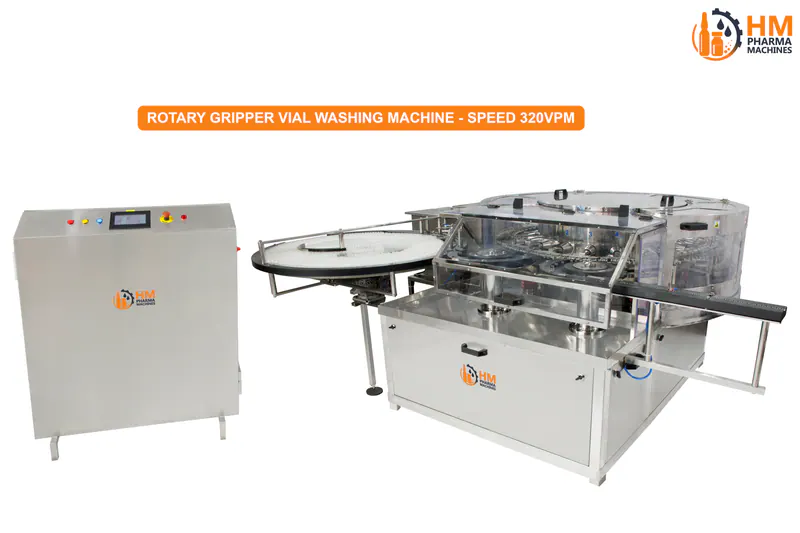
Machine overview
H M Pharma Machines manufactures the Rotary Gripper Vial Washing Machine in Ahmedabad, Gujarat, India. Vials are loaded on the turntable, transferred through the infeed star wheel and then handed to the rotary gripper system, which carries approved 2–100 mL vials through the defined internal and external washing stages.
The machine is available in four separate output models: 120 VPM, 150 VPM, 240 VPM and 320 VPM. VPM means vials per minute and identifies the rated output configuration.
The process arrangement includes six internal stages in the sequence RC water, air, PW, air, WFI and air. Two additional external stages apply RC water followed by air. Separate process tanks of 40 L each can serve RC water, PW and WFI; pump scope, level sensing and pressure monitoring are finalized in the approved order.
Machine running video
Review the reference machine demonstration, then discuss your container format and required output.
Select Play to load the video. This demonstration shows a reference configuration; final format parts, output, utilities, controls and guarding follow the approved project scope.
Available models
Choose the model according to the required vials-per-minute output and the approved 2–100 mL vial configuration.
Why this machine
The rotary gripper arrangement handles approved glass-vial configurations across the specified range.
Select 120, 150, 240 or 320 VPM according to the required production output.
The internal sequence uses RC water, PW, WFI and alternating air stages.
The external vial surface passes through RC water followed by an air stage.
Separate process tanks of 40 L each can serve RC water, PW and WFI; tank materials are finalized in the approved order.
Monitoring and interlock functions are finalized in the approved control specification.
Washing process
The continuous washing sequence combines synchronized infeed, rotary gripper handling and multiple water and air stations to prepare vials for downstream processing.
Vials are loaded onto the infeed turntable and pass through the star-wheel system, which synchronizes their transfer to the rotary grippers. An infeed feedworm, where specified for the selected configuration, assists vial spacing and positioning.
Format-specific gripper assemblies hold each vial securely by the neck and gently invert it into a mouth-down position. This presents the vial opening to the internal washing nozzles while the grippers carry the vials through the washing stations.
Internal nozzles align with the inverted vial openings while external jets wash the outer surfaces. The six internal stages use RC water → air → PW → air → WFI → air; the two external stages use RC water → air. Servo or mechanical nozzle actuation is defined for the selected configuration.
After the washing cycle, the grippers return the vials to an upright, neck-up position and release them to the approved outfeed tray or conveyor. Where the line includes a depyrogenation tunnel, the transfer arrangement is matched to its infeed and the agreed line layout.
Process scope: RC means recirculated water, PW means Purified Water and WFI means Water for Injection. Washing prepares the vials for the next process; sterility and depyrogenation require their own specified and validated treatment.
Published reference wash cycle
Each gripped vial passes through the following six internal water and air stages.
Recirculated water provides the first internal wash.
An air stage follows the RC water wash.
Purified Water provides the next internal wash.
An air stage follows the PW wash.
Water for Injection provides the final water stage.
The final air stage completes the internal cycle.
Terminology: RC means recirculated water, PW means Purified Water and WFI means Water for Injection.
For an explanation of each washing medium and the role of air between rinses, read our vial washing cycle guide: RC Water, PW, WFI and air. Washing, sterilization and depyrogenation have separate process objectives.
External washing sequence: two stages are provided for the vial outer surface.
RC water is applied to the vial outer surface.
An air stage follows the external RC water wash.
Technical details
| Suitable For | Glass vials only |
|---|---|
| Output Unit | VPM — vials per minute |
| Infeed Handling | Turntable → infeed star wheel → rotary gripper washing machine |
| Internal Stages | 6 |
| Internal Sequence | RC water → air → PW → air → WFI → air |
| External Stages | 2 |
| External Sequence | RC water → air |
| Process Tanks | Separate process tanks, 40 L each; quantity and material per approved order |
|---|---|
| Tank Services | RC water, PW and WFI |
| Process Pumps | Defined in the approved order |
| Tank Level Control | Defined in the approved control specification |
| HMI Pressure Display | Monitoring points defined in the approved control specification |
| Safety Interlocks | Defined in the approved control specification |
| Automation Standard | Delta PLC, 7-inch Delta HMI, Delta drive/VFD and Delta servo |
| Compressed Air | 6 bar |
| Documents | May be included as defined in the approved order |
| Model / Series | Published reference. HMRGVWM-120 / HMRGVWM-150 / HMRGVWM-240 / HMRGVWM-320. |
|---|---|
| Output / Throughput | Published reference. 120 / 150 / 240 / 320 vials per minute (VPM), matched to the selected model. |
| Accuracy / Acceptance Criterion | Not applicable. This is not a dosing or label-placement function; acceptance is based on stable container handling, the approved wash sequence and the FAT protocol. |
| Electrical Power | Published reference. 440 V AC, three-phase, 50 Hz; connected load 6 HP. |
| Utilities | Published reference. Compressed air at 6 bar; RC-water, PW and WFI process tanks have a capacity of 40 L each. Pump sizing is defined in the approved order. |
| Overall Dimensions (L × W × H) | Published reference. 2230 × 1750 × 1400 mm (L × W × H); conveyor height adjustable from 850 to 900 mm. |
| Net / Shipping Weight | Published reference. Approximately 1200 kg net. |
| Capacity / Format Range | Published reference. Approved 2–100 mL vials; 40 L per process tank, with tank quantity confirmed in the approved order. |
| Warranty | Published reference. 1 year; commencement, coverage and exclusions are defined in the approved order. |
| Installation / Commissioning Scope | Published reference. Installation and commissioning are available; the exact included work and customer responsibilities are defined in the approved order. |
The 2–100 mL vial range, final model selection, utilities and performance are confirmed against the approved glass-vial sample, drawing and washing process.
Water consumption varies with the selected machine model, operating speed, vial size and approved washing cycle. The project-specific requirement is confirmed for the selected configuration and agreed operating conditions.
Recirculated-water flow and fresh PW/WFI consumption are specified separately during technical review.
₹30–40 lakh (INR)
This is an approximate budget range. The final price is confirmed in the written quotation for the selected model, output and approved configuration.
Confirm GST, packing, freight, installation and commissioning inclusions in the written quotation.
Process control & protection
Monitoring and protection functions are finalized in the approved control specification.
Tank-level sensing and feed logic are included only as defined in the approved control specification.
Required RC-water, PW, WFI and compressed-air monitoring points are finalized in the approved order.
The 7-inch Delta HMI displays the monitoring points included in the approved control scope.
Alarms and automatic-stop responses are defined in the approved control specification.
Format, utilities & integration
The vial washer comparison separates rotary and linear output choices. Once rotary gripper handling is selected, use these checks with the RC/PW/WFI vial wash-cycle guide.
Preparing for the factory trial? Use our washing machine FAT checklist to agree samples, wash conditions, output checks and dispatch records.
Approve samples or drawings for every 2–100 mL glass vial and identify its target VPM. Match HMRGVWM-120 / 150 / 240 / 320 to the required output; confirm star wheel and gripper format parts for each vial.
The published supply is 440 V AC, three-phase, 50 Hz, 6 HP connected load and 6 bar air. Each process tank has a capacity of 40 L. Pump sizing remains order-specific; request the approved RC/PW/WFI and compressed-air flow requirements.
The listed machine dimensions are 2230 × 1750 × 1400 mm, with conveyor height adjustable from 850 to 900 mm. Confirm the selected configuration, tank placement, access and downstream transfer in the approved site drawing.
The approved order may include Design Qualification (DQ), Installation Qualification (IQ), Operational Qualification (OQ), Performance Qualification (PQ), Factory Acceptance Test (FAT) and Site Acceptance Test (SAT) documents, plus the HMI Manual and Operation Manual. Component certificates, wiring diagrams and machine layout are included only when defined in the approved order.
Machine selection
Consider this platform when the approved vial formats suit rotary gripper handling and the process calls for the published six internal and two external washing stages. The HMRGVWM range provides separate 120, 150, 240 and 320 VPM models.
Confirm stable handling, the required washing conditions and the sustainable capacity of the tunnel and filling line before selecting the output model. For an alternative handling arrangement, review the linear tunnel vial washing machine and the rotary gripper versus linear tunnel comparison.
Related machines and guide
Frequently asked questions
Answers to practical questions about vial formats, model selection, washing requirements, utilities, line integration and project documentation.
The published range is 2–100 mL glass vials, subject to approval of the actual container. Share samples or drawings for every format so grippers, guides and other required change parts can be reviewed.
HMRGVWM-120, HMRGVWM-150, HMRGVWM-240 and HMRGVWM-320 are rated at 120, 150, 240 and 320 vials per minute (VPM). Select the model against the approved vial, wash process and downstream line capacity; the rating alone does not establish the finished-line output.
Vials enter on a turntable, pass through the infeed star wheel and transfer to neck-holding rotary grippers. The grippers invert the vials for internal and external washing, then return them to an upright, neck-up position for the approved outfeed and downstream transfer.
Six internal stages apply RC water, air, PW, air, WFI and final air. The two external stages apply RC water followed by air. RC means recirculated water, PW means Purified Water and WFI means Water for Injection.
Separate process tanks of 40 L each can serve RC water, PW and WFI. Tank quantity and material, pump specifications, tank-level sensing, feed logic, pressure monitoring, HMI indications and stop responses are defined in the approved order and control specification.
This rotary platform uses turntable, star-wheel and gripper handling with six internal and two external wash stages. The linear vial platform uses belt, cam and pocket handling with ten configurable internal positions. Selection depends on the approved vial, process, output and line interface.
Provide the tunnel or next-machine details, required transfer height, operating direction, sustainable output and line layout. Transfer arrangements and any start, stop, ready or fault signals must be agreed for the connected equipment.
Send all vial samples or dimensioned drawings, required output, internal and external washing requirements, water and air specifications, room layout, downstream equipment details, changeover expectations and the required testing and documentation scope.
Washing prepares the vials through the approved cleaning sequence. It does not by itself establish sterility or depyrogenation. Any required downstream treatment and its acceptance criteria must be specified and validated separately.
The approved order may include DQ, IQ, OQ, FAT and SAT records, operation and HMI manuals, component certificates, wiring diagrams and machine layouts. Any PQ documentation or support must be agreed with the site team for its specific process.
The published automation uses a Delta PLC, 7-inch Delta HMI, Delta drive/VFD and Delta servo. A 1-year warranty is listed. Installation and commissioning are available; coverage, commencement and the included work are defined in the approved order.
Contact us
Contact H M Pharma Machines for model selection, technical discussion and quotation.