ESTABLISHED 2012 · AHMEDABAD, INDIA☎ +91 97379 73334✉ info@hmpharmamachines.com
Automatic Liquid Dosing & Filling System

Automatic Vial Liquid Filling & Rubber Stoppering Machine

For approved pharmaceutical glass vials, liquid formulations and compatible rubber stoppers, with controlled vial infeed and synchronized indexing.

Suitable for
Approved pharmaceutical glass vials, liquid formulations and compatible rubber stoppers
Method
Precision vial dosing with rubber stoppering
Output
Confirm rate for the approved liquid, fill volume, container and operating conditions.
Fill range
Reference: 10–100 mL with change parts; quoted configuration also includes a 50–250 mL syringe set.
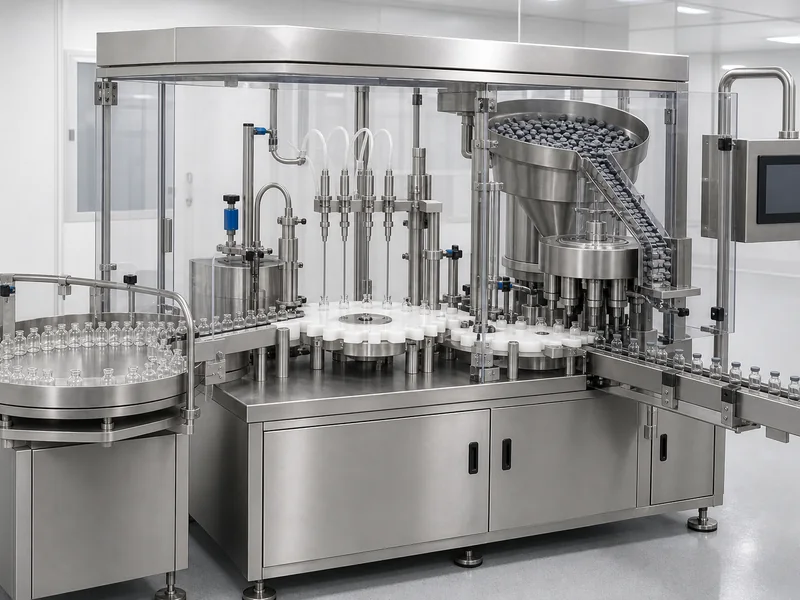
AI-generated conceptual visualization of Automatic Vial Liquid Filling & Rubber Stoppering Machine; final machine configuration may vary
AI-generated conceptual visualization of this machine. Final configuration may vary by approved project scope.
GMP-Oriented EngineeringApplication-Matched DesignInstallation SupportAfter-Sales Service

Machine overview

Automatic Liquid Filling Machine Manufacturer in India

H M Pharma Machines manufactures the Automatic Vial Liquid Filling & Rubber Stoppering Machine in Ahmedabad, Gujarat, India for pharmaceutical, nutraceutical, cosmetic, food, chemical and allied production applications.

The Automatic Vial Liquid Filling & Rubber Stoppering Machine uses controlled vial infeed and synchronized indexing for container and product flow. Its approved process completes when stoppered vials discharge toward the capping machine.

Detailed engineering for the Automatic Vial Liquid Filling & Rubber Stoppering Machine aligns no-vial/no-fill and no-stopper logic with optional gas flushing and barrier integration with the approved application, target output, utility schedule and final line layout before the GA drawing is released.

Why this machine

Why Choose the Automatic Vial Liquid Filling & Rubber Stoppering Machine

01

Precision vial dosing with rubber stoppering

The Automatic Vial Liquid Filling & Rubber Stoppering Machine is intended for approved pharmaceutical glass vials, liquid formulations and compatible rubber stoppers; performance is assessed against the output and acceptance criteria stated for the approved configuration.

02

Controlled Product Handling

Controlled vial infeed and synchronized indexing.

03

Application-Matched Controls

No-vial/no-fill and no-stopper logic with optional gas flushing and barrier integration.

04

GMP-Oriented Engineering

For the Automatic Vial Liquid Filling & Rubber Stoppering Machine, the materials and cleanability review follows this product-contact requirement: Product-contact materials, seals, tubing, valves and surface finish are matched to the product and cleaning method in the approved scope.

05

Efficient Format Changeover

Vial changeover covers format guides, filling nozzles, pump settings and the stopper track and insertion parts approved for the selected vial.

06

Production-Line Integration

Stoppered vials discharge toward the capping machine.

Operating process

How the Automatic Vial Liquid Filling & Rubber Stoppering Machine Works

Vials are indexed under the filling nozzles for measured dosing, then transferred in sequence to the stopper presentation and insertion station before capping.

Step 01

Vial Feed and Indexing

Empty vials enter through the format guides and are positively indexed beneath the active filling nozzles.

Step 02

Precision Vial Filling

The selected dosing pump delivers the programmed liquid quantity into each correctly positioned vial.

Step 03

Stopper Orientation and Presentation

Compatible rubber stoppers are oriented and presented to the stoppering station in synchronization with the filled vials.

Step 04

Stopper Insertion and Vial Transfer

Each stopper is inserted to the specified full or partial position, and the stoppered vial discharges toward the capping machine.

Applications & selection

Built Around Your Product and Production Line

Pharmaceutical liquids and syrups

Pharmaceutical liquids are accurately dosed into approved vials before compatible rubber stoppers are oriented and inserted in sequence.

Nutraceutical preparations

Nutraceutical preparations are considered only when vial packaging, product-contact materials, dose and stopper requirements suit this machine.

Cosmetic and personal-care liquids

Cosmetic and personal-care liquids require a compatible vial-and-stopper format; ordinary bottles or jars need different handling equipment.

Food and beverage products

Food and beverage products are suitable only for approved vial packaging and a hygiene process matched to the dosing and stoppering path.

Oils, chemicals and agrochemicals

Oils, chemicals or agrochemicals require seal, tubing, pump and stopper compatibility plus a documented safety review before filling.

Standalone or integrated bottling lines

The vial filling and rubber stoppering machine can link vial preparation to downstream crimp capping, inspection, labeling and collection equipment.

Technical details

Automatic Vial Liquid Filling & Rubber Stoppering Machine Specifications

Custom RangeApproved product formats
Required OutputConfigured to production target
GMP-OrientedAccessible and cleanable design
Integrated SupplyLine interfaces available
Application & Operating Configuration
MachineAutomatic Vial Liquid Filling & Rubber Stoppering Machine
CategoryLiquid Filling Machines
Suitable ForApproved pharmaceutical glass vials, liquid formulations and compatible rubber stoppers
Working PrincipleVials are indexed below filling nozzles, dosed by the selected pump and transferred directly to an automatic stopper feeding and insertion station.
Infeed / HandlingControlled vial infeed and synchronized indexing
Outfeed / TransferStoppered vials discharge toward the capping machine
Construction, Controls & Integration
Machine ConstructionGMP-oriented stainless-steel construction as defined in the approved scope
Contact MaterialsProduct-contact materials, seals, tubing, valves and surface finish are matched to the product and cleaning method in the approved scope.
Control SystemNo-vial/no-fill and no-stopper logic with optional gas flushing and barrier integration
ChangeoverSettings, guides and format parts matched to approved samples or drawings
Optional ScopeFull or partial stoppering, nitrogen flushing, LAF, RABS or isolator interface can be engineered.
Line IntegrationStandalone supply or integration with approved upstream and downstream machines
Core Technical and Commercial Data
Reference scopeHMLS-20 is the published model reference. The 10–100 mL working range, 50–250 mL syringe set and 1000 mL motor/dose note describe different reference attributes, not one continuous qualified vial-filling range. The quotation must separately state approved vial dimensions, liquid fill-volume range, selected syringe/pump, motor and demonstrated filling conditions.
Model / SeriesPublished reference. HMLS-20
Output / ThroughputConfiguration-specific. The rated output in containers per minute depends on fill volume, viscosity, temperature, foam, container, dosing technology and number of filling heads.
Accuracy / Acceptance CriterionPublished reference. ±1% filling accuracy on a single dose.
Electrical PowerPublished reference: main machine 1 HP, 415 V, 50 Hz; conveyor 0.5 HP, 415 V, 50 Hz; three-phase + neutral + earth; total listed load 2 kW. The reference additionally notes 1.5 HP for a maximum single dose of 1000 mL. Confirm which motor/dose configuration that note applies to; it does not establish a 1000 mL operating dose for the approved vial machine.
UtilitiesPublished reference. Minimum compressed-air pressure 6 bar; consumption 0.5 CFM.
Overall Dimensions (L × W × H)Published reference. Machine: 2135 × 1150 × 1610 mm; shipping case: 2350 × 1350 × 1650 mm; conveyor height adjustable from 860 to 910 mm.
Net / Shipping WeightPublished reference. 600 kg net / 850 kg gross.
Capacity / Format RangePublished working-range reference: 10–100 mL with change parts. The quoted reference also lists a 50–250 mL syringe set; syringe-set capacity must not be treated as the qualified fill range or the approved vial size. Confirm vial dimensions, required liquid dose and pump/tooling together.
WarrantyPublished reference. Manufacturing defects in stainless-steel components are covered; normal wear-and-tear parts, consumables and electrical components are excluded. The quotation does not state a warranty duration.
Installation / Commissioning ScopePublished reference. Pre-dispatch operational and maintenance training; buyer may install, or an H M Pharma Machines engineer can attend site with tickets, accommodation, food and local transportation borne by the buyer.

Final specifications follow the approved quotation, layout, datasheet and project URS.

Options & project scope

Machine Configuration, Integration and Documentation

Approved Product Format

Approved pharmaceutical glass vials, liquid formulations and compatible rubber stoppers.

Optional Equipment

Full or partial stoppering, nitrogen flushing, LAF, RABS or isolator interface can be engineered.

Documented Supply

Documentation for the Automatic Vial Liquid Filling & Rubber Stoppering Machine records no-vial/no-fill and no-stopper logic with optional gas flushing and barrier integration, the confirmed utilities and the agreed acceptance tests; drawings, manuals and qualification records are supplied when ordered.

Controls & protection

Automatic Vial Liquid Filling & Rubber Stoppering Machine Controls and Process Monitoring

Controls, alarms and interfaces are confirmed for the ordered configuration.

Operating Sequence

No-vial/no-fill and no-stopper logic with optional gas flushing and barrier integration.

Infeed / Process Readiness

Infeed readiness: controlled vial infeed and synchronized indexing.

Outfeed / Transfer

Approved transfer: stoppered vials discharge toward the capping machine.

Utilities to Confirm

Published reference: Minimum compressed-air pressure 6 bar; consumption 0.5 CFM.

Acceptance Basis

Published reference: ±1% filling accuracy on a single dose.

Configured Options

Full or partial stoppering, nitrogen flushing, LAF, RABS or isolator interface can be engineered.

Related machines

Compare Vial Filling and Vial-Line Equipment

Use our liquid versus powder vial filling guide to compare dosing, stopper handling and trial requirements, then prepare a quotation brief for the approved product and vial format.

For dosing-method selection using product and container samples, read the liquid filling machine selection guide.

Frequently asked questions

Automatic Vial Liquid Filling & Rubber Stoppering Machine FAQs

What does the Automatic Vial Liquid Filling & Rubber Stoppering Machine do?

The Automatic Vial Liquid Filling & Rubber Stoppering Machine fills measured liquid doses into vials and promptly places rubber stoppers before the downstream crimping operation.

Which products or formats suit the Automatic Vial Liquid Filling & Rubber Stoppering Machine?

Suitable products and formats include approved pharmaceutical glass vials, liquid formulations and compatible rubber stoppers. Final suitability is confirmed from approved samples, drawings and process details.

How does the Automatic Vial Liquid Filling & Rubber Stoppering Machine perform its main operation?

Vials are indexed below filling nozzles, dosed by the selected pump and transferred directly to an automatic stopper feeding and insertion station.

How does material enter and move through the Automatic Vial Liquid Filling & Rubber Stoppering Machine?

The Automatic Vial Liquid Filling & Rubber Stoppering Machine handles material using controlled vial infeed and synchronized indexing.

What determines the rated output of the Automatic Vial Liquid Filling & Rubber Stoppering Machine?

The rated output in vials per minute depends on vial size, fill volume and pump cycle, number of filling nozzles, indexing time, stopper-feed capacity and the selected full or partial insertion process.

What changes for another vial, dose or stopper on the Vial Filling and Rubber Stoppering Machine?

Vial guides and indexing parts, dosing pump or parts, filling needles, recipe, stopper bowl and insertion tooling are qualified together using approved samples.

Which construction details are specified for the Automatic Vial Liquid Filling & Rubber Stoppering Machine?

The dosing pump, tubing or piping, filling needles and associated seals are specified as product-contact parts, while vial guides and stopper-feed components are defined from approved samples.

Which controls and interlocks are available on the Automatic Vial Liquid Filling & Rubber Stoppering Machine?

The available control scope includes no-vial/no-fill and no-stopper logic with optional gas flushing and barrier integration. Final alarms and interlocks are documented in the approved control specification.

Which optional equipment can be added to the Automatic Vial Liquid Filling & Rubber Stoppering Machine?

Full or partial stoppering, nitrogen flushing, LAF, RABS or isolator interface can be engineered.

Where does the Automatic Vial Liquid Filling & Rubber Stoppering Machine connect in a production line?

The machine receives prepared empty vials and discharges stoppered vials directly to aluminum-seal crimp capping, with enclosure, gas, line-status and environmental interfaces included where specified.

Which technical documents can accompany the Automatic Vial Liquid Filling & Rubber Stoppering Machine?

The order can include vial, dose and stopper format data, dosing calibration, stopper-feed and insertion details, product-contact certificates, electrical, pneumatic and gas diagrams, manuals, layout and FAT protocol.

What information is needed to quote the Automatic Vial Liquid Filling & Rubber Stoppering Machine?

Please provide the following: vial and stopper samples, formulation, dose range, output, gassing, barrier and validation requirements.

Contact us

Discuss Your Automatic Vial Liquid Filling & Rubber Stoppering Machine Requirement

Share your application and required capacity for a quotation.

WhatsApp Us