Establish the Liquid Supply
An elevated reservoir supplies liquid to the filling outlets. The supply arrangement needs a controlled operating level so the driving head does not change unpredictably during production.

H M Pharma Machines offers gravity liquid filling machines for projects using compatible, free-flowing liquids. Selection starts with the actual liquid and bottle: flow behavior, foaming, fill quantity and production target determine whether gravity filling is the right approach.
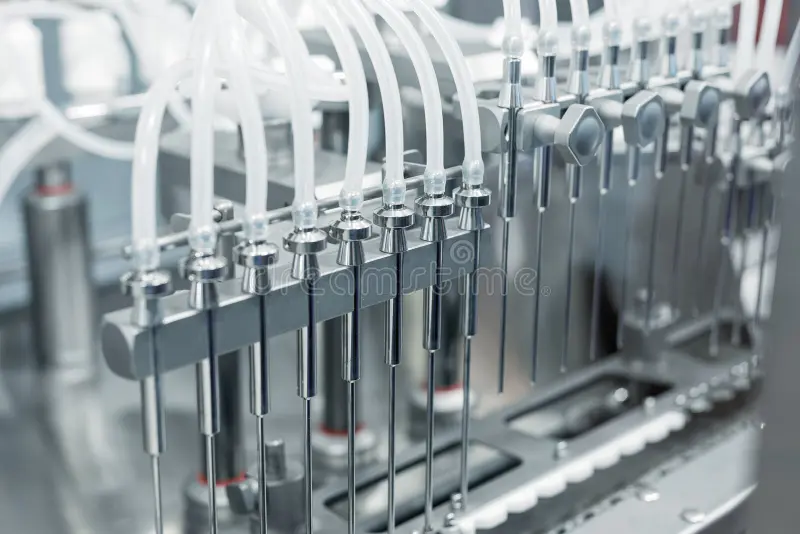
Machine overview
Gravity filling uses the height difference between a supply reservoir and the filling outlet to move liquid into a container. It is a useful starting point for water-like, non-carbonated liquids that flow readily without a dosing pump forcing them through the fill path.
The product name alone does not establish suitability. A thin liquid can still foam, drip, attack seals or change flow with temperature. Share a representative sample and packaging details so the proposed filling arrangement can be reviewed against your actual production conditions.
Operating principle
The following describes the gravity filling principle. The reservoir, valves, controls and container handling are selected for the approved project.
An elevated reservoir supplies liquid to the filling outlets. The supply arrangement needs a controlled operating level so the driving head does not change unpredictably during production.
The bottle is aligned with the outlet before filling begins. Neck clearance, bottle support and manual or conveyor presentation are reviewed together, including how a missing or misplaced container will be handled.
In a timed arrangement, a valve opens for a calibrated interval. The delivered quantity depends on the liquid and flow conditions as well as that setting; trial fills establish the operating recipe.
The outlet closes and the container moves to the next operation. End-of-fill dripping, foam settling and transfer to closing equipment are checked during the application review.
Application selection
Supply viscosity information at the actual filling temperature and describe any foaming, settling or suspended matter. A sample trial is more useful than assuming that all liquids with a similar trade name behave alike.
Provide the smallest and largest bottle formats, the neck opening, the required fill quantities and the acceptance criterion. Volume control and a visually identical fill height are different objectives; agree which one the process needs.
Thick products, difficult particulates and pressure-sensitive processes need a separate method review. Compare an appropriate piston, pump or other filling principle before choosing a gravity arrangement only because the product is a liquid.
Technical discussion
Use these points to prepare the technical enquiry. The final machine specification follows application review and the agreed supply scope.
| Filling principle | Gravity-fed delivery; fill control and valve arrangement confirmed for the liquid. |
|---|---|
| Product review | Liquid sample, composition information, temperature, viscosity and foam behavior. |
| Container range | Bottle drawings or samples, neck opening, dimensions and stability. |
| Fill quantity and acceptance | Required quantities and allowable variation, verified under agreed trial conditions. |
| Output and filling heads | Selected after reviewing fill time, bottle handling and production target. |
| Contact materials and cleaning | Compatibility of reservoir, tubing, valves and seals; cleaning access and procedure. |
| Utilities and installation | Electrical supply, any pneumatic controls, product feed and available height/layout. |
| Final specification | Confirmed in the quotation and approved machine documentation; no universal rating is assumed. |
Installation and changeover
Identify where liquid comes from, how the reservoir will be replenished and what happens when the supply is low. Available installation height can influence the layout of a gravity-fed system.
Review filled-bottle transfer, accumulation and stop/start coordination with capping, labeling and packing equipment. The bottle should remain stable during transfer and any necessary settling period.
List the products that will share the machine. Review draining, access to wetted parts, seal compatibility and the cleaning procedure before agreeing the contact-path construction and changeover scope.
Common questions
No. Low viscosity is a starting point, but foaming, temperature, material compatibility and bottle geometry also matter. Share the actual product and operating conditions for application review.
Not necessarily. A timed gravity fill controls the amount delivered through a calibrated flow interval. A fill-to-level process uses a different control objective. State whether your requirement is quantity, appearance or both.
The height of liquid above the outlet contributes to the driving head. Changes in that condition can affect flow, so the supply arrangement and operating level belong in the filling setup and trial review.
A new product or bottle should be checked and recalibrated. Liquid properties, fill quantity, neck opening and nozzle arrangement can change the suitable filling interval and handling setup.
Send the liquid details or sample, filling temperature, bottle samples or drawings, fill quantities, required output and available installation layout. Include cleaning requirements and the equipment before and after the filler.
Related equipment
Contact H M Pharma Machines
Send your application details for technical review and a project-specific quotation.