High-speed rotary platformRotary Gripper Vial Washing Machine
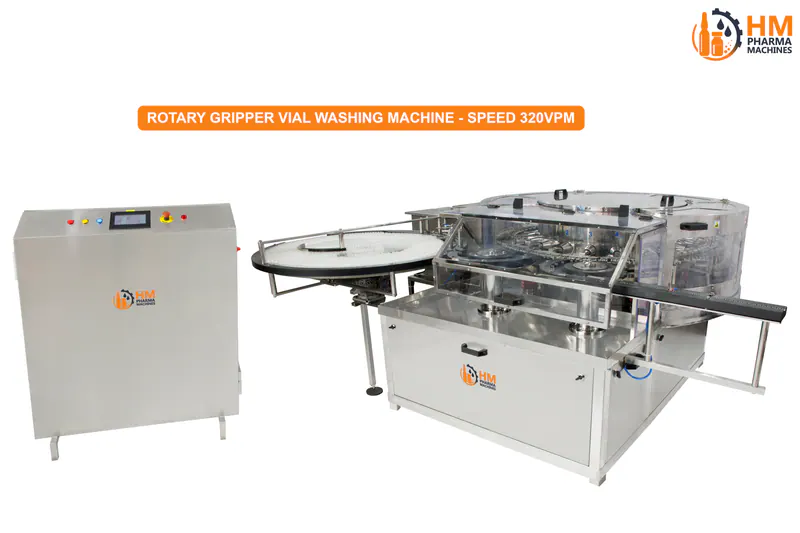
Vials move from the turntable to the infeed star wheel and rotary gripper system for controlled internal and external washing.
Compare rotary gripper and linear tunnel vial washing machines for approved 2–100 mL vial formats, rated outputs from 120–320 vials per minute and controlled RC water, PW, WFI and compressed-air washing.
Two machine platforms
H M Pharma Machines manufactures automatic vial washing machines in Ahmedabad, Gujarat, India for pharmaceutical and injectable production applications. The available rotary gripper and linear tunnel platforms are designed around the approved vial format, required production output, washing sequence, process utilities and downstream line interface.
Both machine families cover approved vial configurations from 2–100 mL. They differ mainly in vial handling, washing-station arrangement and available output models. The comparison below helps shortlist a platform before final technical review against your user requirement specification.
Final machine selection, change parts and rated output are confirmed using the vial sample or drawing, required wash process and the complete line layout.
Available machines
Review the handling method, output choices and washing arrangement of each platform, then open the detailed product page for complete specifications. For other container formats, compare All Washing & Cleaning Machines.
High-speed rotary platformVials move from the turntable to the infeed star wheel and rotary gripper system for controlled internal and external washing.
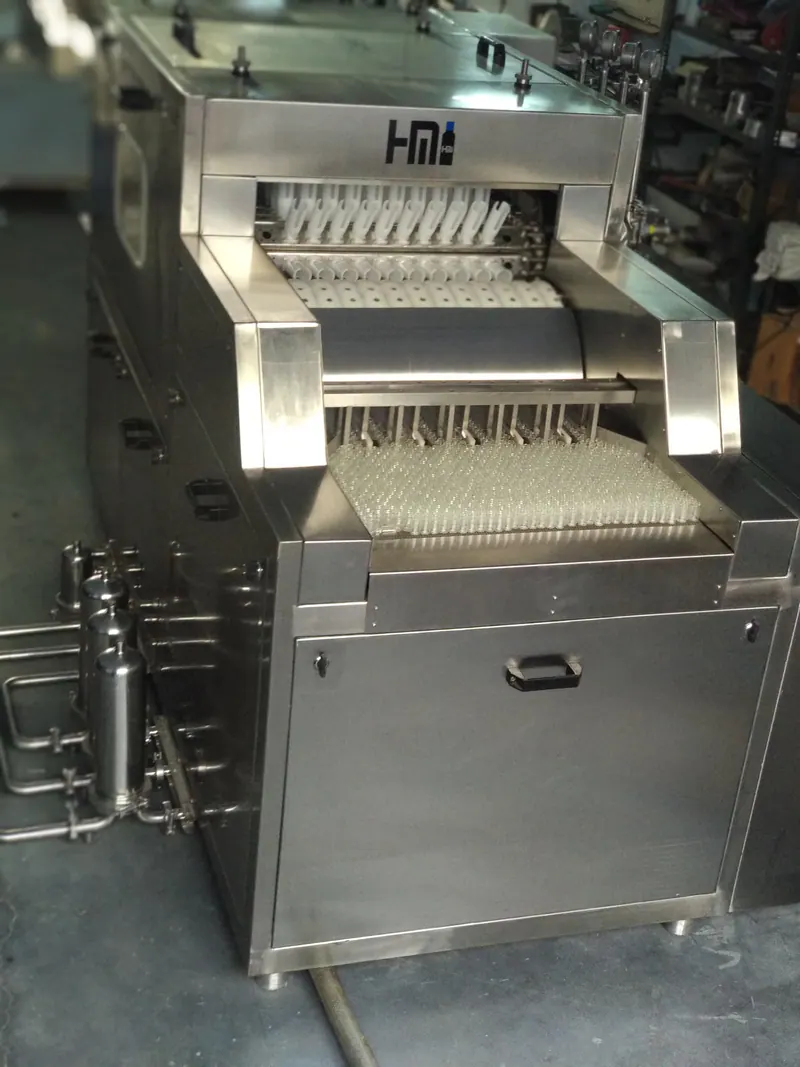
Linear tunnel-line platformA wire-woven infeed belt, mechanical cams and HDPE vial pockets carry approved vials through ten internal washing positions.
Side-by-side comparison
Use this table for initial comparison. Final selection is based on the approved vial, output, wash cycle, utility system and line-integration requirement. For a deeper explanation of handling, wash positions and model outputs, read our rotary gripper vs linear tunnel vial washing machine guide. To compare vial and ampoule applications, use the ampoule vs vial washing machine selection guide.
| Selection point | Rotary Gripper Machine | Linear Tunnel Machine |
|---|---|---|
| Approved vial range | ✓ 2–100 mL glass vials only | ✓ 2–100 mL glass vials only |
| Model & published output | HMRGVWM-120 — 120 VPM HMRGVWM-150 — 150 VPM HMRGVWM-240 — 240 VPM HMRGVWM-320 — 320 VPM | HMLVWM-120 — 120 VPM HMLVWM-150 — 150 VPM HMLVWM-180 — 180 VPM HMLVWM-240 — 240 VPM |
| Vial handling | Turntable, infeed star wheel and rotary gripper system | Wire-woven infeed belt, mechanical cams and HDPE pockets |
| Internal washing | 6 stages: RC water, air, PW, air, WFI and air | 10 configurable positions using compressed air, RC water, PW and WFI |
| External washing | 2 stages: RC water followed by air | External air-and-water washing provision |
| Tank and pump system | 40 L per tank; tank quantity, material and pump scope per approved order | Three process tanks of 40 L each and three process pumps; tank material and pump rating/contact material per approved order. |
| Electrical supply | 440 V AC, three-phase, 50 Hz | 440 V AC, three-phase, 50 Hz |
| Connected load | 6 HP (published reference) | 5 HP (published reference) |
| Compressed-air pressure | 6 bar | 6 bar |
| Automation | Delta PLC, 7-inch Delta HMI, Delta VFD and Delta servo | Delta PLC, 7-inch Delta HMI, Delta VFD and Delta servo |
| Operator interface | 7-inch Delta HMI | 7-inch Delta HMI |
| Water services | Recirculated water, PW and WFI | Recirculated water, PW and WFI |
| Output selection | 320 VPM is listed in this rotary range. The 120, 150 and 240 VPM options also appear in the linear range. | 180 VPM is listed in this linear range. At a shared output, compare the pocket handling and ten-position wash arrangement. |
| Reference conditions | Utilities and automation shown are reference specifications. Confirm final utilities and control scope for the selected model in the approved order. VPM means vials per minute. Confirm the operating rate for each approved glass-vial sample, wash sequence and connected line. A shared nominal output does not mean the handling parts, wash positions or tank scope are interchangeable. | |
These figures are published planning references. Final utility requirements, tank and pump specifications, machine layout and operating conditions are confirmed for the selected model and approved vial formats. Compressed-air pressure alone does not specify the required air-flow capacity.
Water consumption varies with the selected machine model, operating speed, vial size and approved washing cycle. The project-specific requirement is confirmed for the selected configuration and agreed operating conditions.
Recirculated-water flow and fresh PW/WFI consumption are specified separately during technical review.
Selection guide
After comparing the two platforms, resolve these points for the chosen model. Use the rotary vs linear selection guide for the complete project checklist.
Preparing for the factory trial? Use our washing machine FAT checklist to agree samples, wash conditions, output checks and dispatch records.
Supply every glass-vial sample or drawing, not just nominal mL. Review the required gripper or HDPE-pocket format parts for each vial.
Match the required VPM to the model table. For the shared 120, 150 and 240 VPM outputs, compare handling and wash-position requirements before choosing.
Compare the rotary six-stage internal cycle with the linear ten-position arrangement. Define external washing, RC/PW/WFI services and the approved tank and pump scope.
Review transfer height, direction, format change parts and line-control signals against the actual tunnel. Request the selected configuration's layout and utility schedule.
Process and compliance
The approved machine scope is engineered around process-water control, vial handling, alarm philosophy and project documentation.
Separate process circuits support recirculated water, Purified Water and Water for Injection, combined with compressed-air stages in the approved sequence.
Machine construction includes specified stainless-steel contact parts and process components. Filtration ratings and piping scope are confirmed for the selected platform.
Documentation can include DQ, IQ, OQ, PQ, FAT, SAT, operation and HMI manuals, certificates, wiring diagrams and machine layout as defined in the approved order.
Controls and operation
Both machine platforms use a Delta PLC, 7-inch Delta HMI, Delta VFD and Delta servo. The approved control specification defines the operator settings, monitored conditions and machine responses for your washing process.
Confirm the required HMI screens, operating controls and wash-sequence settings during technical review. Available functions are defined for the selected machine configuration.
Agree the required vial-feed, tank-level and RC/PW/WFI or compressed-air monitoring points. Sensors, indications and utility checks depend on the approved scope.
Define alarm indications, interlocks and stop responses, including any downstream tunnel interface. These functions are confirmed in the control specification and checked during the agreed factory trial.
The operator interface provides access to the functions and process information included in the selected machine configuration.
Water and compressed-air monitoring, tank-level sensing, alarms and automatic-stop responses are defined in the approved control specification. The required monitoring points and responses should be agreed during technical selection.
Applications
The machine configuration is finalized for the approved product, vial, washing process and downstream line arrangement.
Project support
For the selected rotary or linear vial washer, review utility connections, transfer height and downstream equipment before installation. Our installation, commissioning and operator support is defined in the agreed project scope. When adding another vial format, request vial handling change parts using the machine details and vial sample or drawing.
Frequently asked questions
Both machine families are offered for approved vial configurations from 2–100 mL. Final suitability and the required change parts are confirmed from the vial sample or drawing.
The rotary machine uses turntable, star wheel and gripper handling with six internal and two external stages. The linear machine uses a wire-woven infeed belt, mechanical cams and HDPE pockets through ten internal washing positions, with external washing provision.
Rotary gripper HMRGVWM models are available at 120, 150, 240 and 320 VPM. Linear HMLVWM models are available at 120, 150, 180 and 240 VPM.
Yes. The approved process arrangement uses recirculated water, Purified Water and Water for Injection with compressed-air stages. The final sequence is confirmed against the user requirement specification.
Integration can be reviewed for the approved machine layout, selected output, vial format and downstream tunnel or filling-line interface.
No. Washing uses the approved water and compressed-air sequence to clean the vials; it does not by itself establish sterility or depyrogenation. Any downstream sterilization or depyrogenation process must be separately specified and validated for the production line.
Vial washing is a cleaning step.
Published VPM identifies the model reference output, not a guaranteed finished-line output. The sustainable operating rate depends on the approved vial geometry, wash sequence, utility availability, feeding and downstream equipment. Confirm the required output with your vial samples and agreed process conditions during the factory trial.
Rated VPM identifies the selected washer model’s output configuration. Sustainable line output also depends on the approved vial, wash process, transfer arrangement and downstream equipment capacity.
Share the vial sizes, required output in vials per minute, vial samples or drawings, required wash sequence, utility details, preferred machine type and downstream line interface.
Vials with the same nominal volume can have different diameters, heights and neck dimensions. Samples or dimensioned drawings help confirm the correct grippers, pockets, guides and other format parts.
The published H M Pharma Machines range covers approved glass-vial formats from 2–100 mL. Plastic-vial compatibility is outside this published specification.
Ahmedabad-based team, nationwide support
H M Pharma Machines provides delivery and service for vial washing machines across India from its only facility in Ahmedabad, Gujarat. Share your state, city and PIN code along with the machine requirement to confirm delivery, installation and service arrangements. Our India delivery and service coverage explains destination planning and support coordinated from Ahmedabad.
Quotation planning
| Machine type | Approximate price (INR) |
|---|---|
| Linear Tunnel Type Vial Washing Machine | ₹15–25 lakh |
| Rotary Gripper Vial Washing Machine | ₹30–40 lakh |
Some linear washer configurations may cost up to approximately ₹25 lakh.
These are approximate budget ranges. The final price is confirmed in the written quotation for the selected model, output and approved configuration.
Confirm GST, packing, freight, installation and commissioning inclusions in the written quotation.
The quotation is based on the approved configuration: rotary or linear platform, selected output model, vial formats and change parts, wash sequence, tanks and pumps, controls and monitoring, and the downstream line interface. Agreed testing, documentation, installation and commissioning scope also affect the quotation.
Share your vial samples or drawings, required VPM, utilities and line layout so the offer can identify the equipment, inclusions and project-specific requirements clearly.
A vial washing machine quotation is prepared for the selected model and project requirements. The scope includes the required output, vial formats, change parts, washing sequence, process tanks, pumps, filtration, controls and downstream equipment interface.
For a clear comparison, review the equipment and services included in each quotation. Confirm the documentation, factory testing, installation and commissioning scope alongside the machine specifications.
To request a configuration-specific quotation, share your vial samples or drawings, target output, washing requirements, available utilities and production-line layout.

Send your vial sizes, required VPM, wash process and line-layout details for technical review and quotation.