
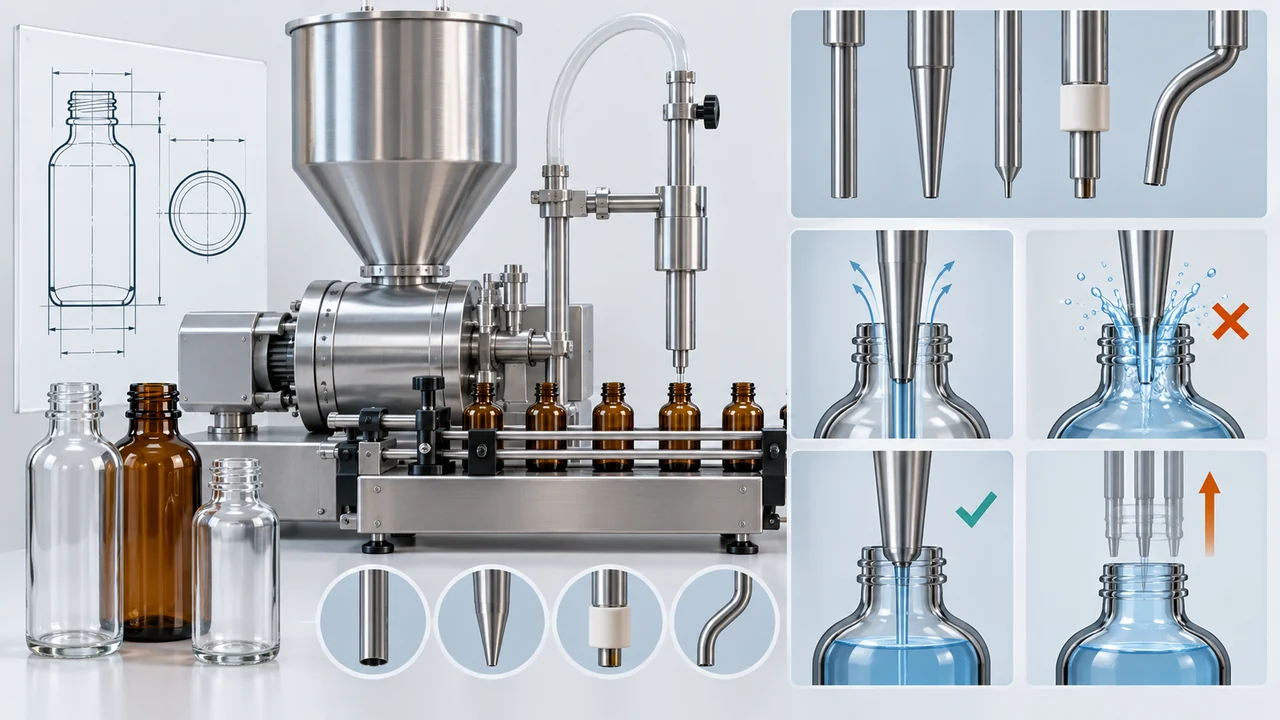
A narrow bottle neck leaves less room for the filling nozzle and for displaced air to escape. The bottle liquid filling machine and its container handling must therefore be reviewed together. Selecting a nozzle from the nominal bottle capacity alone overlooks the opening, neck tolerances and motion that determine whether the actual format can be filled cleanly.
Use the bottle drawing and production samples to review nozzle entry clearance, alignment, air escape, filling behavior and withdrawal. Approve the complete bottle-and-nozzle combination through a controlled trial, rather than choosing the largest nozzle that appears to fit.
Begin with the opening that the nozzle actually enters
Ask for the neck opening, finish geometry and relevant tolerances on the bottle drawing. The dimension controlling nozzle entry is not necessarily the outer neck diameter used to identify the closure. Review shoulders, internal transitions and any feature that could interfere with the intended insertion path.
Compare samples from the bottle supplier with the drawing. A single carefully selected sample does not demonstrate the range of ordinary containers. Identify how bottle manufacturing variation will be represented in the format review before committing to a nozzle and support arrangement.
Treat clearance as a handling question as well
The apparent gap around a stationary nozzle changes when bottle position varies. Guides, indexing, neck support and the stiffness of the container influence alignment. A nozzle that fits on a bench may contact the rim when an empty bottle arrives tilted or stops inconsistently beneath the filling head.
Review the bottle in its intended support system. Document the position reference and the nozzle path, then assess entry without forced contact. Mechanical adjustments belong to trained personnel using the machine procedure; the review is not an invitation to guide a bottle by hand under a moving nozzle.
Leave a path for displaced air
Incoming liquid displaces air from the bottle. A proposed nozzle and neck arrangement should be assessed for the air-escape path during the actual fill. A visibly tight fit can create splash, interrupted flow or an unstable filling surface, but those observations need to be distinguished from product aeration already present upstream.
Do not assume that a special vented nozzle is included in every filler. Ask how the selected configuration handles this duty and compare the intended design with the product and bottle samples. The nozzle arrangement must suit the process, not just occupy the available opening.
Compare entry, filling and withdrawal separately
| Trial stage | What to record |
|---|---|
| Container positioning | Repeatable neck alignment and container support |
| Nozzle entry | Clearance, rim contact or visible deflection |
| Liquid delivery | Splash, bubbles, interrupted flow and quantity results |
| Nozzle withdrawal | Trailing liquid, neck wetting and product carryover |
| Transfer to closing | Condition of the neck and outer bottle surface |
Keep these stages separate in the trial record. A wet neck observed at discharge could result from splash during filling or from liquid deposited during withdrawal; the required follow-up is different.
Match the nozzle to the selected dosing arrangement
The H M volumetric liquid filling machine uses a calibrated piston or metering chamber to draw and discharge a defined volume. The general bottle filler can use a selected dosing technology. Nozzle restriction, valve behavior and motion must be discussed for that particular product path instead of assuming that the same tip suits every platform.
If a diving or anti-drip arrangement is proposed, document its actual scope and check cleaning access. Adding a feature to a quotation does not remove the need to demonstrate how it behaves with the narrow neck and the intended liquid.
Make approval reusable for the next format change
Identify the approved nozzle, bottle drawing revision, guide or support parts, recipe and trial conditions in one format record. Record any restrictions on product characteristics or container variants. This gives the next operator a defined starting point instead of relying on the appearance of an unmarked nozzle.
For a quotation from a filling machine manufacturer in India, provide the neck drawing together with bottles, liquid details and the required dose. Ask for the nozzle-and-format review to be included in the technical discussion, with unresolved points clearly listed before fabrication.
Customer Questions
Is bottle capacity enough to select a filling nozzle?
No. Neck opening, tolerances, internal geometry, bottle support and the liquid behavior also influence the suitable nozzle arrangement.
Can a nozzle fit on the bench but still cause contact on the machine?
Yes. The production review must include the actual container-positioning and support system, not just a stationary bottle sample.
Does a narrow neck always need a special vented nozzle?
The air-escape duty must be reviewed for the particular product and nozzle geometry. A special arrangement should not be assumed without design and trial confirmation.
Product References and Further Details
These pages describe published equipment arrangements. Review the supplied machine, actual materials and agreed operating requirements when applying the guide.
Discuss Your Machine Requirement
Share your product, container or closure samples, required output, process conditions and line layout with H M Pharma Machines for a technical review.
Request a Technical Review