
Browse this topic: Filling machines and product trials
In This Guide
- Identify the filling channels before collecting bottles
- Keep product supply and measuring conditions with the result
- Sample each channel across the agreed run stages
- Observe nozzle finish and the bottles after stopping
- Example: an overall average can hide channel differences
- Complete and use the four-head trial record
- Attach the accepted configuration to the quotation
- Buyer Questions
- Related practical guides
- Source and interpretation
- Discuss Your Requirement
Identify the filling channels before collecting bottles
A multi-head filling demonstration should produce a record that lets the buyer trace an observation to the channel that made it. A tray of unmarked bottles cannot show whether a result came from one nozzle, every nozzle or a particular restart condition. Agree the sample identification method before the trial begins.
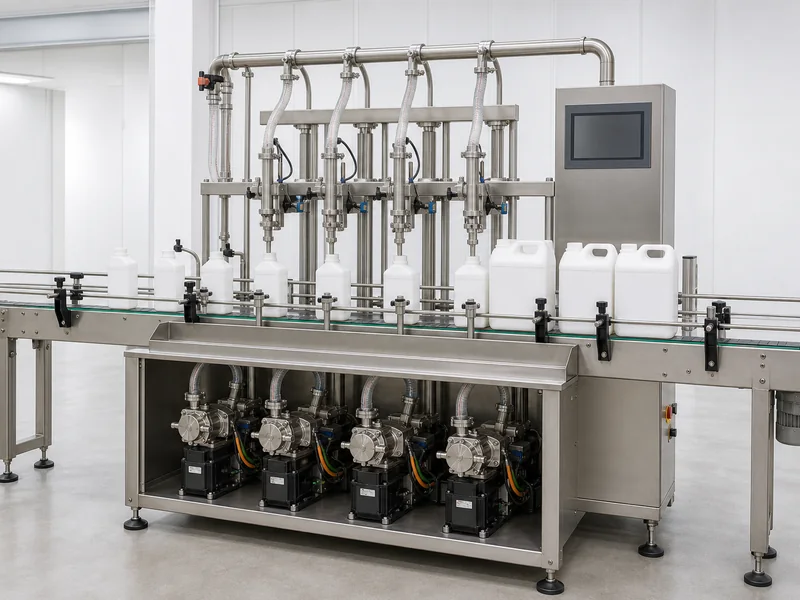
The published four-head servo gear pump filler has four independently driven pump channels. Use that configuration as a starting point for the discussion, rather than assuming every gear-pump filler has the same arrangement. Ask the supplier to identify the pump, nozzle and control reference associated with each channel on the quoted machine.
Keep product supply and measuring conditions with the result
Record the liquid used, its observed condition, container sample and product-feed arrangement. If the trial uses a substitute liquid, identify the substitution and the questions that remain open for the actual formulation. A successful water demonstration is not evidence that another liquid will behave identically.
Agree whether acceptance concerns delivered volume or net mass, which independent measuring method will be used and how its suitability will be checked. Keep the target, acceptance limits and sampling plan in the approved trial scope. When a mass measurement supports a volume comparison, the conversion basis must be agreed; do not silently treat grams and millilitres as interchangeable.
Sample each channel across the agreed run stages
Keep the channel identity on each sample record. Distinguish start-up bottles, bottles collected during stable operation and bottles collected after an agreed stop and restart. Record changes to settings or product supply against the affected samples. Otherwise a later adjustment can make an earlier result difficult to interpret.
Ask to see the agreed minimum and maximum formats or doses that matter to your order. If a format is not available during the demonstration, mark that part of the assessment as outstanding. Testing one container should not quietly become approval of a wider range. The useful record connects each tested condition to the equipment and format parts that produced it.
Observe nozzle finish and the bottles after stopping
Dose measurement and the condition of the finished bottle answer different questions. Observe the agreed nozzle position, the end of flow, visible drips and contamination of the bottle exterior. Include bottles that remain under or near the nozzles during a normal interruption, using the supplier's approved operating sequence.
Record what was actually observed without naming an automatic correction or anti-drip feature that is not in the offer. If a change is proposed, identify whether it requires a nozzle, valve, setting or product-supply change. Recheck the relevant condition after the agreed adjustment; a discussion about a solution is not a completed acceptance result.
Example: an overall average can hide channel differences
Invented training data only. The following net-mass readings illustrate arithmetic. They are not H M Pharma Machines test results, a capability claim, a recommended sample size or the fill range of the linked machine. The example target is 100.0 g; no conversion to millilitres is made.
| Channel | Three example readings (g) | Mean (g) | Range (g) |
|---|---|---|---|
| A | 97.9, 98.0, 98.1 | 98.0 | 0.2 |
| B | 98.9, 99.0, 99.1 | 99.0 | 0.2 |
| C | 100.9, 101.0, 101.1 | 101.0 | 0.2 |
| D | 101.9, 102.0, 102.1 | 102.0 | 0.2 |
The twelve readings total 1,200.0 g, so their combined average is 100.0 g. Yet the channel means differ from the example target by −2.0, −1.0, +1.0 and +2.0 g. The low and high results cancel in the combined mean. The equal 0.2 g ranges describe only the spread of these three readings in each channel; they do not show that every channel is close to the target.
For a second teaching step, suppose the agreed individual-reading limits were 99.0–101.0 g inclusive. Eight of these twelve invented readings would fall outside those limits. B and C have means on a limit but still contain an out-of-limit reading. In a real review, apply the actual agreed decision rule to the raw readings as well as the required summaries. Investigate the affected channel and preserve the original run before making an authorized adjustment.
Keep startup, steady-operation and restart groups separate when comparing channels. A changed setting starts a new comparison group. More evidence is needed to characterize an actual process; these twelve invented values establish neither long-run capability nor statistical control.
Complete and use the four-head trial record
Download the buyer review workbook (XLSX)
Open the Four-head trial tab and save a project copy with its own revision. The template is a working record to complete with the buyer and supplier; it does not approve a machine, material or production batch.
- Agree the basis: record target, units, individual and summary criteria, sample plan, measurement method and responsible reviewers before collecting bottles. Identify the balance or other instrument and the suitability/calibration evidence required by the agreed method.
- Label each observation: retain run ID, channel A–D, stage, sequence/sample ID, product and container identity, settings reference and the raw value. If weighing, document the tare method used to obtain net mass.
- Review by channel and stage: compare raw results with the agreed limits and calculate the required summaries. Keep nozzle-finish and exterior-condition observations beside the quantity evidence.
- Record every intervention: enter the observation prompting a change, authorized action, revised setting or part, owner and repeat-run reference. Retain the earlier readings.
- Close the decision: list the tested conditions accepted, the conditions requiring a repeat and any format or product still untested. Give each open action an owner and required evidence.
Do not place a control limit calculated from a short sample into an acceptance-limit field. The project specification and the analysis method have different purposes; agree both explicitly. Blank criteria or missing channel identity leave the review incomplete.
Attach the accepted configuration to the quotation
The supplier identifies the offered channel arrangement, setup and authorized changes. The buyer supplies the relevant product/container requirements and confirms the intended acceptance scope. The person taking measurements records the method and raw readings; the agreed reviewers decide whether the evidence closes the specified requirement.
Retain the offer revision, pump/nozzle references, format parts, settings and trial record together. Use a decision such as accepted for the tested condition, hold pending evidence or repeat after the recorded change, and define any restriction. A successful water demonstration or one available format leaves the other product/format conditions explicitly untested.
Buyer Questions
Should results from different channels be combined into one average?
Keep channel-specific observations available. A combined figure may hide a difference between nozzles; the agreed acceptance method should state how individual and overall results are assessed.
Does a servo drive guarantee accuracy for every liquid?
No. Suitability and accepted performance depend on the liquid, product supply, container, hardware and trial conditions defined for the order.
What if the required format is not present during the demonstration?
Record it as untested and agree a later sample review or trial. Do not extend acceptance to an unavailable format without the required evidence.
Related practical guides
- Investigate fill-level drift — record when a result changes before attributing a cause.
- Review nozzle entry and withdrawal — separate quantity results from neck wetting and nozzle contact.
- Distinguish a demonstration from order FAT — agree what the visit can establish before accepting the record.
Source and interpretation
The NIST/SEMATECH discussion of variables control charts distinguishes process-control limits from specification limits and explains why variation deserves attention alongside the mean. This guide uses that distinction; its small arithmetic example is not a control-chart study.
The published four-head servo gear pump filler provides the equipment context. The numerical example above does not describe that machine's published fill range or performance.
Discuss Your Machine Requirement
Share the machine duty, actual samples, required result and relevant site information with H M Pharma Machines for a technical review.
Request a Technical Review