
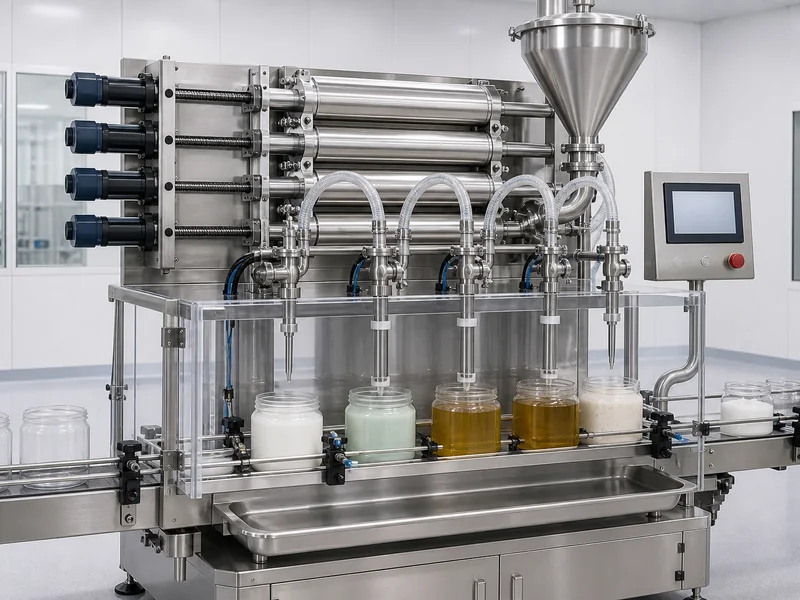
Define what changes between the two products
A product change can involve more than changing the fill setting. Before ordering a liquid filler, describe the products to be run, the contact path that will be retained and the work expected between them. Keep this task separate from a bottle-format change, even when both occur during the same stop.
Review the actual quoted servo piston, volumetric or peristaltic arrangement. Do not assume that a common machine name means every assembly can be removed or cleaned in the same way. The ordered design and supplier instructions establish the access method.
List the contact assemblies and access points
Identify the supply connections, dosing assemblies, valves, hoses, tubing and nozzles that belong to the product path. Ask which remain installed during the proposed cleaning task, which are removed and which are replaced. Include buyer-supplied feed equipment and interfaces so the responsibility does not stop at an undefined boundary.
Ask the supplier to show the relevant access points during an agreed demonstration. Record whether access requires tools, trained personnel or an approved isolation procedure. This is a procurement review, not an instruction to open a working machine. Guarding and interlocks must remain effective, and actual cleaning work must follow approved machine and site procedures.
Review removal and refitting as one task
A component that can be removed still needs an identified method for correct reassembly. Request the assembly reference, part identification and checks used to confirm that seals, connections and nozzles have been refitted as specified. Keep supplied tools and replacement parts in the same handover list.
Agree which tasks are intended for operators and which belong to maintenance or service personnel. Ask what records accompany the delivered revision and how changes to an assembly are communicated. Avoid depending on an informal demonstration sequence that cannot be repeated from the supplied instructions. A photographed arrangement can support identification, but it should not become an undocumented alternative procedure.
Define manual cleaning and any ordered CIP scope separately
Specify the cleaning arrangement actually included in the offer. Manual cleaning access, flushing provisions and a quoted clean-in-place system are different scopes. If CIP is proposed, identify the equipment, connections, controls, customer utilities and responsibilities included; do not infer a complete system from a single connection or marketing phrase.
The buyer's process assessment and the approved materials govern the cleaning method. Do not select chemicals, temperatures, durations or release criteria from a generic machine guide. Likewise, a supplier demonstration of access does not prove a validated cleaning outcome. Keep the required evidence and responsibilities explicit before the machinery and site provisions are finalized.
Include first-off checks after reassembly
The agreed handover should explain how the equipment is returned to its approved setup after the cleaning task. Include the relevant connection checks, settings reference, container handling and first-off dose review. Record what has been demonstrated and any task that still requires training or further evidence.
This blank worksheet defines the discussion; it is not a completed cleaning or validation record.
| Assembly or task | Information to complete |
|---|---|
| Product-contact assembly | Part and drawing reference |
| Access, removal or replacement | Supplier-approved method |
| Instruction and tool requirements | Document and tool references |
| Manual cleaning or ordered CIP | Included scope and responsibility |
| Reassembly and first-off check | Agreed observation and record |
| Training and unresolved item | Owner and required evidence |
Carry the access scope into the order
Keep the completed access schedule, supplied tools, spare references and training scope with the offer revision. Where cleaning provisions depend on customer equipment, identify those provisions before dispatch. Open questions should have a named owner and a defined closing record.
Use the format change-parts checklist for container conversion components and the filling selection guide for mechanism choice. Share the products, proposed changeover task and cleaning-access requirements so H M Pharma Machines can discuss the supplied machinery scope against your actual process.
Buyer Questions
Is a bottle-format change the same as a product-cleaning changeover?
No. Format parts govern container handling; a product change also requires review of the retained contact path, cleaning or replacement task and return-to-service checks.
Does a CIP connection prove a complete cleaning system is included?
No. Equipment, controls, utilities, connections and responsibilities must be specified in the approved offer.
Can a demonstration prove cleaning validation?
An access demonstration shows the agreed mechanical task. Validation and release evidence are separate process requirements that must not be inferred from it.
Related Equipment and Guides
Primary References
Review these published machine and support pages alongside the approved configuration, actual samples and project documents.
Discuss Your Machine Requirement
Share the machine duty, actual samples, required result and relevant site information with H M Pharma Machines for a technical review.
Request a Technical Review