
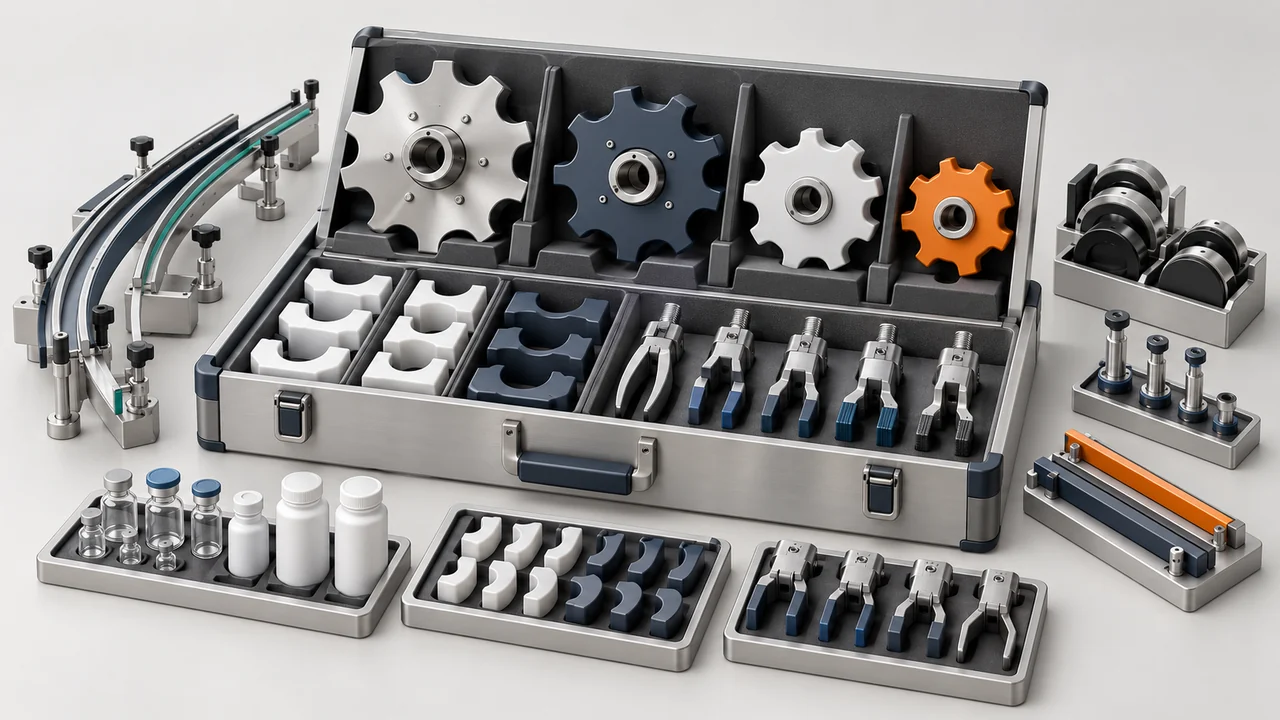
A drawing for one star wheel is not necessarily a complete format conversion. A parts order needs to identify every affected station, the machine revision and the samples used to establish fit. This guide focuses on assembling and checking the order, rather than choosing materials or describing individual part types. The objective is a traceable kit that can be received, fitted and proved without discovering a missing interface during production changeover.
Build a format-by-station register, link each part to its machine assembly and drawing revision, and separate the working kit from recommended spares. Check completeness and identity at receipt, then trial the assembled conversion from infeed to outfeed. Similar container sizes do not establish interchangeable tooling.
Identify the Installed Machine and Assembly
Begin with the machine name, serial identification if available, current configuration and relevant assembly drawings. Photograph the installed part and its mounting points. Record handedness, travel direction and the neighbouring component so that a part is not specified in isolation.
For an existing machine, distinguish a direct replacement from a new-format conversion. A worn sample can help explain the interface but may not represent the intended original dimensions. Ask which measurements and drawings are needed before an existing part is treated as the manufacturing reference.
Build a Format-by-Station Register
List every required container and map its route through the equipment. For a rotary gripper vial washing machine, review infeed transfer, grippers and outfeed handling. The linear tunnel type vial washing machine uses a different arrangement with pockets and mechanical loading or unloading interfaces. Their kits should not be assumed interchangeable.
| Station | Order record |
|---|---|
| Receiving and spacing | Guides, pitch-control parts and interfaces |
| Process position | Container support and process-specific tooling |
| Outfeed | Transfer parts and downstream entry |
| Each required format | Applicable part numbers and shared parts |
Check the Kit Beyond the Main Handling Parts
For a bottle liquid filling machine, review positioning and the fill-path interfaces alongside guides or indexing parts. Do not assume every container change requires a new nozzle, but ask whether neck access, fill position or product compatibility changes the requirement. For a round bottle labeling machine, review support, guide settings and rotation or application position.
Record any brackets, fasteners, spacers, settings or sensor adjustments needed with the supplied parts. Mark items retained from the installed machine separately from new items. This reveals incomplete quotations that list prominent tooling but omit the supporting conversion details.
Freeze the References and Quantities
Give each ordered item a part identity, assembly position, drawing revision, material requirement where relevant and quantity. Link it to the accepted container drawing and sample identifier. State whether the item is shared between formats or belongs to a dedicated kit.
Separate quantities required to run the machine from spare quantities. Ask for the supplier's basis for recommended spares rather than buying an undefined package. Where paired or matched components are involved, record their relationship so that replacement and storage practices preserve the intended assembly.
Inspect and Organize Parts at Receipt
Compare the delivered kit with the order register before installation. Check identity, quantity, revision, visible damage and any specified mating dimensions using the agreed inspection method. Keep uncertain items identified and separate until the discrepancy is resolved.
- Confirm the container and machine references supplied with the kit.
- Check labels or markings against the parts list.
- Record missing items and shipping damage.
- Store shared and format-specific parts in defined locations.
- Retain drawing and inspection records with the kit.
A complete receipt record reduces the chance of discovering a mismatch during a scheduled changeover.
Prove the Assembled Conversion
Use the machine manufacturer's setup and safety procedure for fitting. Check the complete container path before assessing production performance. Observe entry, support, process position and discharge for interference, instability or unwanted contact. Include a normal stop and restart after the setup is established.
Evaluate the machine's task as well as mechanical fit: a filler needs the agreed fill result, and a labeler needs the accepted label application. Retain the final setup record and identify any revised parts. Release the kit only after the agreed trial, not solely because an individual component fits its mounting point.
Buyer Questions
Can one change-parts kit cover containers with the same nominal volume?
Not automatically. Body shape, neck, height and handling interfaces can differ. Identify the actual containers and confirm which parts are genuinely shared.
Should a worn part be copied directly?
Use it as evidence of the installed arrangement, but resolve wear and intended dimensions with drawings or agreed measurements before treating it as the manufacturing reference.
Is checking an individual part's fit enough?
No. The complete conversion must support the container through the machine and deliver the required washing, filling, labeling or transfer result.
Related Machine Guides
Product References and Further Details
These primary pages describe the published machine arrangements discussed in this guide. Use the actual product and component requirements when reviewing a configuration.
Discuss Your Machine Requirement
Share your product, container or closure samples, required output, process conditions and line layout with H M Pharma Machines for a technical review.
Request a Technical Review