
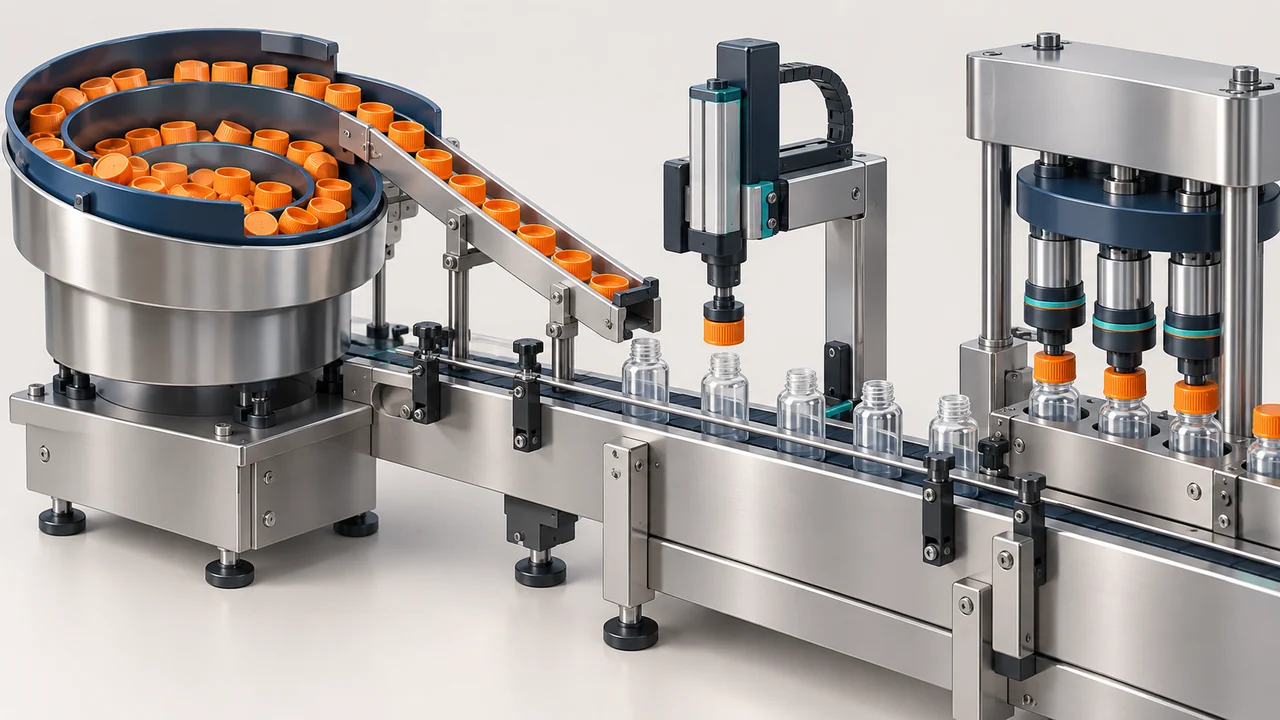
A capping machine can only close the bottle reliably when the correct cap arrives in the correct position. Cap presentation links the feeder, pickup or placement mechanism, bottle support and closing action. This guide compares the published H M Pharma Machines arrangements and explains which interface questions to resolve before selecting tooling, especially when a cap-feed interruption or format change affects the rest of the line.
Review the cap and bottle as a matched pair, then define orientation, delivery, placement and tightening or sealing. Multi-head describes the number of closing heads; pick and place describes cap transfer. These features can coexist, so compare actual mechanisms rather than treating names as exclusive categories.
Start with cap drawings and the matching bottle neck
Supply the cap dimensions, external shape, thread or closure details and representative samples alongside the bottle drawing. Identify the liner or internal component where relevant. A feeder must present the cap in a usable orientation, while the pickup or tightening tool must engage its actual surfaces.
Include all intended closures and supplier revisions. A similar diameter does not prove that another cap will orient, release or grip in the same way. Record the bottle and cap pairing so the review does not accidentally demonstrate one combination and quote another.
Compare the mechanism behind the machine name
| Published arrangement | Cap and bottle path | Presentation question |
|---|---|---|
| Multi-head screw capping | Worm and star wheel feed a rotary turret with multiple chucks | Is each screw cap squarely presented before engagement? |
| Pick and place multi-head | Heads collect oriented caps and transfer them to positively handled bottles | Is pickup, carry and placement synchronized? |
| Linear capping | Guided bottles continue along the conveyor through tightening elements | Does the cap enter the tightening path squarely? |
Pick and place is a transfer action that can form part of a multi-head machine. The closing operation and tooling still depend on the selected closure; the name alone does not confirm compatibility.
Trace the cap from supply to placement
Ask how the selected cap is oriented, accumulated and released at the presentation point. Review whether it arrives squarely, remains controlled and is available when the matching bottle reaches the station. Separate these questions from the final tightening setting, which cannot correct an incorrectly presented cap.
For a pick and place system, observe collection, carrying and release onto the neck. For screw-cap presentation, observe the cap position before the chuck or linear elements engage it. Discuss guide and cap-path parts for each format rather than assuming a common feeder arrangement handles every cap shape.
Keep bottle support synchronized with cap engagement
The multi-head screw platform establishes bottle pitch through an infeed worm and star wheel. The pick and place platform uses positive container handling selected for the application. Both require the cap action to remain coordinated with the supported bottle position through the rotary path.
The linear capping platform keeps bottles on the conveyor between adjustable guides while selected belts, spindles or wheels tighten the cap. Review upright guidance and resistance to bottle rotation. Do not transfer a star-wheel changeover assumption to an inline machine that uses a different support arrangement.
Review empty-feed and restart behavior
A useful presentation trial includes normal supply, a planned cap-feed interruption and recovery. Ask what happens to a bottle when no cap reaches the placement point, and how the system resumes after replenishment. Observe whether a restart creates misaligned caps or unsuitable bottles entering the next operation.
Document the selected bottle and closure sensing, alarms and line handshakes. Inspection and automatic rejection are separate functions where included; do not assume cap sensing supplies both. Agree the destination of an uncapped or incorrectly capped bottle and the responsibilities for resolving the interruption.
Prepare a cap-presentation setup record
Record the bottle and cap references, cap-path parts, pickup tools, bottle-support parts and placement settings. Keep the closing setting alongside them, but report placement and closure acceptance separately. The record should explain what changes when another format is installed and what is checked before running it.
- Observe correct orientation and clean release at the presentation point.
- Check cap placement before the selected tightening or sealing action.
- Review startup, steady flow and restart with the intended components.
Use that evidence to discuss the required system with H M Pharma Machines. More heads or a particular transfer name does not by itself demonstrate the finished closure quality or sustained output of the connected line.
Buyer Questions
Are multi-head and pick and place alternative categories?
Not necessarily. Multi-head describes the closing-head arrangement, while pick and place describes cap transfer. A machine can use both; review its actual bottle handling, cap action and closing tooling.
Can tightening correct a cap placed at an angle?
Do not rely on it. Review orientation and square placement before the closing action, then assess the finished closure separately using the defined bottle and cap acceptance criteria.
Does cap detection mean automatic rejection is included?
No. Sensing, stopping, inspection and rejection are distinct functions. Specify the required response and bottle destination for the selected controls rather than assuming they are all supplied together.
Related Machine Guides
Product References and Further Details
These primary pages describe the published machine arrangements discussed in this guide. Use the actual product and component requirements when reviewing a configuration.
Discuss Your Machine Requirement
Share your product, container or closure samples, required output, process conditions and line layout with H M Pharma Machines for a technical review.
Request a Technical Review