
In This Guide
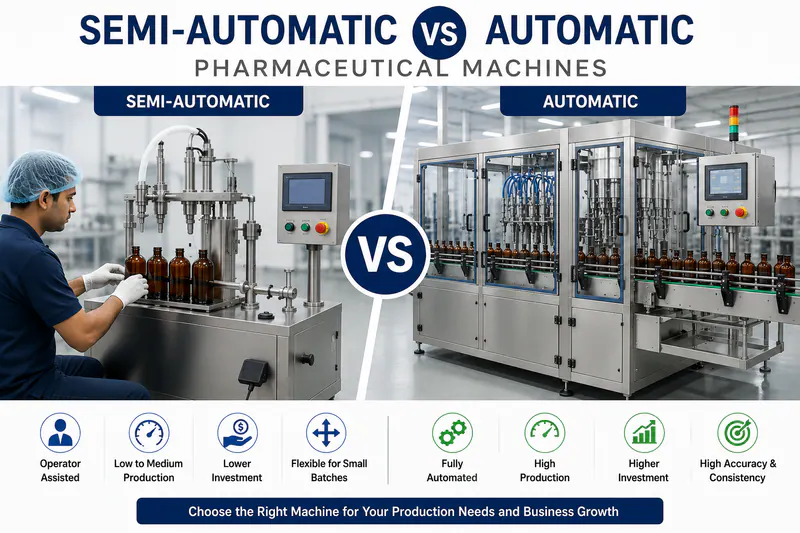
Part of Utilities, Installation & Line Planning.
Compare the work required to finish a batch, including preparation and cleaning. The words semi-automatic and automatic describe an arrangement of tasks; they do not, by themselves, establish accuracy, staffing, changeover time or total cost.
1. Define the tasks included in each offer
In a semi-automatic arrangement, the machine may perform the dosing, washing, capping or labeling cycle while an operator loads, presents or removes the pack, or starts the cycle. Specify those duties instead of assuming that every semi-automatic machine follows the same sequence.
What changes with an automatic arrangement?
Automatic handling can transfer and position containers through the specified process. The scope may still leave replenishment, sample collection, inspection, fault response, material reconciliation, cleaning and changeover to operators. Identify which tasks can run concurrently and which require a stop.
For example, a peristaltic dosing principle can sit within different levels of pack handling. The Flexicon manufacturer range spans hand-filling, semi-automatic and fully automatic arrangements. This is an example of separating dosing from handling, not a statement that HM supplies those systems.
2. Put the complete-batch task map first
| Stage | Record during the demonstration | Decision it supports |
|---|---|---|
| Setup and format change | Parts, tools, settings, line clearance, first-off checks, people and elapsed minutes. | How the actual SKU mix affects available production time. |
| Loading and replenishment | Product, bottles, caps or labels; refill frequency; running versus stopped work. | Remaining handling duties and access requirements. |
| Productive cycle | Good packs, observed running time and people continuously assigned. | Demonstrated operating rate and attended labor for the stated duty. |
| Checks and exceptions | Sample collection, inspection, rejects, brief stops and authorized recovery. | Support work that a headline cycle rate leaves out. |
| End of batch | Unloading, reconciliation, product-path clearing, cleaning and release checks. | When the equipment and operators are ready for the next batch. |
Record elapsed minutes separately from person-minutes. Two people assigned for 30 minutes represent 60 person-minutes, even though only 30 minutes pass. Avoid counting an overlapping task twice in elapsed time; retain its actual labor contribution.
3. Work through an illustrative batch and cost comparison
All numbers in this example are invented planning assumptions. They are not HM machine rates, staffing commitments, quotations or observed cleaning times. Assume one 1,000-pack batch, sequential stages, no rejects and no unlisted stops. The operating rates apply only to the fictional productive stage.
| Stage | Semi-automatic: minutes × people | Automatic: minutes × people |
|---|---|---|
| Setup / format change | 30 × 1 | 60 × 1 |
| Loading, replenishment and unloading outside the productive cycle | 20 × 1 | 20 × 1 |
| Productive cycle | 50 × 2, assuming 20 packs/min | 25 × 1, assuming 40 packs/min |
| Sampling and checks outside the productive cycle | 15 × 1 | 15 × 1 |
| Cleaning and clearing | 45 × 1 | 60 × 1 |
| Total elapsed batch time | 160 minutes | 180 minutes |
| Total assigned labor | 210 person-minutes | 180 person-minutes |
The automatic option has the faster fictional production cycle and uses 30 fewer person-minutes. It nevertheless finishes this small batch 20 minutes later because the assumed preparation and cleaning take longer. This outcome comes from the entered assumptions; it is not a general rule about either automation level.
For an equally fictional labor rate of ₹300 per person-hour, the labor amounts are ₹1,050 and ₹900. Add assumed batch energy/consumables of ₹100 and ₹180: the narrow operating subtotals become ₹1,150 and ₹1,080. The ₹70 difference excludes equipment purchase, finance, floor space, maintenance, rejected product and other ownership costs; it cannot establish payback.
Replace every assumption with the proposed machine’s task record and current costs. Test the smallest routine batch, the busiest shift and a shift with several changes. Keep replenishment and cleaning tied to the actual batch and product; do not scale only the running time and assume all other work stays fixed.
4. Decide from constraints and evidence
- Accuracy and repeatability: compare results for the actual dosing or processing method, setup, product and measurement plan. Reduced manual pack handling does not itself prove a more accurate dose.
- Staffing: identify continuously assigned roles and intermittent support. Confirm training, safe access and responsibility during stops.
- Integration: confirm transfer geometry, container support, machine-state signals, backup handling and each supplier’s responsibility. “Automatic” does not mean interfaces are already compatible.
- Space and utilities: include material staging, change-part storage, cleaning access and operator circulation in the proposed layout.
- Cost and growth: compare the complete scope and several demand scenarios. A startup can require high output; an established plant can need a small-batch arrangement.
For the underlying process choice, use the liquid-filling shortlist or the bottle-labeling selection guide. For a connected line, review bottleneck and usable-output planning.
5. Download the task comparison worksheet
Download the buyer review workbook (XLSX) and use the Automation tasks tab. Record task, elapsed minutes, people, overlap or stop condition, evidence reference and remaining responsibility. Keep observed results separate from planning assumptions.
Request a quotation that identifies the automation functions, format parts, controls, safety provisions, documentation, installation and training included. Required electronic records or qualification support need their own scope review; the presence of an HMI or SCADA connection does not settle those requirements.
Frequently asked questions
Is a semi-automatic machine always the right choice for a startup?
No. Choose from the actual product, batch mix, required good output, staffing, site and budget. Business age is not an equipment requirement.
Are automatic machines always more accurate?
No. Compare the actual processing or dosing method and measured results under the agreed conditions. Automatic handling alone is not proof of dose accuracy or process capability.
Does an automatic machine eliminate operators?
Only specified tasks are automated. Loading, replenishment, checks, cleaning, changeover and exception handling may still require people; confirm them in the complete-batch task record.
How should I compare capacity?
Compare required good packs with the demonstrated productive rate and the total batch time, including setup, stops, checks and cleaning. Test representative batch sizes and format changes rather than relying only on a maximum rate.
Browse utilities, installation and line-planning guides for the site and interface decisions that accompany an automation choice.
Need Help Selecting the Right Machine?
Share your product, bottle size, cap type and required production capacity with H M Pharma Machines.
Request a Free Quote Email Us