
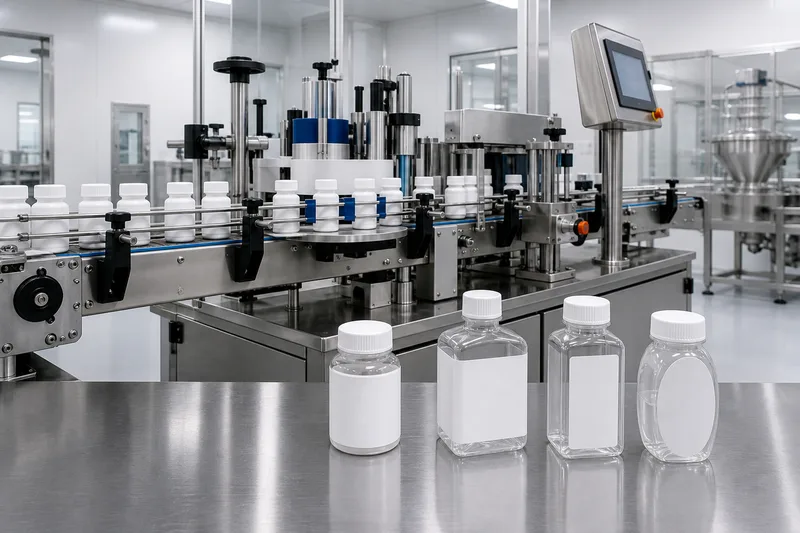
A bottle label may look simple, but consistent application depends on the interaction between the container, label stock, liner, dispensing system and bottle-handling arrangement. Two bottles with the same capacity can behave differently because their shape, surface, weight, rigidity and center of gravity are different.
H M Pharma Machines supplies a range of sticker labeling machines for round, square, rectangular, oval, vial and ampoule applications. Start with the bottle labeling machine comparison for bottle shapes, or evaluate the dedicated vial labeler and ampoule labeler for small pharmaceutical containers. The matrix below explains which handling questions to resolve before requesting a model recommendation.
Quick Selection Matrix: Bottle Shape and Label Application
| Container | Required Application | Machine Type to Evaluate | Main Check |
|---|---|---|---|
| Round bottle | Full or partial wrap-around label | Round bottle labeling machine | Stable rotation and label-to-bottle contact; the published HSL-120 reference is for approved 50 mL–1 L HDPE bottles |
| Square or rectangular bottle | One panel | Single-side labeling machine | Panel alignment and top stabilization |
| Square or rectangular bottle | Front and back labels | Double-side labeling machine | Two-head synchronization and bottle orientation |
| Oval or flat-sided bottle | Front and back labels | Oval bottle double-side labeling machine | Orientation, spacing and anti-rotation control |
| Small vial or ampoule | Wrap-around pharmaceutical label | Vial or ampoule labeling machine | Gentle spacing and small-container stability |
| Mixed high-output formats | Application-specific | Rotary labeling machine | Approved samples, change parts and line balance |
1. Define the Container Geometry
Container shape is the first selection factor because it determines how the bottle must be guided, rotated or oriented while the label is applied.
Round
The bottle can rotate for wrap-around application, but diameter, surface and stability must be controlled.
Square or Rectangular
One or two flat panels are labeled while the bottle remains correctly aligned and stabilized.
Oval
The bottle can rotate unintentionally, so orientation and top or side stabilization become critical.
Vial or Ampoule
Small cylindrical containers need gentle spacing, accurate rotation and suitable label-web control.
Share the minimum and maximum bottle height, width, depth or diameter. Also identify tapered panels, recessed areas, shoulders, seams, molding marks and any flexible surfaces that may affect label contact.
2. Choose Wrap-Around, Single-Side or Double-Side Labeling
Wrap-Around Labeling
Wrap-around labeling is used mainly for cylindrical containers. The bottle is rotated while the label is dispensed and pressed onto the surface. Bottle diameter, label length, overlap or gap, and the required orientation of printed information must be confirmed.
Single-Side Labeling
Single-side labeling applies one label to one flat panel. It is commonly considered for stable square or rectangular containers. The machine must keep the selected panel facing the label head throughout application.
Double-Side Labeling
Double-side labeling uses two dispensing heads to apply front and back labels in one pass. Bottle spacing, orientation, top holding and the relative position of both labels must be confirmed using approved samples.
3. Confirm the Complete Bottle and Label Range
The machine should be designed around the full approved range rather than one sample. Prepare a format matrix that includes:
- Minimum and maximum bottle dimensions.
- Bottle material, rigidity, weight and filled condition.
- Minimum and maximum label length and width.
- Label material, liner material and label gap.
- Maximum roll outside diameter and core inside diameter.
- Roll-winding direction and print orientation.
- Opaque, metallic or transparent label construction.
- Required label position from the bottle base, shoulder or panel edge.
- Number of bottle and label formats.
A label that fits the bottle on paper may still wrinkle, lift or bridge across a curved or recessed surface. Representative filled bottles and production-quality labels should therefore be reviewed before final design.
4. Calculate Sustainable Production Output
Specify the required labeled bottles per minute or per hour, but also consider the complete line. The sustainable rate may be affected by bottle spacing, label length, sensor response, container stability, changeover frequency and the speed of upstream filling or capping machines.
Use the required shift output to estimate capacity:
A machine with a high headline speed may not provide the best daily output if bottles become unstable or label placement drifts. Ask for speed to be confirmed using the approved bottle and label combination.
5. Define Label Placement and Confirm It by Trial
Placement accuracy should be defined against a clear reference point, such as the bottle base, shoulder, side panel or existing printed mark. The tolerance must consider variation in bottles, labels and liner quality.
During sample trials, check:
- Vertical and horizontal label position.
- Front-to-back relationship on double-side applications.
- Wrinkles, bubbles, lifting edges and label skew.
- Registration on tapered or irregular surfaces.
- Repeatability after stopping and restarting.
- Performance at the agreed sustainable speed.
6. Review Container Handling and Stabilization
Label placement is only as consistent as the bottle movement. Depending on the application, the machine may use a bottle separator, side guides, top stabilization, wrap belt, roller, feed worm, star wheel or dedicated change parts.
- Bottles enter at a controlled spacing.
- Guides or orientation devices position the container.
- The label sensor detects the label gap.
- The dispenser releases the label at the coordinated time.
- A belt, roller or pressing arrangement applies the label to the surface.
- The labeled bottle exits without disturbing the applied label.
Lightweight empty bottles may behave differently from filled bottles. Confirm whether trials and rated performance will use empty or production-filled containers.
7. Compare Stepper, Servo and Label-Sensor Options
| Item | When It May Be Suitable | What to Confirm |
|---|---|---|
| Stepper label dispensing | Many standard applications with a defined operating range | Label length, response, repeatability and sustainable speed |
| Servo label dispensing | Applications needing a different level of dynamic control or response | Approved performance target, recipe needs and cost-benefit |
| Standard label sensor | Opaque labels with a detectable gap | Label and liner contrast, gap size and sensor mounting |
| Clear-label or ultrasonic sensor | Transparent or difficult-to-detect labels | Actual label and liner trial before selection |
The sensor should be selected for the actual label stock. Transparent labels, metallic films, unusual liners or very small gaps may require an application-specific sensor.
8. Review Controls and Protection Features
The control system should make the machine easy to operate and should protect both the process and the label web. Depending on the approved model and scope, review:
- PLC and HMI operating controls.
- Variable-speed conveyor and synchronization.
- Automatic label-length learning or setting.
- No-bottle-no-label logic.
- Label-roll end or web-break indication.
- Emergency stop and motor overload protection.
- Password or recipe control, where required.
- Coding, inspection or rejection interfaces, only when included in scope.
Do not assume every option is standard. The controls, interlocks and optional devices should be listed clearly in the approved quotation and technical specification.
9. Plan Changeover and Line Integration
If one machine handles several bottle formats, ask how guide rails, separators, stabilization devices, label heads and sensors are adjusted. Record the expected changeover method, required tools and format-specific change parts.
For an integrated line, review the bottle-washing guide and coordinate the labeling machine with the upstream bottle filler and capping machine. Check:
- Conveyor height and direction of operation.
- Bottle accumulation before the labeler.
- Minimum and maximum line speed.
- Start, stop and fault signals between machines.
- Space for operators, roll loading and maintenance.
- Downstream inspection and packing requirements.
10. Avoid Common Buying Mistakes
Selecting Only by Bottle Capacity
A 500 mL round bottle and a 500 mL oval bottle need different handling. Shape and dimensions matter more than nominal volume alone.
Quoting Only Maximum Speed
Speed must be linked to the approved bottle, label and application method. Request a sustainable operating rate rather than only a theoretical maximum.
Sending Photographs Without Samples
Photographs help with initial review, but they cannot confirm rigidity, surface finish, exact dimensions, liner behavior or bottle stability.
Ignoring Transparent-Label Detection
Standard label sensors may not detect some clear labels. Share production label rolls before the sensor is selected.
Not Defining Front and Back Label Position
For double-side applications, provide marked samples or drawings showing both label positions and the permitted tolerance.
Information to Share Before Requesting a Quote
- Product and industry application.
- Bottle material and whether samples are empty or filled.
- Minimum and maximum bottle dimensions.
- Required wrap-around, single-side or double-side application.
- Minimum and maximum label dimensions.
- Label and liner materials, gap and transparency.
- Label-roll OD, core ID and winding direction.
- Required sustainable output.
- Label placement reference and tolerance.
- Number of formats and changeover expectation.
- Upstream and downstream machines.
- Available electrical and pneumatic utilities.
- Factory layout and direction of operation.
- Required coding, inspection or rejection options.
- Physical bottles and complete production label rolls.
Complete information allows the machine manufacturer to recommend a practical configuration and reduces changes after manufacturing begins.
Frequently Asked Questions
1. Which labeling machine is suitable for round bottles?
A wrap-around round bottle labeling machine is normally considered for cylindrical containers. Final suitability depends on bottle diameter, height, surface, label size, bottle stability and the required output.
2. What is the difference between single-side and double-side labeling?
A single-side machine applies one label to one panel. A double-side machine uses two label-dispensing heads to apply front and back labels in one pass. The bottle must be guided and stabilized so both labels are placed consistently.
3. Can one labeling machine handle different bottle sizes?
A machine can often handle multiple compatible bottle formats through adjustments and approved change parts. The complete bottle and label range should be confirmed before design, and representative samples should be tested.
4. Can transparent labels be detected?
Transparent labels may require a clear-label or ultrasonic sensor because a standard photoelectric sensor may not reliably detect the label gap. The label material and liner should be tested before the sensor is finalized.
5. Is a servo label dispenser always necessary?
Not always. A stepper-based dispenser may be suitable for many standard applications, while a servo system may be selected when the application needs higher dynamic control, faster response or a different performance level. The decision should follow sample trials and the approved requirement.
6. How should labeling speed and accuracy be confirmed?
Speed and placement accuracy should be evaluated together using approved bottles, labels and operating conditions. A representative trial or Factory Acceptance Test is more useful than relying only on a headline maximum speed.
Final Recommendation
The right bottle labeling machine is selected by matching container geometry, label application, approved sample range and sustainable production output. Round, square and oval bottles should not be treated as the same application, even when their nominal capacity is similar.
Before ordering, confirm bottle and label samples, placement tolerance, sensor type, container handling, controls, changeover and line integration. A representative trial provides the strongest basis for finalizing the machine.
Need Help Selecting a Bottle Labeling Machine?
Share your bottle drawings, physical samples, label rolls, required label position and production output. Our team can review the application and recommend a suitable round, single-side, double-side, oval, vial or ampoule labeling configuration.
Request a Free Quote Email Your Requirements