
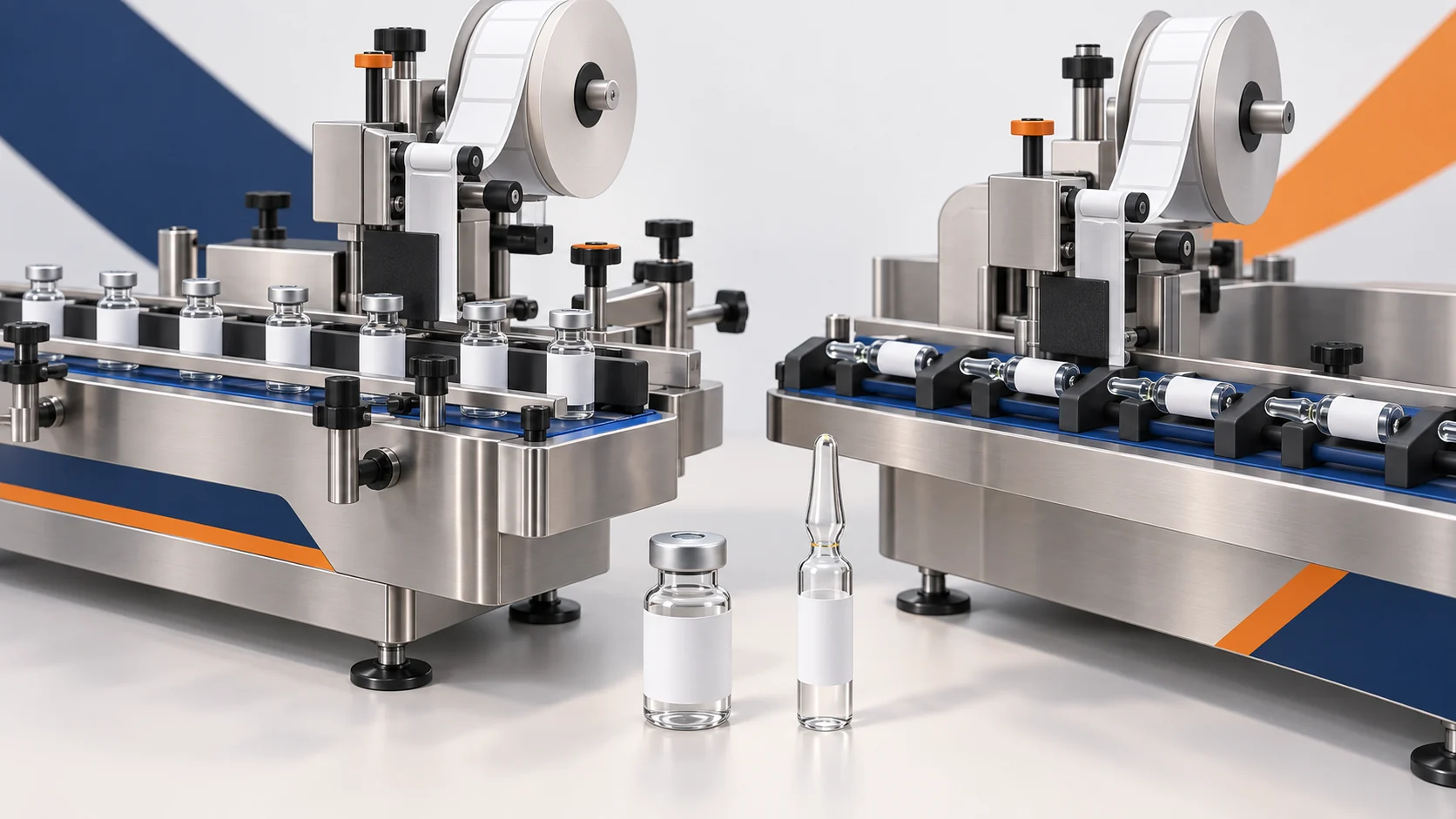
A vial labeling machine and an ampoule labeling machine may both apply self-adhesive labels around a small cylindrical container, but the engineering decision starts before the label dispenser. The machine must separate, support, detect and rotate each container consistently without damaging it.
This guide compares the practical selection points for pharmaceutical production teams. It explains what to include in a requirement, what to demonstrate during a trial and how to compare quotations for an automatic sticker labeling machine. Use it alongside the individual product specifications and your approved packaging requirements.
1. Vial vs Ampoule Labeling: What Changes?
Compare the vial body and closure configuration with the complete body and neck geometry of the ampoule. The label belongs on the approved body area, while guides, rollers and transfer components must suit the complete container shape. Nominal fill volume alone is not a sufficient machine-selection specification.
| Selection point | Vial labeling | Ampoule labeling |
|---|---|---|
| Container | Approved cylindrical glass or plastic vials, with the actual closure fitted. | Approved fragile glass ampoules, including their complete sealed-neck geometry. |
| Handling priority | Controlled accumulation, separation, spacing and stabilization at the label application point. | Gentle positive spacing and support through infeed, rotation and discharge. |
| Possible arrangement | Vertical or horizontal handling, selected for the approved vial and output. | Tray, conveyor or horizontal roller handling, with suitable worm or star-wheel arrangements where required. |
| Label application | Full or partial wrap-around pressure-sensitive labels on the approved cylindrical body. | Full or partial wrap-around labels positioned within the usable body area. |
| Line handoff | Review transfer after stoppering and capping or crimp sealing, and onward to inspection or packing. | Review receipt of sealed ampoules and discharge to trays, inspection or secondary packing. |
| Acceptance basis | Actual container and label samples, agreed output, placement criteria, start-stop behavior and any specified coding or inspection functions. | |
These are selection considerations, not a claim that every machine includes every handling option. Explore the pharmaceutical labeling machine range to separate small-container applications from bottle, flat-top and rotary platforms.
2. Start with Container Drawings and Samples
Provide the minimum and maximum body diameter, total height, usable label height, material and expected dimensional variation. Include the closure on vial samples and the finished neck on ampoule samples. Identify any shoulder, taper, embossing or surface feature near the intended label position.
Review the least stable format as well as the most common one. A machine that runs one vial smoothly may need different guides or format parts for another diameter. For ampoules, confirm how individual containers remain supported through each transfer and how operators load or collect them.
3. Match the Label to the Application
Define label width and length, material, adhesive, backing liner, label gap, roll outside diameter, core size and winding direction. For a full wrap, agree the intended overlap or gap. For a partial wrap, identify the required position and whether orientation to another feature matters.
Clear or translucent labels may require a suitable clear-label or ultrasonic sensor. Sensor selection should follow a test with the actual label and liner. Also assess container surface condition and label suitability if lifting, bubbles or wrinkles occur; changing machine speed alone may not resolve a material or application mismatch.
Keep the label within the agreed body area and confirm that the finished pack remains readable. Teams also labeling larger containers can use our separate bottle labeling machine selection guide for round, square, oval and double-side applications.
4. Compare Handling and Sustainable Output Together
A headline speed is meaningful only when the tested container, label and operating conditions are stated. Vial diameter, label length, container pitch, rotation time and coding or inspection requirements can all affect the suitable operating rate.
The H M Pharma Machines vial labeler product page gives an HML240S reference of 220–240 vials per minute on 10 mL vials. Treat this as a reference configuration, not a promise for every vial size, label or line. The ampoule configuration should be reviewed separately against its approved samples and required output.
During evaluation, observe accumulation, separation, label application and discharge at the same time. Check continuous running as well as controlled stops and restarts. A faster applicator cannot compensate for an unstable infeed or a discharge arrangement that cannot accept the finished containers.
Where positive worm, star-wheel and turret handling is relevant, review a rotary labeling machine with the technical team. Rotary architecture should be selected for the specific format and output requirement, rather than assumed to suit every vial or ampoule.
5. Define Coding, Inspection and Rejection
List the variable information that must appear on the label or pack, where it will be printed and how its readability will be checked. Review the batch coding machine options against the label material, available print area and line speed.
- Label detection: specify the label material and the response to a missing label or label-web fault.
- Print and position inspection: define whether camera checks are required and what each check must detect.
- Reject handling: agree how a rejected container is separated, collected and confirmed.
- Controls: define machine messages, permitted adjustments and the required response to upstream or downstream stops.
Coding, camera inspection and rejection are configuration-dependent options. Confirm their inclusion in the quotation and acceptance scope; do not assume that the term “automatic labeling machine” includes them all.
6. Plan Changeovers and Line Interfaces
Create a format list covering each approved container-and-label combination. Identify adjustable settings, replaceable handling parts, setup references and the procedure for clearing the previous format. Discuss access for cleaning and label-roll replacement as part of the machine layout.
Our machine change parts range and change-parts selection guide explain the information needed to review feed worms, star wheels, guides and other format components. Sharing a nominal container size does not mean two machines can share the same parts.
For line integration, record the actual infeed and outfeed height, direction, transfer gaps, available space and buffer arrangement. Confirm interfaces with inspection and packing conveyors. A labeler applies labels; it does not replace filling, sealing, washing or any separate process required by the approved production flow.
7. Agree the Trial and Acceptance Checklist
A Factory Acceptance Test (FAT) should follow an agreed scope using the specified samples. Set measurable acceptance criteria before the test so that output and appearance are assessed together. Include all formats and optional functions that the purchase decision depends on.
- Handling: observe container separation, support, transfer, accumulation and collection.
- Placement: assess label height, skew, wrap finish and overlap or gap against the approved drawing.
- Output: record the tested format, settings and achieved acceptable output under the agreed conditions.
- Fault response: demonstrate the specified label detection, coding, inspection and reject functions.
- Changeover: review the settings, parts, access and instructions needed for another approved format.
Record exceptions and any required adjustments. General claims such as “high accuracy” or “high speed” should be translated into agreed, application-specific criteria. Machine selection and a FAT do not by themselves establish regulatory approval of a pharmaceutical process.
8. What to Send for a Useful Quotation
Container information
Drawings, physical samples, material, closure or sealed-neck details, all sizes and usable label area.
Label information
Artwork, position drawing, full or partial wrap, material, liner, roll dimensions, core and winding direction.
Production requirement
Required acceptable output, format mix, operating pattern, changeovers and available utilities.
Project scope
Coding, inspection, reject handling, line layout, interfaces, installation location and acceptance requirements.
For an existing line, also provide its layout and the equipment that will remain. This helps distinguish the standalone machine price from format parts, connecting equipment and optional systems.
Common Buying Mistakes to Avoid
- Selecting a machine using only fill volume or a catalogue photograph.
- Assuming a vial and ampoule of similar diameter need identical handling.
- Comparing maximum speeds without stating the tested container and label.
- Ordering clear-label sensing, coding or camera checks after the machine scope is fixed.
- Testing the easiest format while leaving difficult sizes and discharge transfers unreviewed.
Frequently Asked Questions
Can one machine label both vials and ampoules?
Possibly for an engineered, approved format range, but it should not be assumed. Container support, feeding, rotation and transfer requirements must be checked with samples. A shared label dispenser does not establish handling compatibility.
Should I choose horizontal or vertical labeling?
Choose according to container stability, fragility, the available label area and the infeed and outfeed arrangements. Confirm the proposed orientation through an application review and sample trial.
Why do labels become skewed, wrinkled or lifted?
Review container control, applicator setup, label dimensions, roll condition and surface or adhesive suitability. Identify the cause using actual samples before changing settings or ordering a different machine.
Are coding and camera inspection standard?
They depend on the selected configuration and purchase scope. State the required checks, print information and reject response in the quotation request, then verify them during acceptance.
Choose a Labeler Around Your Actual Pack
Share your vial or ampoule samples, label roll, required output and line layout with H M Pharma Machines in Ahmedabad, India. We can review the application and discuss a suitable machine configuration and trial scope.
Request a Technical ReviewExplore Labeling Machines