
In This Guide
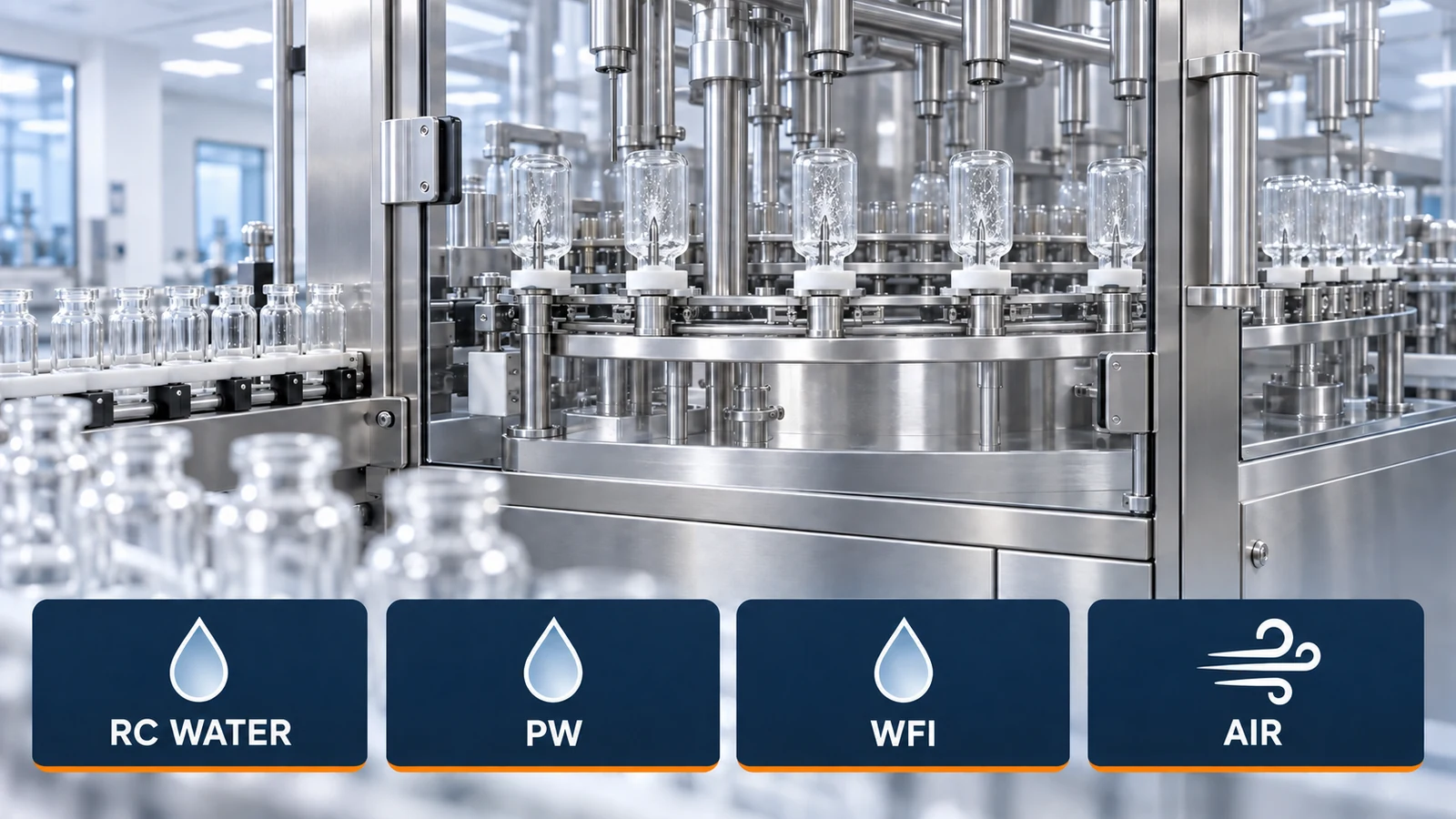
Three water stages. Air between each.
Published rotary-gripper internal vial wash sequence
- 01RC WaterInitial wash
- 02AirLiquid removal
- 03PWIntermediate rinse
- 04AirLiquid removal
- 05WFIFinal water rinse
- 06AirFinal blow-off
A vial washing machine prepares empty vials for the next stage of pharmaceutical production. Understanding the wash cycle helps engineering, production and quality teams specify what each station must achieve and how that performance will be checked.
Explore the H M Pharma Machines vial washing machine range alongside this guide. Here, we explain the role of each washing medium and the practical questions to resolve before approving a cycle.
RC Water, PW, WFI and Air: Quick Comparison
| Medium | Meaning | Role in the Cycle | Key Check |
|---|---|---|---|
| RC Water | Recirculated water | Initial washing using an approved recovery circuit | Source quality and reuse controls |
| PW | Purified Water | Intermediate rinsing before the WFI stage | Applicable water specification at use |
| WFI | Water for Injection | Final water rinse in the cycle described | WFI quality, including endotoxin control |
| Air | Compressed process air | Helps expel liquid between and after rinses | Quality, filtration and delivery conditions |
1. What Is RC Water in a Vial Washing Machine?
RC means recirculated water. It describes water collected and returned through a defined washing circuit for reuse. It is a description of the process stream, rather than a separate pharmacopoeial water grade.
During the initial wash, the water jet helps dislodge loose contamination and carry it out of the vial. An approved recirculation arrangement can reduce the fresh-water demand of this stage. The water entering that circuit and the conditions under which it may be reused still need to be specified.
For example, where a machine recovers water from a later rinse for an earlier wash, the recovered stream must be evaluated for its new duty. Water originally supplied as WFI should not automatically be described as WFI after use and recovery.
- Identify which water enters the recovery tank and which stations it supplies.
- Define filtration, tank cleaning and water-replacement requirements.
- Review drainage, overflow and any routes that could mix process streams.
- Establish acceptance criteria and responses when reuse conditions are exceeded.
2. Why Is Purified Water Used?
PW means Purified Water. In the cycle described here, it rinses the vial after the initial RC-water wash and before the final WFI rinse. Its flow helps carry away remaining loose material and replace water left from the earlier stage.
PW should meet the applicable pharmaceutical-water requirements for its intended use. The water-treatment method alone does not establish that quality: a supply described as RO water or demineralized water is not automatically qualified PW.
Water quality also requires appropriate microbial control. USP explains that users should establish fitness-for-use microbial specifications for their applications. See USP’s water-quality FAQs.
During process review, confirm that the delivered rinse reaches the intended vial surfaces. A correct utility connection cannot compensate for a blocked nozzle, incorrect vial position or inadequate delivered volume.
3. Why Is WFI Used for the Final Water Rinse?
WFI means Water for Injection. It is the specified pharmaceutical-water grade for the final rinse in this vial washing sequence. Its quality requirements include bacterial endotoxin control, which matters when preparing containers for injectable products.
The European Medicines Agency’s water-quality guideline identifies WFI as the minimum final-rinse quality for equipment, containers and closures used for sterile parenteral products, subject to the guideline’s stated scope and exceptions. See EMA guidance, Section 5.3 and Table 5.
The final rinse must deliver water of the required quality at the point of use. Its specification should therefore cover the complete route from the supply through any machine-side storage, piping and nozzles.
A WFI rinse is not a sterilization cycle and does not demonstrate complete endotoxin removal from a vial. Washing performance and any subsequent depyrogenation treatment require their own evidence.
4. What Does Air Do Between Water Washes?
Air stages help push retained liquid out of the vial. Between water stages, this reduces carryover into the next rinse. The last air stage provides a final blow-off before discharge.
Blow-off assists liquid removal; it should not be taken as proof of complete dryness. Any residual-moisture requirement must be defined and verified for the actual vial and downstream process.
Because this air contacts the inside of the container, its quality is part of the washing process. EU GMP Annex 1, Section 6.18 addresses chemical, particulate and microbial quality of gases contacting primary-container surfaces, including oil and water content. Section 6.19 specifies additional filtration controls for gases used in aseptic processes.
5. The Rotary Vial Washing Cycle, Step by Step
H M Pharma Machines lists the following six internal stages for its Rotary Gripper Vial Washing Machine:
- RC-water wash: Starts the internal washing process.
- Air stage: Helps clear water remaining after the first wash.
- PW wash: Provides the intermediate internal rinse.
- Air stage: Helps remove retained PW before the next stage.
- WFI wash: Applies the final internal water rinse.
- Final air stage: Helps remove residual rinse water before discharge.
The published rotary arrangement also includes two external stages: RC water followed by air. Internal and external washing should be identified separately when documenting the process.
6. How Does the Linear Washing Cycle Differ?
The linear tunnel vial washing machine offers ten configurable internal positions. H M Pharma Machines’ rotary-versus-linear comparison describes an arrangement of air, RC water, RC water, air, PW, air, PW, air, WFI and final air. The position assignment is confirmed against the approved process.
Additional positions allow a different distribution of washing and air stages. Station count alone does not demonstrate a better washing result. Compare what is delivered at each position, the time available and the performance obtained with the approved vial formats.
7. What Determines Whether the Wash Cycle Works?
A useful cycle specification connects every setting to a measurable result. These four areas provide a practical starting point for the engineering review:
Vial and Nozzle Position
Check neck clearance, spray access, container stability and drainage throughout the wash path.
Delivered Media
Define pressure, flow or delivered volume, and temperature where relevant, for each stage.
Time and Machine Speed
Confirm the effective application time at the intended operating speed and approved recipe.
Fault Detection
Specify how utility loss, low tank level, flow failure and interrupted cycles are detected and handled.
For example, a normal pressure reading upstream may not reveal one blocked washing needle. The qualification plan should explain how delivery across the washing positions will be assessed and what happens to potentially affected vials.
8. Washing, Sterilization and Depyrogenation
These operations have distinct objectives. Washing removes contamination from the container. Sterilization uses a validated process to achieve the required sterility assurance. Depyrogenation reduces or inactivates pyrogenic contamination to a validated acceptance level.
For a glass-vial line using a dry-heat tunnel, define the transfer from washer to tunnel as part of the overall process. Review container accumulation, permitted holding time and the response to a downstream stop.
The washing assessment should identify representative and worst-case vial formats, justified operating conditions, sampling methods and acceptance criteria. Depending on the application, this may include particle-removal performance, chemical residues, microbial quality and endotoxin-related assessments. The quality team should define the required evidence before trials begin.
9. Information to Share Before Requesting a Quotation
- Vial drawings or samples, including every planned format.
- Required output and the proposed internal and external wash sequence.
- Water and air specifications at the machine connection and point of use.
- Recovery arrangement, tank requirements and filtration scope.
- Required monitoring, alarms and handling of incomplete cycles.
- Downstream equipment details and the intended transfer arrangement.
- Acceptance criteria, trial requirements and qualification-document scope.
Frequently Asked Questions
1. What is the full form of RC Water?
RC means recirculated water. It identifies a water stream reused through an approved circuit; it is not a separate pharmacopoeial grade.
2. Are PW and demineralized water the same?
Not automatically. Demineralization describes a treatment process. PW must meet the applicable Purified Water specification and be suitable for its intended pharmaceutical use.
3. Can PW replace WFI in the final rinse?
A substitution must follow the product’s approved requirements and applicable standards. In the injectable-vial cycle described here, WFI is the specified final-rinse medium.
4. Why is air used after a water wash?
Air helps expel retained water and limit carryover between stages. The final air stage assists liquid removal before the vial leaves the washer.
5. Does WFI washing make a vial sterile?
No. A WFI rinse does not establish sterility. The required sterilization and depyrogenation processes are specified and validated separately.
6. Is one wash sequence suitable for every vial?
The approved sequence depends on the machine configuration, container and process requirements. Changes to vial format or operating conditions need an appropriate assessment.
Final Recommendation
Start with a defined purpose for every stage: initial washing with RC Water, intermediate rinsing with PW, final water rinsing with WFI and liquid removal with air. Then confirm the quality delivered, nozzle coverage, exposure time and acceptance criteria for the actual vials.
Documenting these requirements before machine selection makes the technical discussion more precise and gives the project team a clear basis for testing the proposed cycle.
Agree a Fault-Response Record for Each Media Duty
For the approved wash arrangement, ask what happens when a required media condition is unavailable or uncertain. Keep RC water, PW, WFI and air duties identifiable rather than treating all utility faults as the same event. Record the indication or response actually included in the offer, along with any additional monitoring requested by the buyer.
The record should describe the affected container group, expected machine response and responsibility for restart or product disposition. Use the supplier's approved trial method to review those cases; do not bypass protection or infer fault detection from a display label. Keep media availability evidence separate from the buyer's cleaning and process acceptance. A named utility and an uninterrupted cycle are useful observations, but they do not by themselves establish the required wash outcome.
- Media duty and agreed availability condition.
- Included indication, response and monitoring boundary.
- Affected trial group and approved recovery requirement.
- Process-assessment responsibility and open scope item.
Planning a Vial Washing System?
Send H M Pharma Machines your vial samples, target output, washing requirements and available utilities to discuss a suitable machine configuration.
Request a Technical Review View Vial Washing Machines