
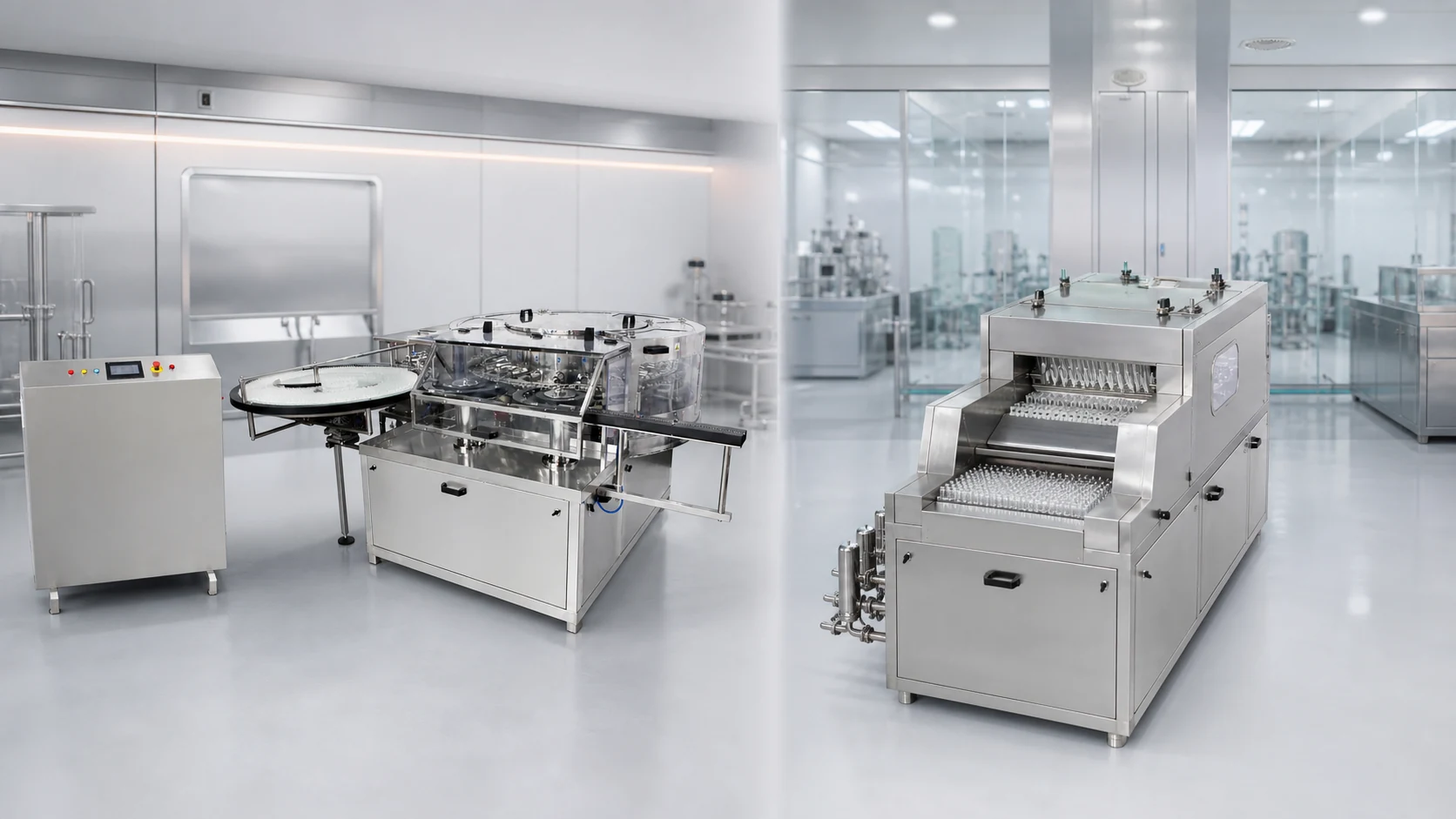
Vial washing is an important container-preparation step before sterile or controlled filling operations. The selected machine must handle each approved vial format consistently while applying the required recirculated water, Purified Water, Water for Injection and compressed-air stages.
H M Pharma Machines manufactures both rotary gripper vial washing machines and linear tunnel type vial washing machines. This guide explains where the platforms differ and what information is required for a responsible technical selection.
Rotary vs Linear Vial Washing Machine Comparison
| Selection Point | Rotary Gripper | Linear Tunnel |
|---|---|---|
| Approved container range | Glass vials, 2–100 mL | Glass vials, 2–100 mL |
| Available output models | 120, 150, 240 and 320 VPM | 120, 150, 180 and 240 VPM |
| Vial handling | Turntable, infeed star wheel and rotary grippers | Wire-woven infeed belt, mechanical cams and HDPE pockets |
| Internal washing | 6 defined stages | 10 configurable positions |
| Internal media | RC water, air, PW, air, WFI, air | Compressed air, RC water, PW and WFI in the approved ten-position sequence |
| External washing | 2 stages: RC water followed by air | Configured external wash provision according to the approved order |
| Process system | Separate process tanks for RC water, PW and WFI; final details per approved order | Three process tanks and pumps; final capacities, materials and ratings per approved order |
| Initial shortlist | Consider when rotary gripper handling and an available output up to 320 VPM match the project | Consider when pocket-based linear handling and the tunnel interface match the project |
How a Rotary Gripper Vial Washing Machine Works
The rotary platform first receives vials on a turntable. An infeed star wheel spaces and transfers them into the rotary gripper mechanism. Each gripper controls a vial while the internal and external washing stages are applied.
- Approved vials enter through the turntable and infeed star wheel.
- The rotary gripper system holds and carries each vial through the washing path.
- Six internal stages apply RC water, air, PW, air, WFI and final air.
- Two external stages apply RC water followed by air to the vial exterior.
- Washed vials leave through the approved discharge arrangement.
The HMRGVWM family is offered at 120, 150, 240 and 320 vials per minute. These are model ratings; sustainable production must still be confirmed using the approved vial range, process conditions and connected line.
How a Linear Tunnel Vial Washing Machine Works
The linear platform receives glass vials through a wire-woven infeed belt. Mechanical cams load the vials into HDPE pockets, which carry them through the internal washing positions. The outfeed arrangement then transfers washed vials toward the tunnel interface.
- A wire-woven belt brings approved vials to the loading system.
- Mechanical cams load vials into dedicated HDPE pockets.
- The pockets carry vials through ten internal washing positions.
- Compressed air, RC water, PW and WFI are applied in the approved sequence.
- Mechanical cams unload vials for transfer through the prism and pusher arrangement.
The HMLVWM family is available at 120, 150, 180 and 240 VPM. The ten internal positions can be configured based on the approved process and user requirement specification.
Vial Handling: Grippers vs Pockets
Handling method is the most visible mechanical difference between the two platforms. It influences vial-format change parts, vial transfer, machine arrangement and the way the washing path interfaces with adjacent equipment.
Rotary Grippers
Vials move through a turntable and star wheel before controlled gripper handling around the washing path.
Linear Pockets
Mechanical cams load vials into HDPE pockets that carry them through a straight-line washing arrangement.
Format Range
Both platforms cover approved 2–100 mL glass-vial configurations, subject to sample and change-part review.
Transfer Interface
The approved tunnel or filling-line connection must be reviewed with machine direction, transfer height and line speed.
Do not select only by nominal vial capacity. Two vials with the same stated volume may differ in height, diameter, neck finish, weight, glass quality and dimensional tolerance. Provide physical samples or dimensioned drawings for every required format.
Washing Sequence and Process Media
Both machine families can be engineered around recirculated water, Purified Water, Water for Injection and compressed air. The difference is how the stages are arranged.
Rotary Gripper: Six Internal and Two External Stages
The defined internal sequence is RC water, air, PW, air, WFI and air. The two external stages apply RC water followed by air. This provides a clearly defined sequence for the rotary platform.
Linear Tunnel: Ten Configurable Internal Positions
The standard described sequence uses compressed air, two RC-water positions, air, PW, air, a second PW position, air, WFI and final air. The exact arrangement is confirmed against the approved washing process and URS. External stages and media are finalized in the approved order.
Compare Output Without Ignoring Line Balance
Rotary models are available at 120, 150, 240 and 320 VPM. Linear models are available at 120, 150, 180 and 240 VPM. The correct model is not simply the fastest option.
Start from the required finished-vial output per shift, then review:
- The slowest machine in the connected washing, tunnel, filling, stoppering and capping line.
- Expected format changes, cleaning time and planned inspection stops.
- Vial accumulation and transfer between machines.
- The sustainable operating rate for the approved vial rather than only model nameplate output.
- Future capacity expansion and the available room layout.
A 320 VPM washer cannot improve finished-line output if the downstream equipment is designed for a substantially lower sustainable rate. Matching the complete line protects both capital investment and operating stability.
Utilities, Tunnel Interface and Documentation
Machine selection must include the process-water system, compressed-air supply and interface with adjacent equipment. Share the available pressure, temperature, flow and quality requirements defined by the project team.
During technical review, confirm:
- RC-water, PW, WFI and compressed-air connections.
- Tank, pump, filtration and process-piping scope.
- Utility-pressure and tank-level monitoring required by the control specification.
- Machine direction, conveyor height and sterilizing-tunnel interface.
- Start, stop, fault and line-control signals between connected machines.
- Room access for operation, cleaning, maintenance and changeover.
- Required DQ, IQ, OQ, FAT, SAT, manuals, certificates, wiring diagrams and layout documents.
The exact monitoring, interlocks, piping, filtration and documentation package should be written into the approved order. Do not assume that an optional project requirement is part of the standard machine scope.
Which Vial Washing Machine Should You Choose?
| Project Requirement | Initial Platform to Evaluate | Reason for Review |
|---|---|---|
| Required model output up to 320 VPM | Rotary gripper | The rotary family includes a listed 320 VPM model |
| Required model output of 180 VPM | Linear tunnel | The linear family includes a listed 180 VPM model |
| Defined six-stage internal and two-stage external sequence | Rotary gripper | The rotary platform has this stated stage arrangement |
| Ten-position configurable internal wash sequence | Linear tunnel | The linear platform provides ten internal positions |
| Existing tunnel or room-layout constraint | Review both | Transfer interface and footprint must be checked against the actual layout |
| Multiple vial formats from 2–100 mL | Review both | Both cover the stated range, subject to sample, drawing and change-part confirmation |
This matrix is an initial shortlist, not a final machine recommendation. The selected model must be confirmed against the complete user requirement specification and approved samples.
Common Selection Mistakes to Avoid
Choosing Only by Maximum VPM
Output must match the complete line. A faster washer can create transfer or accumulation problems if the tunnel and filler are not balanced.
Comparing Only the Number of Wash Positions
More positions do not automatically make a platform better. The approved media sequence, contact time, utility conditions and process requirements are more important than the number alone. Use the RC water, PW, WFI and air wash-cycle guide to review what each medium does.
Sending Only One Vial Sample
Provide every vial format planned for production. The minimum and maximum sizes are important, but intermediate formats may also require specific change parts or adjustments.
Ignoring the Downstream Interface
The machine must transfer washed vials reliably to the approved tunnel or next line stage. Confirm height, direction, speed, controls and available space before ordering.
Leaving Documentation Until the End
Qualification and project documents should be defined before order approval. Late additions can affect engineering scope, testing and delivery planning.
Information to Share for Technical Selection
- Every vial capacity and dimensioned drawing.
- Representative physical vial samples.
- Required sustainable output in VPM.
- Approved internal and external wash sequence.
- RC-water, PW, WFI and compressed-air specifications.
- Required tank, pump, piping and filtration scope.
- Existing or proposed sterilizing-tunnel details.
- Downstream filling-line capacity and interface.
- Room layout, operating direction and available floor space.
- Required alarms, interlocks and line-control signals.
- Changeover expectations and number of formats.
- Required qualification, FAT, SAT and technical documents.
- Installation location and commissioning scope.
Complete project information allows the manufacturer to compare both platforms responsibly and recommend a machine configuration that fits the actual production process.
Frequently Asked Questions
1. What is the main difference between rotary gripper and linear tunnel vial washing machines?
The rotary platform transfers vials from a turntable through an infeed star wheel into rotary grippers. The linear platform uses a wire-woven belt, mechanical cams and HDPE pockets to move vials through a linear washing path.
2. Which vial washing machine offers the higher available output?
The H M Pharma Machines rotary gripper range includes 120, 150, 240 and 320 VPM models. The linear tunnel range includes 120, 150, 180 and 240 VPM models. Final sustainable output is confirmed for the approved vial and process.
3. Can both machines handle 2–100 mL vials?
Both machine families are offered for approved glass-vial configurations from 2–100 mL. Final suitability and the required change parts are confirmed from vial samples or drawings.
4. How do the internal washing sequences differ?
The rotary platform has six defined internal stages using RC water, air, PW, air, WFI and air. The linear platform provides ten configurable internal positions using compressed air, RC water, PW and WFI according to the approved process.
5. Which machine is better for integration with a sterilizing tunnel?
The correct platform depends on the approved vial format, target output, wash process, transfer height, tunnel interface and room layout. The complete line arrangement should be reviewed before selection.
6. What information is required to select a vial washing machine?
Share every vial size, samples or drawings, required VPM, washing sequence, utility details, room layout, tunnel interface, downstream filling-line capacity and documentation requirement.
Final Recommendation
Choose the rotary gripper platform when its gripper-based handling, defined six-plus-two washing arrangement and available outputs—including the 320 VPM model—match the approved project. Choose the linear tunnel platform when its belt, cam and pocket handling, ten-position internal sequence and available 120–240 VPM models match the line.
For either platform, final selection should follow a review of vial samples, URS, required wash process, utilities, room layout and connected equipment. The best machine is the one that delivers stable handling and the approved washing result within the complete production line.
Need Help Comparing Vial Washing Machines?
Share your vial samples or drawings, required VPM, washing sequence, utility details and tunnel interface. Our team can review both platforms and recommend a suitable configuration.
Request a Technical Review Compare Product Models