
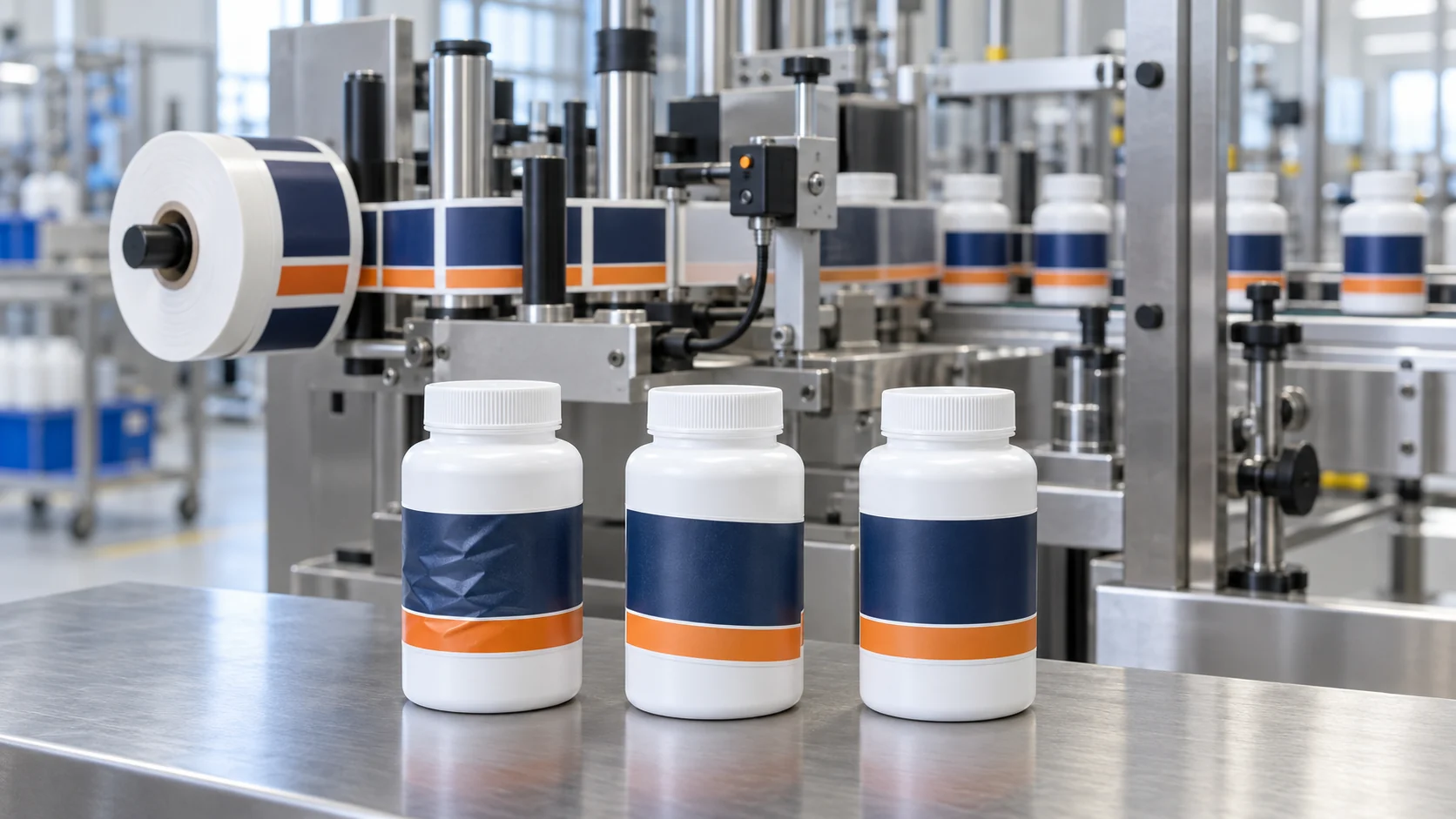
This guide covers self-adhesive bottle labeling, including wrap-around and front-and-back applications. Use it to organize troubleshooting on an existing line. For choosing a machine or a different container format, see our bottle labeling machine selection guide.
Begin with a short fault record: machine and recipe, bottle batch, label-roll identification, operating speed, time of failure and the last change. Keep acceptable and rejected bottles together. A photograph of the finished defect helps; a safely recorded view of the application sequence may show when it develops.
Observe only from an approved position with guards in place. Before reaching into the machine, cleaning, clearing a jam or adjusting hardware, stop and isolate hazardous energy under the equipment manual and site procedure. Guard removal, electrical work and internal repairs belong to trained, authorized technicians. Never bypass an interlock to continue a trial.
Quick Symptom Check
| Symptom | First question | Keep for review |
|---|---|---|
| Wrinkles or folds | Where does the crease begin? | Photo of the crease and bottle profile |
| Skewed or spiraling label | Is the error similar on every bottle? | Samples showing both label edges |
| Bubbles | Are they immediate or delayed? | Samples at exit and after holding |
| Lifting edges | Does lifting begin before downstream handling? | Label batch and storage conditions |
| Missing or double labels | What happened to the bottle trigger and label feed? | Alarm record and affected roll section |
| Position changes during a run | Is it a fixed offset or progressive movement? | Samples in production order |
| Sensor fault | Which device reports the problem? | Sensor model and exact indication |
1. Wrinkles or Folds During Application
Likely causes: Bottle taper, unstable movement, an unsuitable label shape or a mismatch between dispensing and application can fold the label. Excessive contact pressure may also worsen the result.
First safe check: Examine a rejected bottle away from the line. Mark the first crease and compare its location across several samples. During an approved guarded trial, establish whether that crease appears at initial contact or during wrapping. Treat this as evidence for the technician, not a reason to reach into the application zone.
Prevention: Keep a reference sample for each approved bottle-and-label combination. When a different bottle arrives, compare its profile with that sample before reusing the old setup. Follow the machine-specific adjustment procedure; increasing pressure is not a general remedy. Quadrel describes these interacting application causes.
2. Crooked, Skewed or Spiraling Labels
Likely causes: A tapered container or incorrectly loaded label roll can contribute to crooked application. Setup must suit the actual bottle geometry, not just its nominal capacity.
First safe check: Put several rejected bottles upright on a suitable inspection surface. Compare the label's top edge with the agreed reference and note whether the angle repeats. After isolation, have the authorized operator verify roll loading and container positioning against the machine manual. Do not borrow roller positions or adjustment dimensions from another manufacturer's machine.
Prevention: Include a front view, rear view and bottle profile in the format record. Approve the result against a marked sample after each changeover. Primera's applicator manual illustrates why taper and roll setup matter; its adjustment instructions apply to its own models.
3. Bubbles Beneath an Otherwise Smooth Label
Likely causes: Trapped air, surface contamination or incomplete adhesive contact can leave raised areas. A bubble does not necessarily indicate a label-sensor fault.
First safe check: Record whether bubbles are visible immediately at the outlet or develop later. Compare a production bottle with a representative clean, dry sample prepared using the approved method. Keep the same label batch for this comparison. Ask the label supplier to assess the bottle surface and application conditions if the result remains uncertain.
Prevention: Define where and when appearance is checked, including the relevant holding period. A good-looking bottle at the applicator outlet may not represent the result after storage. Do not introduce a new solvent, heating method or manual rework process without checking material compatibility and the site's quality procedure.
4. Label Edges Lift After Application
Likely causes: Adhesive incompatibility, surface residue, label age or unsuitable storage can reduce adhesion. Lifting around a cylindrical pack is often called flagging. Avery's adhesion guidance explains these material-related possibilities.
First safe check: Retain bottles before and after downstream handling. Record which edge lifts and when. Check the label-roll identity and storage history with the packaging team. Compare the current bottle and label batches with the last accepted combination before assuming the applicator requires a mechanical change.
Prevention: Obtain label-supplier guidance for the actual container material and intended conditions. Agree the inspection time and acceptance standard. Do not assume that more pressure or an overlapping label will suit every application; packaging design and adhesive suitability need their own review.
5. Missing Labels or Two Labels Dispensed Together
Likely causes: Unreliable bottle detection, inconsistent spacing, a missed label gap or a roll defect may interrupt the intended sequence. Two labels feeding together and two separately triggered applications are different observations.
First safe check: Use the permitted diagnostic display to establish whether the bottle was detected and a dispense command occurred. Record what the web then did. If two labels left together, retain that section of liner for examination after isolation. Compare the selected recipe and actual roll with the approved job record.
Prevention: Include label count and stop-start behavior in the changeover trial. Check any configured inspection and rejection functions according to the agreed test procedure. Keep affected output segregated under the site's procedure while the cause is unresolved. For broader context, see Quadrel's missed-label and double-feed guidance.
6. Label Position Moves During Production
Likely causes: Web movement, changing container presentation or a shifting reference can produce a changing placement error. A constant offset from the first bottle should be recorded separately from progressive drift.
First safe check: Place retained samples in production order and measure from the same agreed bottle reference. Note the time, roll change and restart beside each sample. Ask the technician to compare these observations with the machine's available records. Repeatedly changing an offset without keeping the earlier measurements makes the investigation harder.
Prevention: Save the accepted recipe and physical setup record together. If a correction works only briefly, escalate with the sample sequence instead of treating each recurrence as a new setup job. After a confirmed repair, repeat the conditions associated with the fault before releasing the line.
7. Sensor Alarms or Unreliable Label Detection
Likely causes: Material incompatibility, moisture, web flutter or a jam in a sensing slot can affect some label sensors. Teaching, reset and indicator behavior vary by model; there is no universal calibration sequence.
First safe check: Identify whether the fault belongs to the bottle detector or the label sensor. Record its exact part number and indication before a reset. Follow its manual for cleaning and setup after isolation. During the authorized test, confirm the expected indication using the actual label and liner.
Prevention: Review material changes against the installed sensor's documented limits. For example, Banner's SLC1 datasheet describes a self-teaching sensor but excludes certain metallic constructions. A sensor's ability to detect clear labels does not establish that it detects every roll, or that the separate bottle detector suits transparent containers.
Record a Repeatable Setup
Use a short record that the next operator can follow. It should capture the accepted result as well as the settings:
- Machine identification, selected recipe and authorized setup revision.
- Bottle and label-roll references, including approved artwork and winding direction.
- Marked label position and agreed appearance criteria.
- Installed format parts and a photograph of the approved setup.
- Sensor model, relevant setup procedure and confirmed response.
- Trial conditions, sample results, open issues and release decision.
Change one authorized setting at a time and record the outcome. Keep unsuccessful adjustments in the fault record so another shift does not repeat them. When the container format itself has changed, review the machine change parts as well as the recipe.
Frequently Asked Questions
Should we slow the machine whenever labels wrinkle?
A controlled speed trial may help identify when a defect appears, but it does not prove the cause. Record the result and confirm the accepted operating conditions after the underlying issue is addressed.
Do clear labels always need an ultrasonic sensor?
No universal choice applies. Sensor suitability depends on its specified detection method and the actual label-and-liner construction. Check the installed model's documentation and test representative material before selecting a replacement.
Why can a new roll cause problems without a settings change?
Compare the new roll with the approved reference and retain its identification. Differences in construction or a loading problem require different responses. Start with that comparison rather than assuming the existing recipe has become incorrect.
What should we send when requesting support?
Send the machine model, defect photographs, bottle and label details, roll reference, exact alarm and a description of when the issue started. Include a safely recorded video and the results of authorized checks where available.
Discuss Your Bottle Labeling Requirement
Share your bottle samples, label-roll details and observed problem with H M Pharma Machines in Ahmedabad. Our team can review the application and discuss the relevant machine configuration or support requirement.
Request a Technical ReviewExplore Labeling Machines