☎ +91 97379 73334 ✉ info@hmpharmamachines.com
Pharmaceutical Bottle Washing Guide

Complete Guide to Bottle Washing Machines for Pharmaceutical Manufacturing (2026)

Learn how pharmaceutical bottle washers work, compare linear and rotary machines, understand GMP and utility requirements, and use a practical checklist to select the right system.

Quick answer A pharmaceutical bottle washing machine is a controlled cleaning system that removes visible and sub-visible particles, dust, glass fragments, residues and other contaminants before filling. Depending on the application, it uses a validated sequence of recirculated water, purified or demineralized water, Water for Injection and filtered compressed air to clean internal and external container surfaces.

For pharmaceutical manufacturers, choosing a bottle washer is not simply a question of bottles per minute. The machine must deliver repeatable cleaning, protect fragile containers, integrate with upstream and downstream equipment, and support the qualification and routine records required by the site quality system.

This guide explains the working principle, machine types, utility requirements, GMP considerations, validation lifecycle and purchasing criteria for bottle, vial and ampoule washing systems. It also links to the relevant washing-machine models offered by H M Pharma Machines in Ahmedabad, India.

Important distinction: Washing reduces contamination and prepares a container for the next process. It does not automatically make the container sterile or pyrogen-free. Sterilization or depyrogenation requires a separately defined and validated process unless the approved process specifically demonstrates the required result.

Why Bottle Washing Is Critical in Pharmaceutical Manufacturing

Primary packaging comes into direct contact with the medicine. A contaminant left inside a bottle or vial may affect product quality, patient safety, filling performance and batch acceptance. Container preparation is therefore part of the pharmaceutical quality system—not merely a packaging housekeeping step.

Common risks include:

  • Dust and fibres introduced during transport or storage.
  • Glass particles generated during container manufacture or handling.
  • Microorganisms and endotoxin burden.
  • Oils, salts or processing residues.
  • Detergent or rinse-water residue.
  • Cross-contamination from an incorrectly designed recirculation loop.
  • Water droplets retained after the final wash.
  • Chipped, cracked or incorrectly oriented containers entering the filling line.

In the United States, 21 CFR 211.94 requires drug-product containers and closures to be clean and, where indicated, sterilized and processed to remove pyrogenic properties. It also requires written procedures for the applicable cleaning, sterilization and depyrogenation methods.

For sterile manufacturing, the FDA aseptic-processing guidance states that glass-container preparation normally includes multiple wash and rinse cycles and recommends WFI-specification water for the final rinse of parenteral containers.

What Is a Pharmaceutical Bottle Washing Machine?

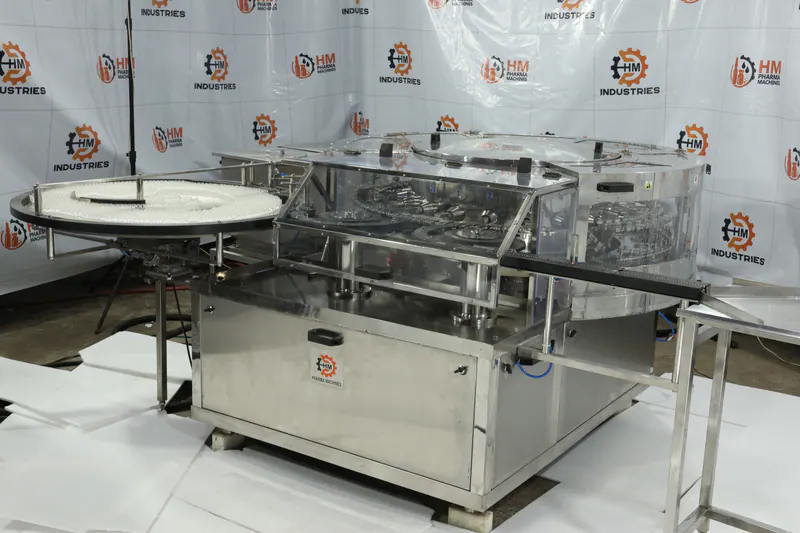
A pharmaceutical bottle washer is a manual, semi-automatic or automatic machine engineered to expose each container to a defined cleaning sequence. Depending on the design, containers may be indexed through a straight-line system, held in pockets, or gripped by the neck and inverted on a rotary carousel.

01

Oral Liquids

Syrup, suspension, tonic, nutraceutical and Ayurvedic bottles.

02

Sterile Containers

Injectable vials, ampoules, cartridges and infusion containers.

03

Speciality Products

Eye-drop, nasal-product and compatible diagnostic containers.

04

Allied Industries

Selected cosmetic, food, beverage and chemical containers.

The word “bottle” is often used broadly in machinery searches. However, an oral-liquid bottle washer and a sterile vial washer can have different requirements. The correct design depends on the container, dosage form, cleanliness target, water strategy and process that follows washing.

How Does a Pharmaceutical Bottle Washing Machine Work?

The exact sequence is product- and machine-specific, but an automatic washing system commonly follows these stages:

  1. Bottle feeding: Containers arrive from a turntable, unscrambler or conveyor. A feed screw, guide rail or star wheel spaces them correctly while sensors detect low supply, jams or incorrect positioning.
  2. Container positioning: The machine places each bottle in a pocket or grips it by the neck. Containers are normally inverted with the opening facing the internal wash nozzles.
  3. Pre-rinse: A first rinse removes loose dust and larger particles. The selected water grade must match the approved process and intended container use.
  4. Internal and external washing: Dedicated nozzles direct controlled jets into the container and over its external surface. Pressure, flow, temperature, spray time and nozzle position may be critical parameters.
  5. Intermediate rinse or recirculated wash: Some systems use a validated cascade or recirculation arrangement to reduce water consumption. The design must prevent a dirtier stage from contaminating a cleaner downstream stage.
  6. Final rinse: The final rinse uses the water grade defined in the process specification. For parenteral containers, FDA guidance recommends WFI-specification final-rinse water.
  7. Filtered-air blow: Oil-free, suitably filtered compressed air may be pulsed inside and outside the container to remove droplets and loose residual matter.
  8. Drainage and discharge: The machine allows the container to drain, returns it upright and transfers it to the filling machine, clean conveyor, sterilizer or depyrogenation tunnel.
Process-development point: More wash stations do not automatically mean better cleaning. Performance must be demonstrated through development studies and qualification at defined operating ranges.

Types of Pharmaceutical Bottle Washing Machines

Comparison of pharmaceutical bottle washing machine types
Machine type Best suited for Main advantages Points to evaluate
Semi-automatic rotary washer Small batches, laboratories and lower-volume oral liquids Lower investment, simple operation and compact footprint Operator dependence, manual handling, output and record capability
Automatic linear bottle washer Oral liquids, syrups and medium-to-high-volume round bottles Straight-line integration, accessible format parts and multiple stations Floor length, indexing stability, bottle shapes and change parts
Rotary gripper bottle washer Controlled automatic washing and higher-output bottle lines Secure neck handling, reliable inversion and compact rotary layout Gripper range, bottle tolerances, utility control and changeover
Rotary gripper vial washer Parenteral vial lines and integration with a depyrogenation process Controlled inversion, minimal body contact and continuous handling Water grade, sterile interface, hold time and tunnel synchronization
Air-jet bottle cleaning machine Dry containers or applications where added moisture is undesirable No process-water addition and easier downstream drying Not a substitute for a validated water wash where adhered contamination is a risk
Automatic inverting bottle washer Compatible bottle formats requiring a focused water-and-air sequence Simple automatic inversion and line integration Required cleaning result, format range and wash-stage suitability

Linear vs Rotary Bottle Washing Machine

Choose a linear washer when the application involves oral-liquid bottles, straight-line integration and accessible format changes. Choose a rotary gripper washer when secure inversion, a compact high-output layout and controlled movement through several wash stations are priorities.

The decision should be based on demonstrated performance at the minimum and maximum container sizes—not on a generic claim that one machine type is always better. Use the bottle washing machine comparison page to review the available H M Pharma Machines configurations.

Bottle Washing Machine vs Vial Washing Machine

A bottle washing machine commonly handles larger containers used for syrups, suspensions and other oral liquids. A vial washing machine typically processes smaller glass containers for injectable or lyophilized products and may discharge directly into a depyrogenation tunnel.

Compared with a general bottle washer, a sterile vial washer usually requires tighter control over final-rinse water, filtered-air quality, particle and endotoxin reduction, clean-area interfaces, hold time, recipe security and tunnel synchronization.

Cleaning, Sterilization and Depyrogenation Are Different

Difference between washing, sterilization and depyrogenation
Process Primary purpose Typical method
Washing or cleaning Removes particulate matter, residues and a portion of microbial or endotoxin load Water jets, filtered air, justified detergents, ultrasonic action or a validated combination
Sterilization Destroys or removes viable microorganisms to achieve a defined sterility assurance objective Moist heat, dry heat, radiation, gas or another validated compatible method
Depyrogenation Removes or inactivates pyrogenic material, particularly bacterial endotoxins Validated dry heat or, for suitable applications, validated rinsing or physical removal

For sterile products, the washer is one part of a broader contamination-control strategy. EU GMP Annex 1 emphasizes a facility-wide contamination control strategy rather than reliance on one terminal step or finished-product test.

Water and Compressed-Air Requirements

Utilities are part of the process. A well-built machine cannot compensate for unsuitable water or compressed air.

Recirculated Water

Recirculated water may be used in an earlier wash stage where the approved process permits it. Tanks, filters, pumps, return lines and drains should be designed for access, cleaning, sanitization and controlled separation from cleaner downstream stages.

Purified or Demineralized Water

Purified Water or Demineralized Water may be used in one or more stages when supported by the process. Chemical and microbiological quality, temperature, flow, storage and distribution conditions must remain controlled.

Water for Injection

WFI is commonly specified for the final rinse of parenteral containers. WHO guidance on water for pharmaceutical use explains that the water grade should reflect the product, process stage and intended use.

WFI should not be added to a specification as a marketing label. The entire supply path—from distribution loop to point of use, spray and drainage—must support the required water quality.

Compressed Air

Compressed air that contacts the internal container surface should be oil-free and suitably filtered. Define and qualify relevant attributes such as particles, viable microorganisms where applicable, oil, moisture, pressure, flow, filter integrity and point-of-use monitoring.

Main Components of an Automatic Bottle Washing Machine

  • Infeed conveyor, turntable or unscrambler.
  • Bottle-spacing screw or timing mechanism.
  • Star wheels, pockets, grippers or carrier baskets.
  • Internal and external spray nozzles.
  • Separate manifolds for different water grades.
  • Recirculation tanks and sanitary pumps, where applicable.
  • Water and compressed-air filters.
  • Stainless-steel wash chamber and drain pan.
  • PLC, HMI and variable-speed or servo controls.
  • Pressure, flow, temperature and level instruments.
  • Safety guards, interlocks, jam detection and bottle counting.
  • Discharge conveyor or tunnel interface.
Ask an important controls question: Which process values are merely displayed, and which values are measured, alarmed, recorded and protected against unauthorized change? The answer affects both operation and qualification.

GMP and Regulatory Considerations

There is no universal certificate that makes a bottle washer “GMP compliant” on its own. Compliance depends on equipment design, installation, procedures, utilities, qualification, validation, maintenance and actual use.

United States: 21 CFR Parts 210 and 211

  • 21 CFR 211.67: equipment cleaning and maintenance at appropriate intervals, with written procedures and records.
  • 21 CFR 211.68: controls for automatic, mechanical and electronic equipment.
  • 21 CFR 211.94: containers and closures must be clean and, when required, sterilized and depyrogenated using written procedures.
  • 21 CFR 211.100: written production and process-control procedures, including deviation handling.

If electronic records or signatures are used to meet regulatory requirements, assess the system against its intended use and the applicable requirements of 21 CFR Part 11.

EU GMP Annex 1

For sterile products, include the washer and its interfaces in the site contamination control strategy. Consider transfer paths, cleanroom classification, utility quality, interventions, equipment cleaning, hold times, airflow protection and integration with sterilization or depyrogenation.

WHO GMP and Pharmaceutical Water

WHO guidance supports risk-based selection of water quality and lifecycle control of pharmaceutical water generation, storage and distribution. This is especially important where the washer uses several water grades or recirculation stages.

Data Integrity

Where the washer creates electronic GMP records, the control strategy should address unique user access, role-based permissions, recipe version control, audit trails, date and time synchronization, alarm history, data backup, secure export and review of critical parameter changes.

Do not specify “21 CFR Part 11 compliant” as one checkbox. Define the actual records, workflows and controls that the machine must support.

Qualification and Validation Roadmap

1. User Requirements Specification

Define intended use, container formats, throughput, wash sequence, utilities, critical parameters, data requirements, alarms, line interfaces, materials, changeover targets and documentation deliverables before requesting quotations.

2. Design Qualification and Risk Assessment

Confirm that the proposed design can meet the URS. Review contamination risks, dead legs, drainability, cross-connections, recirculation, nozzle alignment, bottle-contact parts, cleanability, software functions and failure modes.

3. Factory Acceptance Test

At the supplier’s facility, test mechanical operation, format handling, recipes, alarms, safety systems, instruments, documentation and preliminary wash performance. Use representative containers, including dimensional extremes where possible.

4. Site Acceptance Test

After installation, verify the machine with actual site utilities and line interfaces. Check transport, filler or tunnel communication, drainage, room conditions and utility stability.

5. Installation Qualification

Document installation against approved drawings and specifications. Verify components, materials, instruments, utilities, software versions, calibration, manuals, spare parts and certificates.

6. Operational Qualification

Challenge operating ranges, alarms, interlocks, recipes, access controls, critical instruments and failure conditions. Establish acceptable ranges for parameters such as wash pressure, flow, temperature, time and line speed.

7. Performance Qualification

Demonstrate repeatable performance using approved container formats and routine conditions. Include worst-case selections justified by bottle size, geometry, line speed, contamination challenge and wash recipe.

8. Continued Verification

Trend alarms, deviations, rejects, utility data, filter changes, maintenance, calibration and cleaning-performance results. Requalification should be triggered by defined changes or adverse trends—not performed as a paperwork exercise.

What Should Be Tested?

  • Challenge-particle removal and visible or sub-visible particulate assessment.
  • Bioburden reduction and, where relevant, bacterial endotoxin reduction.
  • Residual detergent when detergent is part of the approved process.
  • Conductivity, total organic carbon or other rinse attributes.
  • Internal and external spray coverage.
  • Residual water, drainage and compressed-air quality.
  • Nozzle pressure, flow, alignment and filter integrity.
  • Container breakage, chipping and cosmetic defects.
  • Handling at minimum and maximum speeds.
  • Worst-case container size and geometry.
  • Hold time before filling, sterilization or depyrogenation.
  • Alarm, interlock, electronic record and audit-trail functions.

Acceptance criteria should be approved before testing and linked to product and process risk. “Visually clean” may be one observation, but it is rarely a complete validation strategy for a critical pharmaceutical application.

How to Select the Right Bottle Washing Machine

1. Define Every Container Format

Document material, volume, height, diameter, neck finish, mouth diameter, weight, shape and dimensional tolerance. Include the smallest, largest and most difficult format—not only the most common bottle.

2. Calculate Sustainable Throughput

Match the washer to the sustainable output of the complete line. Consider micro-stops, format changes, cleaning, maintenance and upstream or downstream constraints. Nameplate speed alone can create a false capacity expectation.

3. Specify the Required Cleaning Outcome

Define whether the objective is dust removal for oral-liquid bottles, particle reduction before filling or preparation of parenteral vials before depyrogenation. The target determines the wash sequence, utility grade, testing and design.

4. Confirm Available Utilities

Confirm pressure, flow, temperature and consumption for each water grade and compressed air. Also check electrical load, drainage, heat release, ventilation and available water-system capacity.

5. Demonstrate Changeover

Ask the supplier to demonstrate a complete format change. Evaluate the number and weight of change parts, tool-free adjustments, recipe verification, line-clearance access, risk of incorrect assembly and storage of removed parts.

6. Review Cleanability and Maintenance Access

Look for smooth accessible surfaces, sloped drain paths, minimal liquid retention, hygienic piping, identifiable flow paths and safe access to nozzles, tanks, filters, grippers and sensors.

7. Define Data and Integration Needs

Decide whether batch reports need bottle counts, recipe, operator, time, critical process values, alarms and audit-trail events. Verify conveyor height, accumulation, reject logic, emergency-stop circuits and communication handshakes with the filling machine and downstream equipment.

8. Confirm Documentation and Support

The supplier package may need general arrangement and utility drawings, P&ID, electrical drawings, functional and software specifications, material and surface-finish certificates, calibration certificates, manuals, FAT/SAT documents, qualification support, software backup procedures, training and spare-parts recommendations.

Planning a complete line? Review washer capacity together with the bottle filling machine, capping machine, labeling machine and conveyors. Stable line balance matters more than the maximum speed of one machine.

Practical Bottle Washer URS Checklist

  • Dosage form and intended regulatory markets.
  • Container type, material and full size range.
  • Required output and complete-line efficiency target.
  • Internal and external washing requirements.
  • Proposed wash sequence and water grades.
  • Fresh-water versus recirculated stages.
  • Compressed-air quality and point-of-use filtration.
  • Critical parameter ranges, alarms and records.
  • Construction materials and surface finishes.
  • Drainage and cleanability expectations.
  • Environmental and cleanroom interfaces.
  • PLC, HMI, preferred components and recipe controls.
  • Access levels, audit trail and report requirements.
  • Format-change time and change-part storage.
  • Upstream and downstream equipment interfaces.
  • FAT, SAT, IQ/OQ support and validation tests.
  • Spare parts, operator training and after-sales service.
  • Water, compressed-air and energy-consumption targets.

Common Bottle Washing Machine Buying Mistakes

Selecting Only by Purchase Price

A lower initial price can be offset by excessive water use, long changeovers, frequent bottle breakage, proprietary spare parts or weak service support.

Using Maximum Speed as the Main Decision

The best washer repeatedly delivers acceptable containers at the required line output. A fast machine that creates jams or unstable cleaning is not high performance.

Treating WFI as Proof of Cleaning

The use of WFI does not validate the cleaning result. Nozzle position, flow, time, pressure, drainage, container geometry and the complete process sequence still matter.

Ignoring Worst-Case Formats

A recipe that works on a wide-mouth bottle may not clean a narrow-neck or unusually shaped container. Worst-case rationale should be part of design review and validation.

Accepting “GMP Compliant” Without Evidence

Ask the supplier to demonstrate how specific design features and documents meet the URS. Marketing terminology cannot replace qualification evidence.

Overlooking Line Stoppages

Define what happens to containers inside the washer and between the washer and next machine during a stop. Time limits and recovery procedures may be critical, particularly in sterile processing.

Maintenance and Routine Control

A risk-based preventive-maintenance programme should cover:

  • Inspection and cleaning of spray nozzles.
  • Replacement or integrity testing of filters.
  • Pump seals, valves and sanitary connections.
  • Grippers, pockets, star wheels and guides.
  • Tank condition and drain performance.
  • Pressure, flow, temperature and level instruments.
  • Compressed-air traps and point-of-use filters.
  • Safety guards and interlocks.
  • PLC and HMI backups and time synchronization.
  • Lubrication controls that prevent contamination.

Operators should check for unusual noise, unstable pressure, misaligned bottles, damaged containers, clogged nozzles, slow drainage and abnormal water consumption. Small changes can become product-quality risks if they are not investigated.

Reducing Water and Energy Use

Sustainable strategies may include a validated counter-current rinse, reuse of cleaner downstream rinse water in an earlier stage, automatic flow shutoff during approved idle states, recipe-specific flow and spray time, low-hold-up piping and consumption monitoring by batch or operating hour.

Any reuse strategy must preserve separation between water grades and prevent backflow or cross-contamination. Savings should be verified against cleaning performance, microbial control and water-system capacity.

Bottle Washing Machine Cost and Total Cost of Ownership

There is no reliable one-price answer because cost changes with output, container range, wash stations, automation, water systems, sterile interfaces, electronic records, documentation and validation support.

Total cost of ownership:
Purchase and integration + utilities + change parts + validation + labour + maintenance + spares + downtime − recoverable productivity and resource savings.

Request a utility-consumption sheet at the proposed operating speed. A machine that uses less high-purity water, changes format faster and has responsive local service may have a lower five-year cost even when its initial price is higher.

The most useful developments improve control and lifecycle performance rather than adding automation for its own sake:

  • Recipe-driven wash sequences with protected operating ranges.
  • Electronic batch summaries and stronger audit-trail review.
  • Monitoring of water pressure, flow, temperature and consumption.
  • Servo-controlled handling for repeatable format changeover.
  • Condition-based maintenance using load, vibration or cycle data.
  • Camera-assisted detection of jams, damage or incorrect setup.
  • Lower-water cycles developed through risk-based testing.
  • Tighter communication among washer, depyrogenation tunnel, filler and site data systems.

In 2026, a smart machine should not merely generate more data. It should make deviations easier to detect, investigate and prevent.

Frequently Asked Questions

What is a pharmaceutical bottle washing machine?

It is a controlled machine used to remove particles, dust, residues and other contaminants from the internal and external surfaces of pharmaceutical containers before filling or further processing.

How does an automatic bottle washing machine work?

It feeds, spaces, grips or pockets the bottles, inverts them, applies a defined sequence of water and filtered-air jets, drains them, returns them upright and transfers them to the next line operation.

What is the difference between a linear and rotary bottle washer?

A linear washer transports containers through straight-line indexed stations. A rotary washer moves containers around a carousel. The right design depends on container formats, output, process and line layout.

Is WFI always required for bottle washing?

No. The water grade depends on the product, container, process stage and regulatory strategy. For parenteral containers, FDA guidance recommends WFI-specification water for the final rinse.

Does bottle washing sterilize containers?

Not by default. Washing reduces contamination. Sterilization requires a separately defined and validated process unless the validated washer process is specifically intended and demonstrated to achieve the required result.

Can a bottle washer remove endotoxins?

Rinsing can reduce endotoxin load when properly developed and validated, but a generic wash cycle should not be described as depyrogenation. Heat-stable glass containers for sterile products commonly proceed to a validated dry-heat depyrogenation tunnel.

Can one machine wash glass and plastic bottles?

Some machines can, but every material and format must be assessed. Plastic containers may deform, scratch or retain static and water differently, so pressure, temperature, handling and drainage require validation.

What capacity should I choose?

Choose a sustainable output that matches the filler and complete line, allowing for changeovers, cleaning, maintenance and short stops. Do not decide only from the advertised maximum speed.

What documents should a bottle washer supplier provide?

Typical documents include approved drawings, P&ID, electrical drawings, material and calibration certificates, functional specifications, manuals, spare-parts lists, software backup procedures and FAT, SAT or qualification support.

How often should a bottle washing machine be revalidated?

Use a documented risk-based schedule and defined triggers. Significant format, recipe, software, utility, component or process changes, adverse trends and major repairs should be assessed for requalification or revalidation.

Conclusion

The right pharmaceutical bottle washing machine is the one that consistently achieves the defined cleanliness result, handles every approved container safely, fits the complete production line and provides defendable qualification evidence.

Begin with the product and contamination risks. Then define the container range, wash sequence, utility quality, output, data needs and validation strategy in a clear URS. This turns supplier selection from a price comparison into an engineering and quality decision.

Discuss Your Bottle Washing Requirement

Share your container sizes, material, required output, proposed washing sequence, utility details and installation location with H M Pharma Machines. Our team will review the application and recommend a suitable rotary, linear, semi-automatic or air-jet cleaning system.

Request a Machine Quote Discuss on WhatsApp