
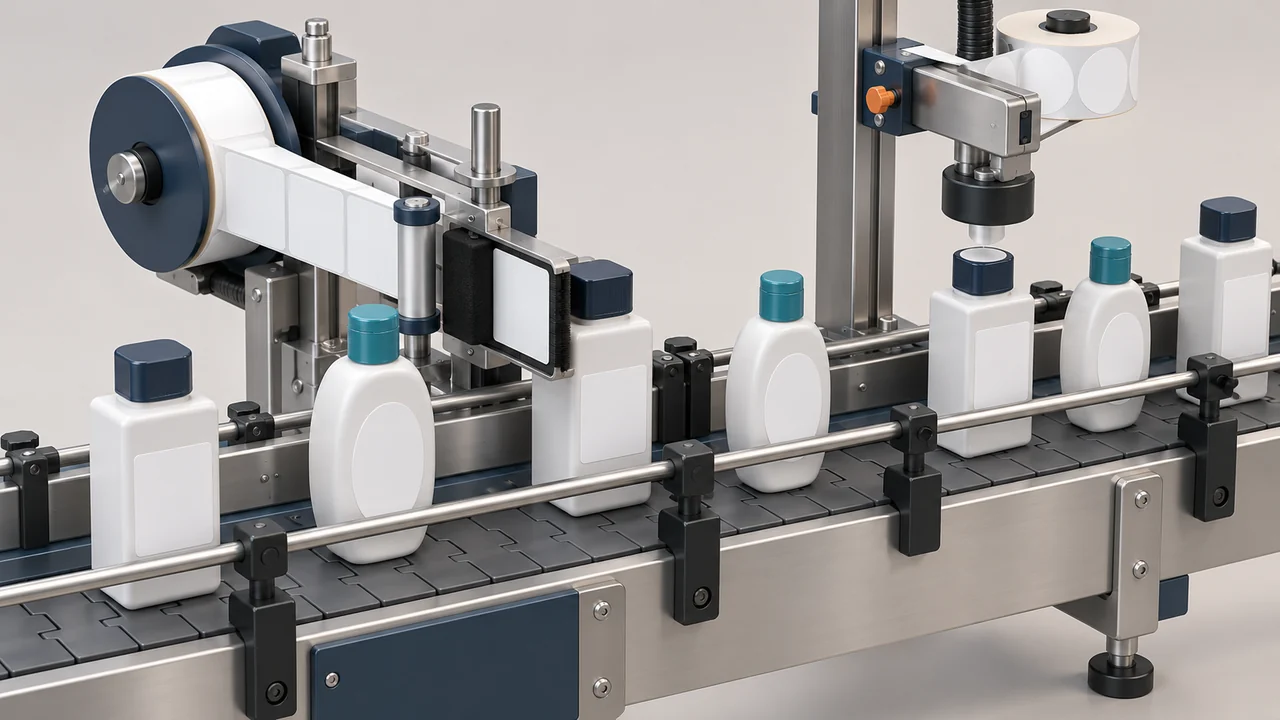
The applicator can dispense a label consistently while the container presents the wrong face. This distinction matters when selecting a square bottle single side labeling machine, a square bottle double side labeling machine, an oval bottle labeling machine or a top side sticker labeling machine. Begin with the pack's geometry and intended label position. Orientation must remain controlled through entry, application and discharge, including the ordinary interruptions that happen on a packaging line.
Define the face to be labeled, the reference used to orient the pack and how the machine keeps that orientation during application. Use actual filled and closed containers where relevant. Trial guides, stabilization and transfers together; label placement cannot be assessed independently of container handling.
Define the Label Face and Its Reference
Mark the intended front, back and top on sample containers. Show the relationship between the label and a molded feature, seam, handle, closure or existing decoration if that relationship matters. State whether the pack must leave the machine facing a particular direction for the next operation.
For square and rectangular bottles, check that the proposed label sits within the usable panel rather than bridging an unwanted edge. For oval bottles, identify the two broad faces and their permitted label positions. A sketch of the finished pack is more informative than a label size alone.
Review the Handling Method by Pack Shape
The single-side square bottle page describes spacing, orientation and stabilization before application to the selected face. The double-side and oval pages describe front-and-back labeling using two label heads. Top-side labeling addresses an approved top surface on containers, tubs, boxes and compatible packs; it is a separate application problem.
| Pack | Question to resolve |
|---|---|
| Square or rectangular | Which face enters the label head, and how is rotation restrained? |
| Oval | How are broad faces aligned and held through both heads? |
| Flat-top pack | How are top height, flatness and approach position maintained? |
Choose Guide Contact Around the Actual Container
Review where guides and any stabilizing belt contact the pack. Contact should control presentation without distorting the body, disturbing a closure or obscuring the intended application area. Ask the supplier to demonstrate the proposed arrangement on the lightest and least stable samples in the format list.
Filled and empty bottles may behave differently. Test the production condition, including closure and fill state, rather than relying only on empty display samples. Check the exit transfer for tipping, unwanted rotation and pressure from accumulating containers.
Treat Front-and-Back Registration as a Combined Result
For double-side labeling, approve the two label positions together. Record their height relationship, intended alignment and orientation relative to the bottle. A front label that looks correct in isolation can still produce an unacceptable pack when the back label is skewed or displaced.
Inspect both heads after normal stops and roll changes. If the two rolls have different label dimensions or repeat lengths, show those specifications clearly. Define whether the packs need a fixed facing direction after labeling, since the downstream inspection or packing arrangement may depend on it.
Check Top-Side Application on Complete Packs
A top-side sticker labeling machine needs a stable, accessible application surface. Supply lids, closures or assembled cartons as they will arrive in production. Check recessed areas, curved edges and height variation so that the label can be pressed onto the intended area without an unsupported edge.
The published top-side page includes product sensing and no-container/no-label logic. That sensing is not a promise of orientation verification or printed-label inspection. If either is required, define the defect to detect and request a specific inspection arrangement rather than assuming the basic applicator performs it.
Use an Orientation Trial Checklist
Ask the supplier to run representative packs through the proposed guides and transfers, then document:
- The starting orientation and whether operators must pre-orient containers.
- Label position on each face and the accepted finished-pack example.
- Results at entry, application and exit after a normal stop and restart.
- Setup changes for the smallest and largest required packs.
- Any separate equipment needed for orientation or inspection.
When comparing a labeling machine manufacturer or supplier in India, keep this record consistent between quotations. It makes the container-handling responsibility visible instead of comparing label-head specifications alone.
Buyer Questions
Can an oval bottle use the same settings as a rectangular bottle?
Do not assume so. Both may use a double-side platform, but their guide contact and stabilization depend on the actual geometry. Approve each container's setup separately.
Does no-container/no-label logic verify the correct face?
Not by itself. It prevents a label cycle when a container is absent. Orientation detection and inspection require their own defined functions.
Should a top-side labeling trial use an open container?
Use the complete pack in its production condition when the label is applied to a lid, closure or assembled carton. An open sample does not reproduce that surface.
Related Machine Guides
Product References and Further Details
These primary pages describe the published machine arrangements discussed in this guide. Use the actual product and component requirements when reviewing a configuration.
Discuss Your Machine Requirement
Share your product, container or closure samples, required output, process conditions and line layout with H M Pharma Machines for a technical review.
Request a Technical Review