Applied engineering reference
Compressed-Air Leaks: Compare Capacity Loss with the Energy Consequence
Keep compressed-air leak flow distinct from the electrical savings that the real compressor controls can deliver after repair.
Read Full Article →
Applied engineering reading, separated from practical machine selection guides.
Browse by task
Start with the machine or task you are planning. Each topic brings together selection guides, practical checks and relevant engineering references.
Compare container handling, wash access, cleaning utilities and acceptance checks before selecting a washer.
Choose a dosing method and prepare product, container, nozzle and repeatability checks for the machine trial.
Compare cap presentation, closure methods and the evidence needed to approve the finished pack.
Match the container and label format, approve the sample roll, and define coding or inspection evidence.
Define format kits, container references and transfer interfaces for each planned product and pack size.
Prepare the site, utility connections and line interfaces before confirming the machine scope.
Agree trial evidence, dispatch checks, operator training and the spares required for the supplied machine.
Search practical Machine guides first, or choose the separate Engineering reference archive. Use a keyword, a topic, or both.
Search all 737 articles by keyword, topic, or both.
Or browse Machine guides and the Engineering reference archive.
Reference reading
Applied engineering background. These references are separate from machine selection guides.
Engineering references
Background reading is labelled by scope. For practical machine selection, use the separate Machine guides.
Applied engineering reference
Keep compressed-air leak flow distinct from the electrical savings that the real compressor controls can deliver after repair.
Read Full Article →Applied engineering reference
Compare timer-driven and condensate-responsive drain behavior against actual removal and air-loss requirements.
Read Full Article →Applied engineering reference
A rotor’s RPM needs its diameter before it becomes a tip velocity. Keep those two inputs together in a scale comparison.
Read Full Article →Applied engineering reference
A stirred-vessel Reynolds number uses an impeller scale. Do not copy a pipe-flow formula without defining the geometry.
Read Full Article →Applied engineering reference
A mixing-power estimate can be very sensitive to speed and diameter. Expose those exponents before comparing rounded motor figures.
Read Full Article →Applied engineering reference
Geometric scale-up can preserve one mixing criterion while changing another. State which similarity condition is being chosen.
Read Full Article →Applied engineering reference
Identify which claims belong to a frozen-rotor approximation and which need time-dependent mixing evidence.
Read Full Article →Applied engineering reference
An impeller’s pumping rate is a local discharge quantity. It is not automatically a tank blending-time certificate.
Read Full Article →Applied engineering reference
Define what concentration agreement means before comparing two reported mixing times.
Read Full Article →Applied engineering reference
A delayed tracer signal can reflect the route from injection to observation. It does not identify a global mixing time by itself.
Read Full Article →Applied engineering reference
Describe the needed bulk fluid movement before choosing an impeller family from its appearance.
Read Full Article →Applied engineering reference
Visible fluid rotation can be impressive while exchange between vessel regions remains weak. Identify the motion the task actually needs.
Read Full Article →Applied engineering reference
When a proposal includes a draft tube, review the defined circulation passage rather than treating the tube as extra storage volume.
Read Full Article →Applied engineering reference
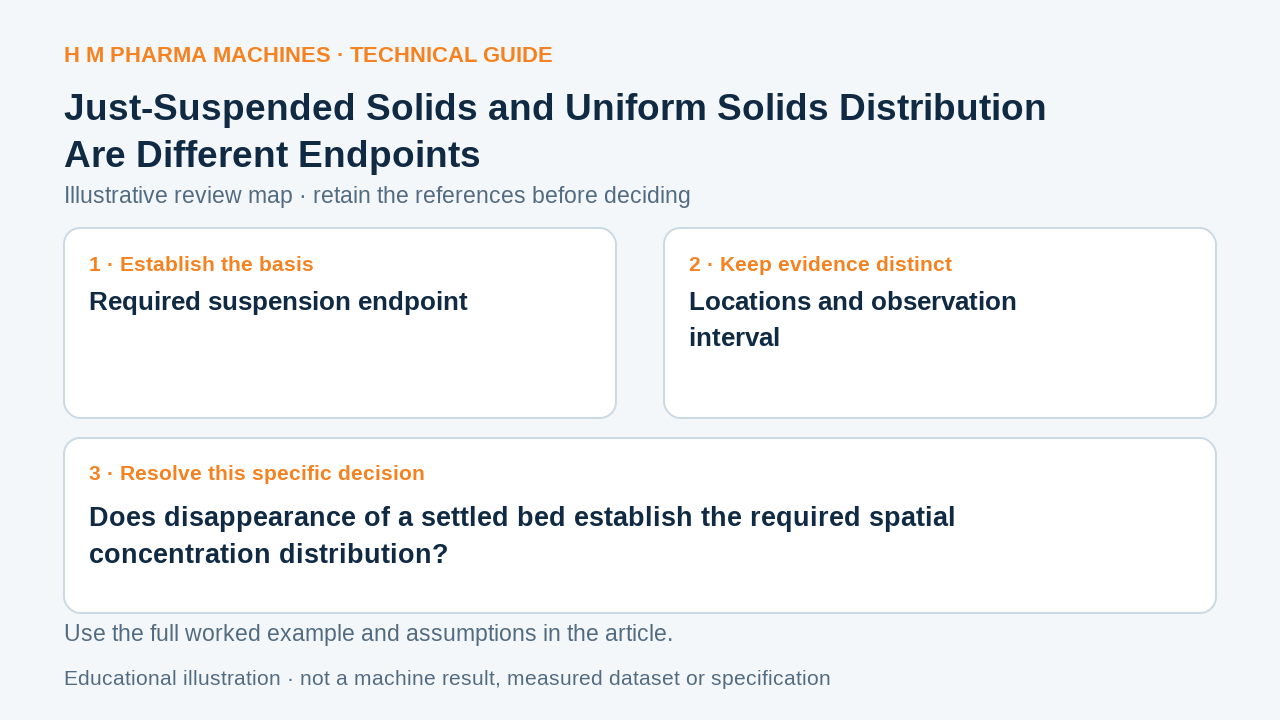
Keeping solids off the bottom and producing the same concentration everywhere are different suspension requirements.
Read Full Article →Applied engineering reference
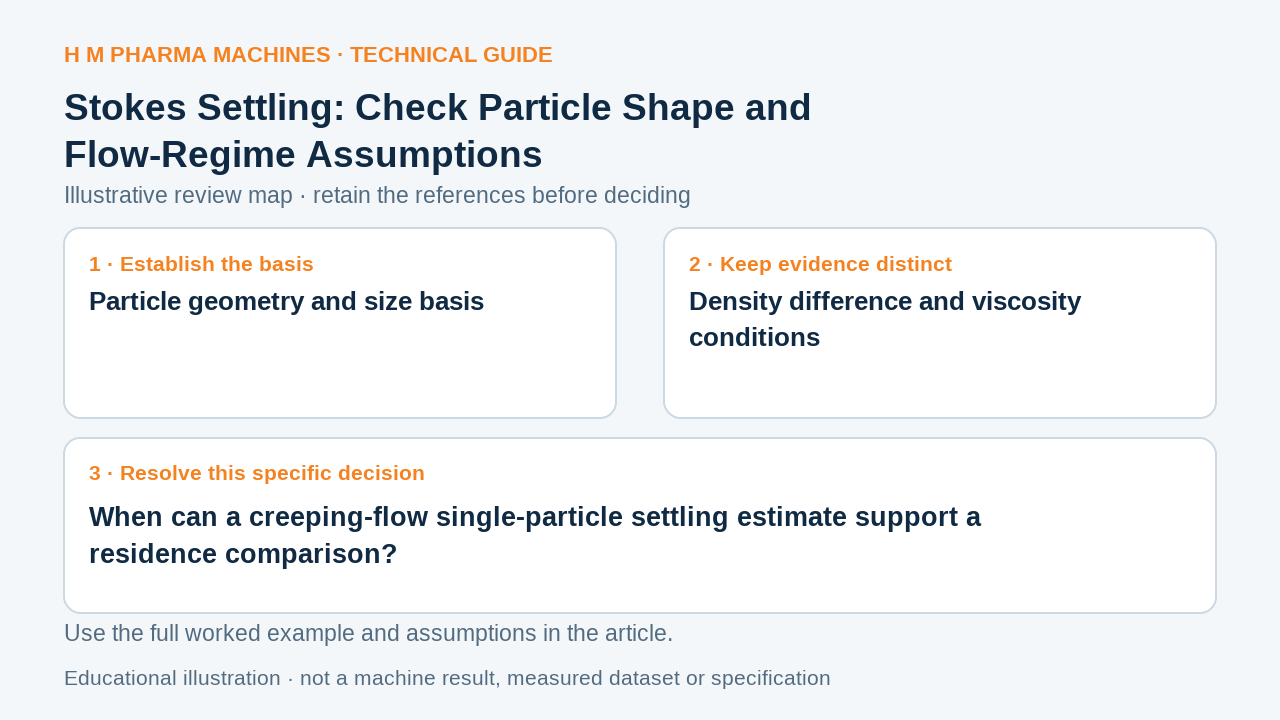
Use a Stokes settling estimate only after checking the particle and flow assumptions that make it meaningful.
Read Full Article →Applied engineering reference
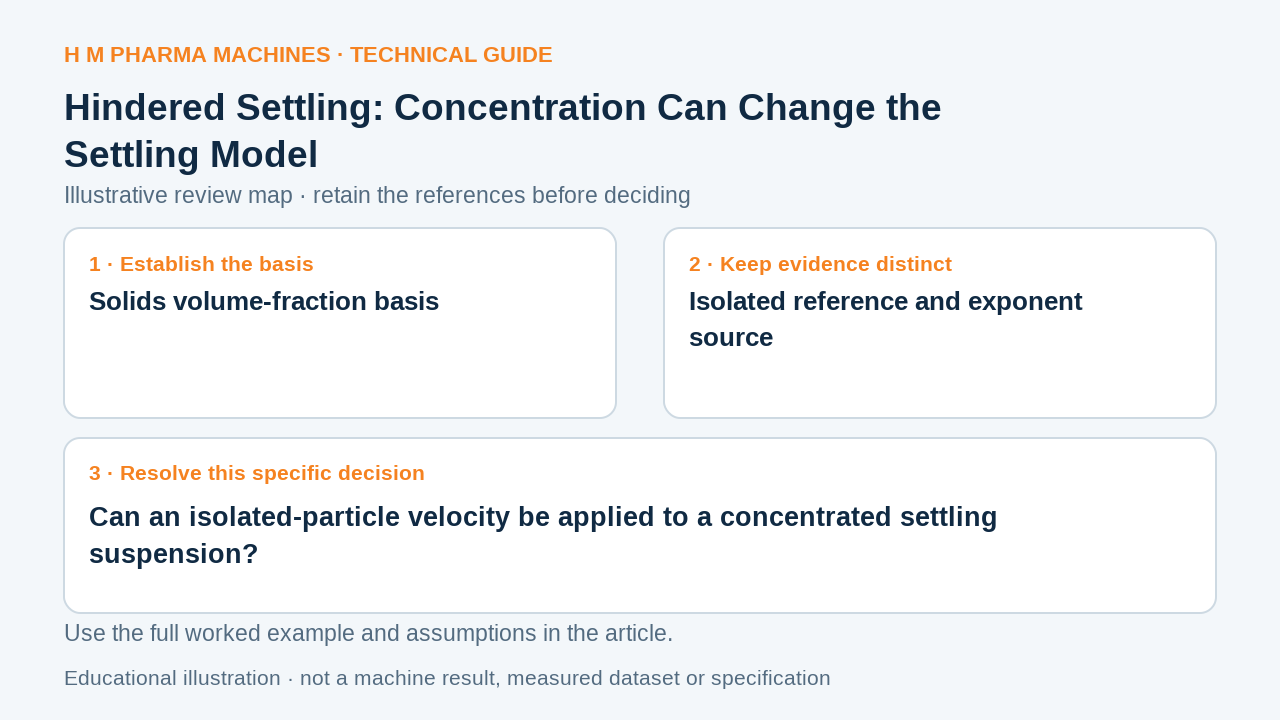
A settling estimate for one isolated particle can overstate the settling speed of an interacting suspension.
Read Full Article →Applied engineering reference
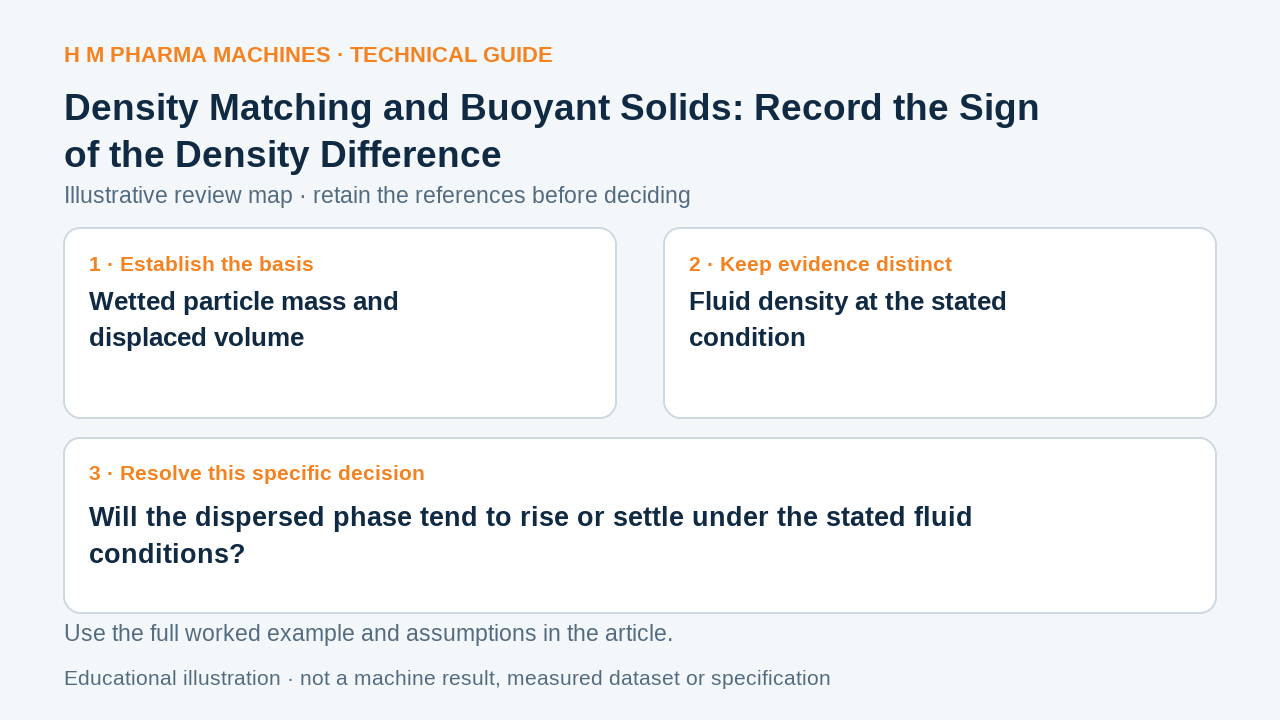
Before estimating a particle’s migration rate, establish whether its buoyancy-corrected weight points downward or upward.
Read Full Article →Applied engineering reference
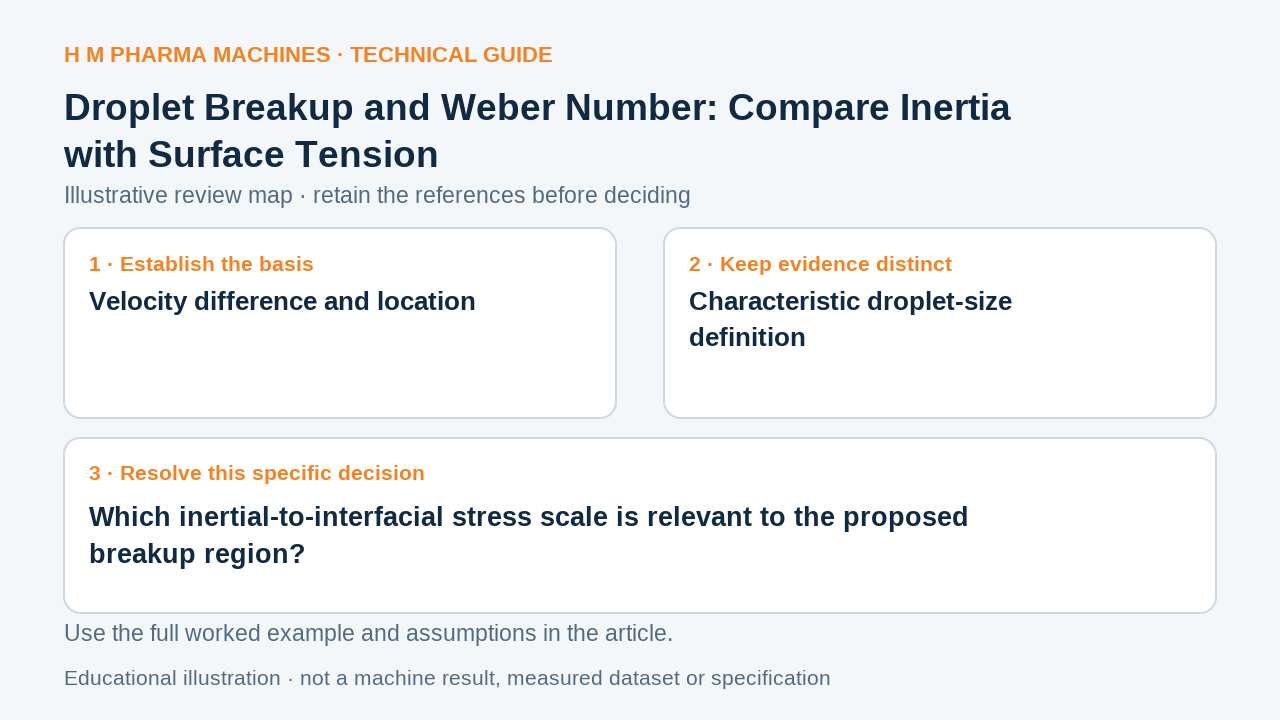
A droplet Weber number needs a velocity and length scale that belong to the selected breakup model.
Read Full Article →Applied engineering reference
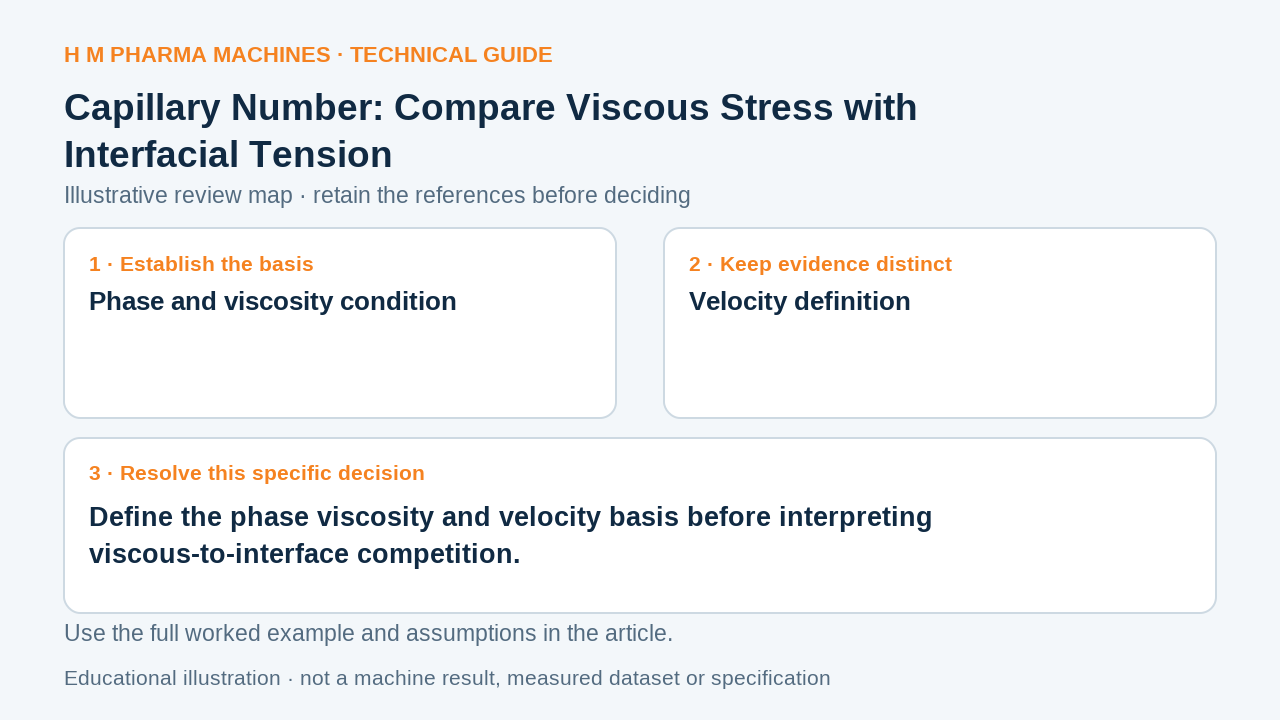
The capillary number tests a viscous-to-interface comparison. It answers a different question from an inertia-based Weber number.
Read Full Article →Applied engineering reference
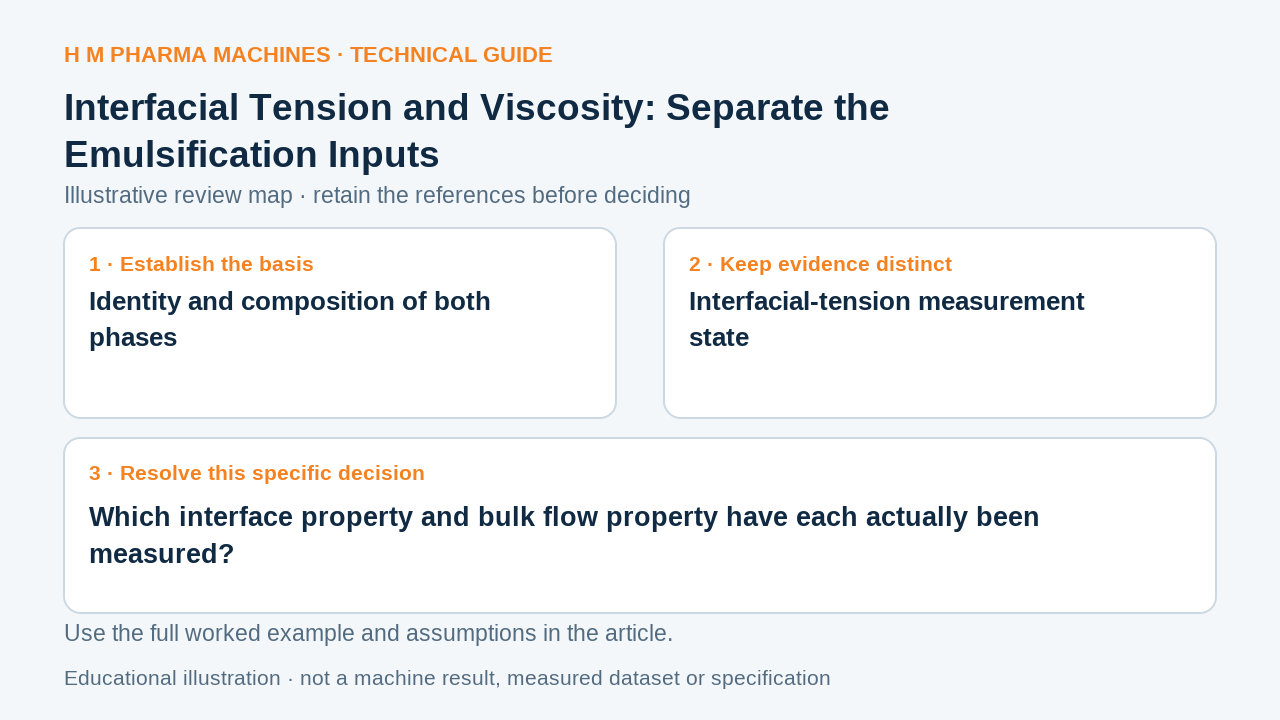
Viscosity and interfacial tension describe different resistance mechanisms. One cannot be inferred from the other.
Read Full Article →Machine guide
Keep unconfirmed machine-project assumptions visible by recording their source, affected decision, evidence needed and owner before scope is approved.
Read Full Article →Applied engineering reference
A separated-looking emulsion may have migrated droplets or merged droplets. Those observations suggest different mechanisms.
Read Full Article →Applied engineering reference
Use a surface-area-to-volume size measure when interfacial area is the question. A differently weighted mean answers another question.
Read Full Article →Applied engineering reference
Decide whether the required endpoint is a solution or a distribution of separate particles. A smooth-looking mixture does not answer that question.
Read Full Article →Share your product, container, closure, required output and process details with our engineering team.