Applied engineering reference
Flexible Coupling Inserts: Compare Torque Behavior with Environmental Compatibility
Compare a flexible coupling insert's motion function and environmental suitability separately.
Read Full Article →
Applied engineering reading, separated from practical machine selection guides.
Browse by task
Start with the machine or task you are planning. Each topic brings together selection guides, practical checks and relevant engineering references.
Compare container handling, wash access, cleaning utilities and acceptance checks before selecting a washer.
Choose a dosing method and prepare product, container, nozzle and repeatability checks for the machine trial.
Compare cap presentation, closure methods and the evidence needed to approve the finished pack.
Match the container and label format, approve the sample roll, and define coding or inspection evidence.
Define format kits, container references and transfer interfaces for each planned product and pack size.
Prepare the site, utility connections and line interfaces before confirming the machine scope.
Agree trial evidence, dispatch checks, operator training and the spares required for the supplied machine.
Search practical Machine guides first, or choose the separate Engineering reference archive. Use a keyword, a topic, or both.
Search all 737 articles by keyword, topic, or both.
Or browse Machine guides and the Engineering reference archive.
Reference reading
Applied engineering background. These references are separate from machine selection guides.
Engineering references
Background reading is labelled by scope. For practical machine selection, use the separate Machine guides.
Applied engineering reference
Compare a flexible coupling insert's motion function and environmental suitability separately.
Read Full Article →Applied engineering reference
Keep the shaft, key and hub contact geometry together when reviewing torque transmission.
Read Full Article →Applied engineering reference
Read a taper-bushing connection using the instructions for its identified surfaces and assembly design.
Read Full Article →Applied engineering reference
Decode metric module and imperial diametral pitch before comparing gear dimensions.
Read Full Article →Applied engineering reference
Interpret gear backlash in the context of required clearance, operating conditions and reversal behavior.
Read Full Article →Applied engineering reference
Read a worm-gear self-locking statement as a conditional behavior rather than a universal holding guarantee.
Read Full Article →Applied engineering reference
Use gear ratio for an ideal torque relation while keeping losses and ratings explicit.
Read Full Article →Applied engineering reference
Read screw pitch and lead as distinct geometry quantities when interpreting travel per revolution.
Read Full Article →Applied engineering reference
Identify how a screw-driven load is held instead of assuming reverse motion is inherently blocked.
Read Full Article →Applied engineering reference
Include moments from load offsets when reviewing a linear-guide arrangement.
Read Full Article →Applied engineering reference
Investigate guide geometry and alignment before assuming a higher motor torque solves resistance.
Read Full Article →Applied engineering reference
Calculate the force at a stated spring position using a defined rate and installed compression.
Read Full Article →Applied engineering reference
Use free, working and solid lengths to describe compression-spring travel without treating coil bind as an operating target.
Read Full Article →Applied engineering reference
Describe a cyclic spring-stress case using its minimum, maximum, mean and alternating components.
Read Full Article →Applied engineering reference
Separate fastener strength class from alloy identity and corrosion-related material requirements.
Read Full Article →Applied engineering reference
Keep initial clamp condition and applied external load separate in a bolted-joint review.
Read Full Article →Applied engineering reference
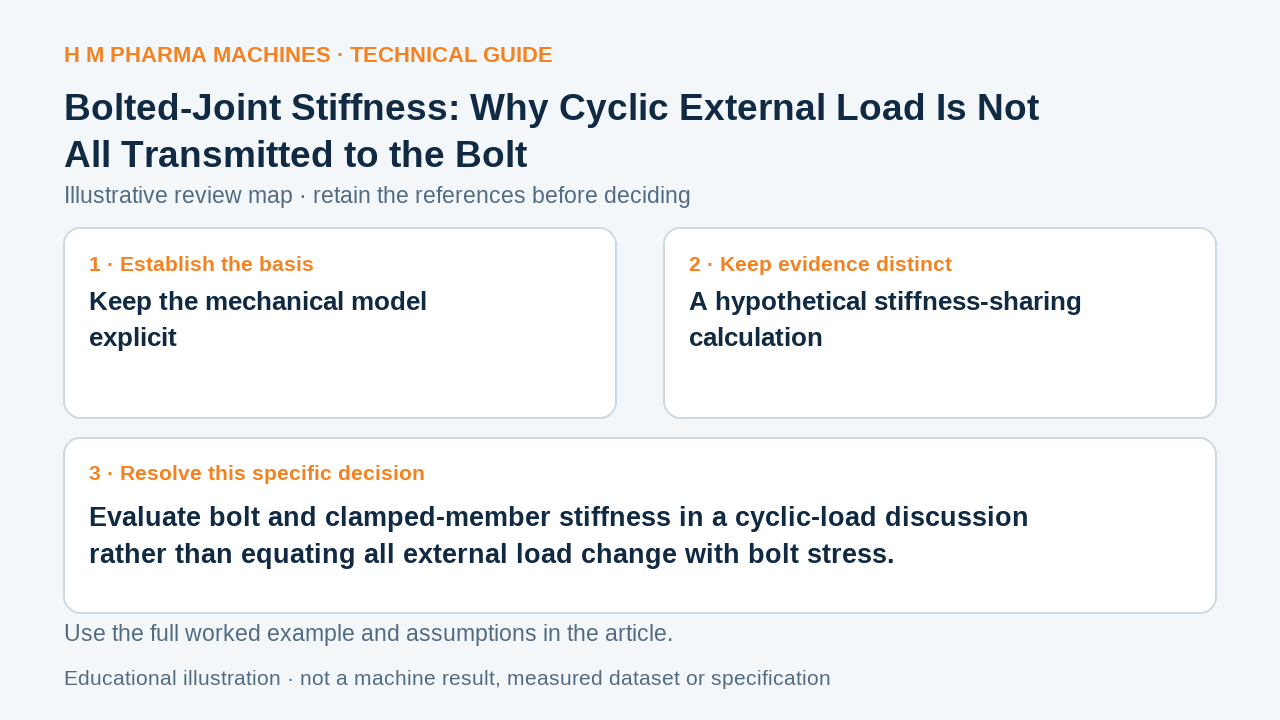
Relate cyclic bolt-load change to the defined stiffness sharing of the assembled joint.
Read Full Article →Applied engineering reference
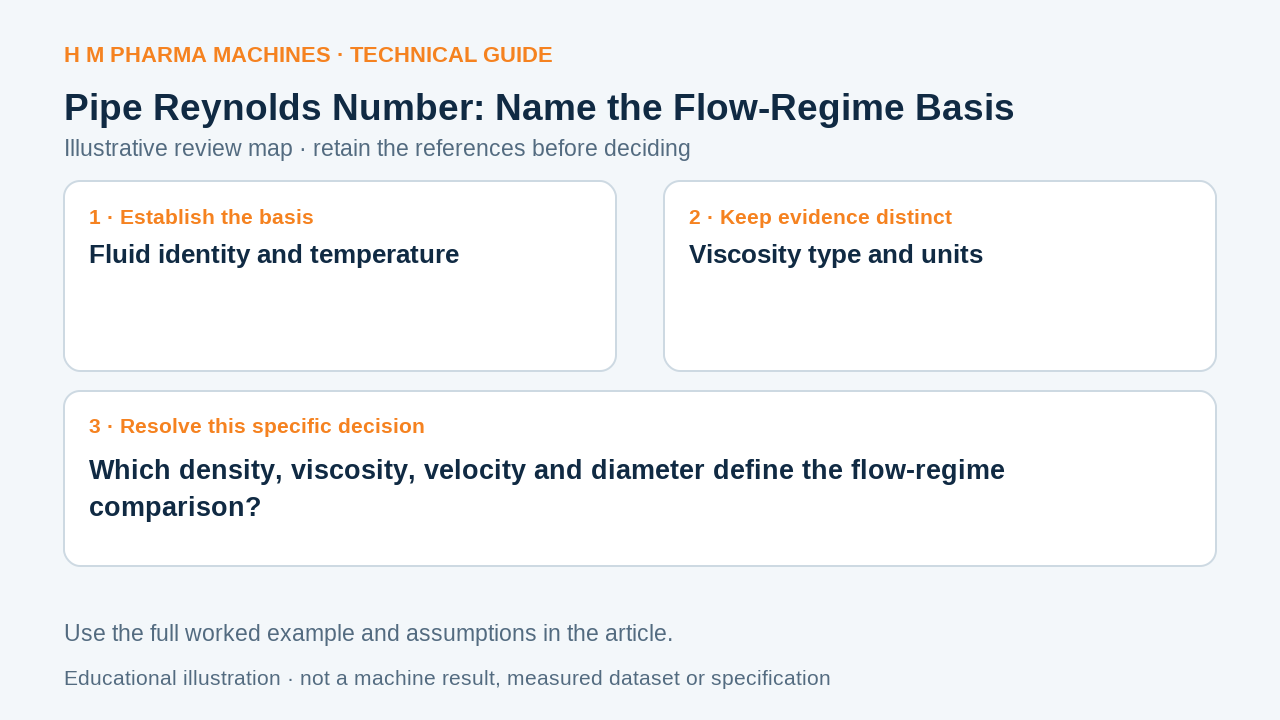
Before choosing a pipe-loss correlation, identify the fluid properties and actual passage used to calculate Reynolds number.
Read Full Article →Applied engineering reference
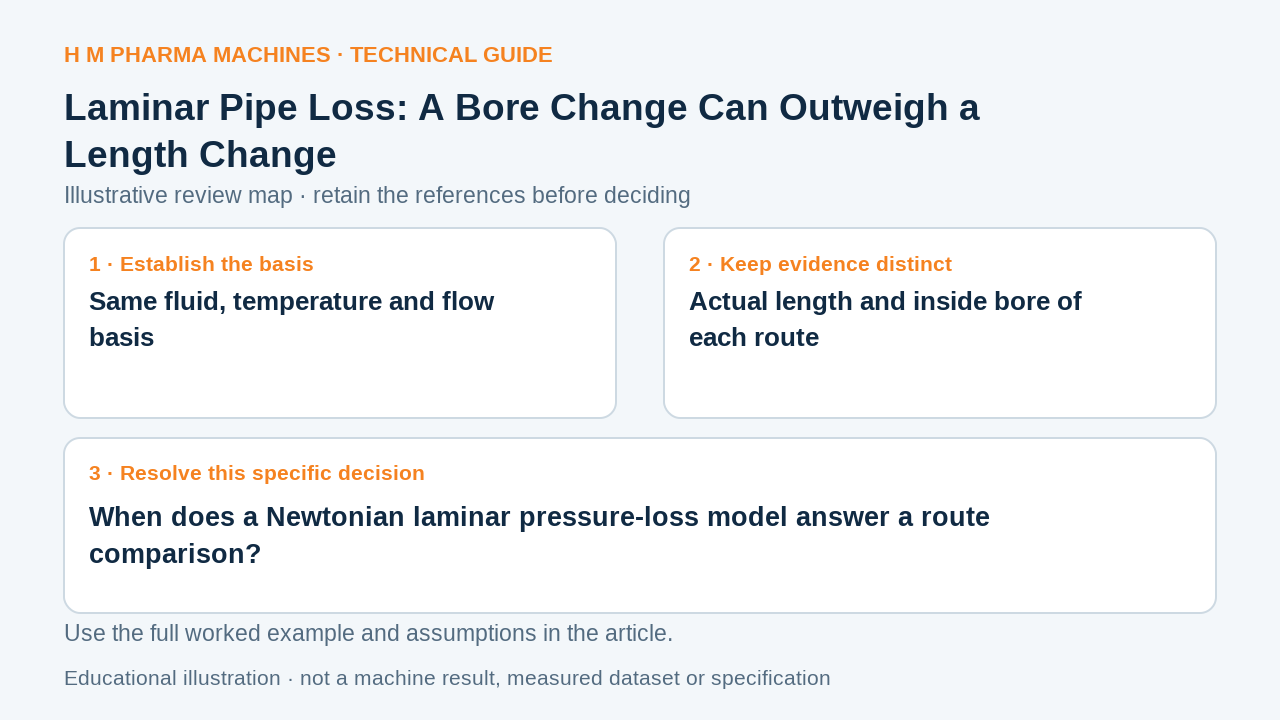
Use the laminar model to separate the effects of length and bore before treating a longer transfer route as the main source of loss.
Read Full Article →Applied engineering reference
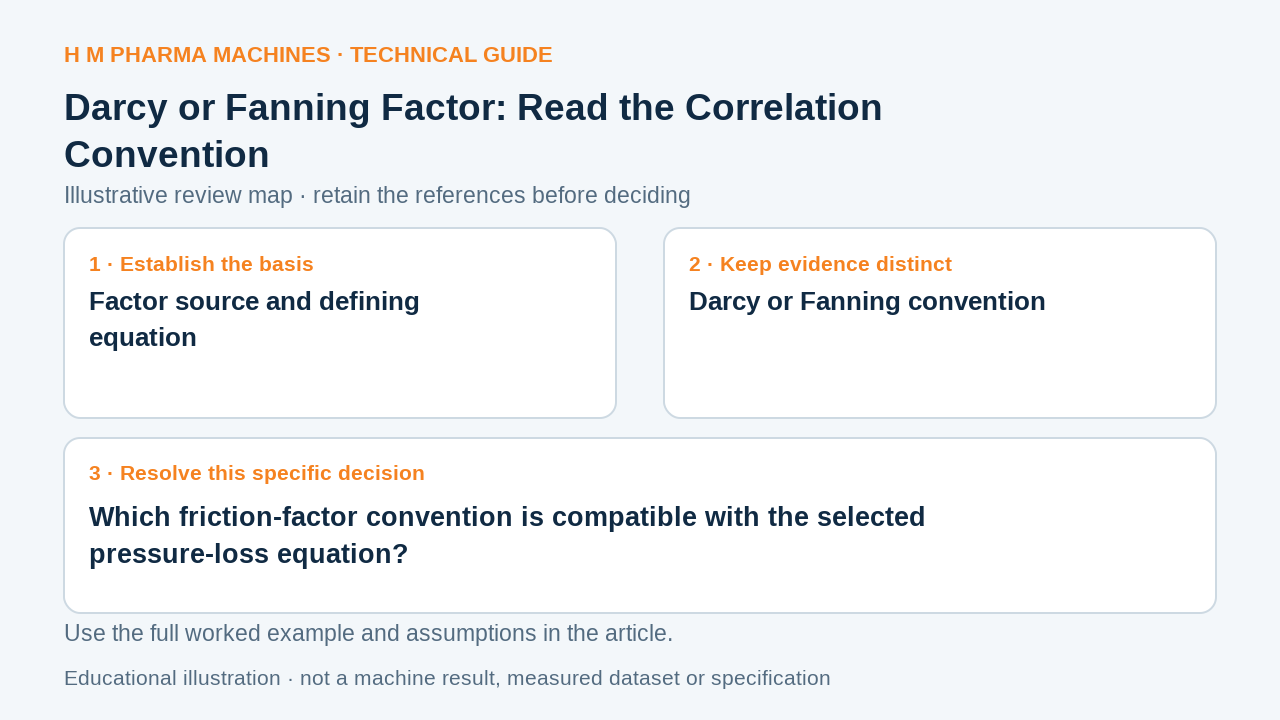
A friction-factor number needs its convention. Otherwise a correct-looking pressure-loss calculation can carry a fourfold error.
Read Full Article →Applied engineering reference
For a noncircular flow passage, the relevant characteristic dimension may come from fluid area and wetted perimeter rather than the outside width.
Read Full Article →Applied engineering reference
A fitting represented by a loss coefficient and the same fitting represented by equivalent length need the same hydraulic basis.
Read Full Article →Applied engineering reference
Two centrifugal pumps in series add head at a common flow. The resulting system duty still needs a combined curve.
Read Full Article →Applied engineering reference
A water-tested centrifugal pump curve may need a fluid-specific correction before it supports a viscous-liquid duty.
Read Full Article →Share your product, container, closure, required output and process details with our engineering team.