Rotational Rheometer Geometry: Cone, Plate and Cylinder Need Their Own Rate Model
Use the geometry-specific motion-to-rate model before treating equal rotor speed as equal shear rate in different rheometer fixtures.
Read Full Article →
Practical guides for selecting, planning, operating and maintaining pharmaceutical manufacturing and packaging machinery.
Latest articles
Practical guides to washing, filling, capping, labeling and machine planning. Each card has a distinct Library date; actual publication and revision dates remain inside the article.
Machine guide library
Browse guides by their distinct Library date. These collection labels are separate from actual publication and revision dates shown inside each article.
Use the geometry-specific motion-to-rate model before treating equal rotor speed as equal shear rate in different rheometer fixtures.
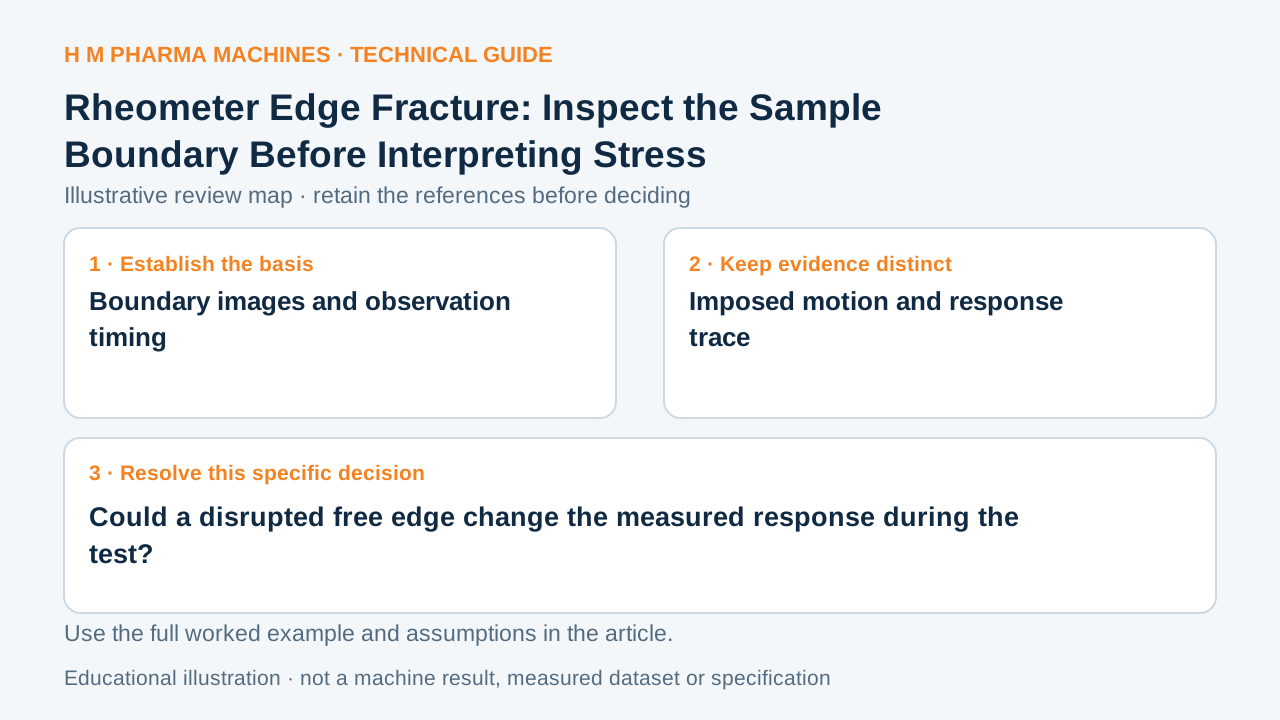
Read Full Article →Inspect the free sample edge when a sheared material develops an unexpected response; a disturbed boundary can compromise the intended measurement geometry.
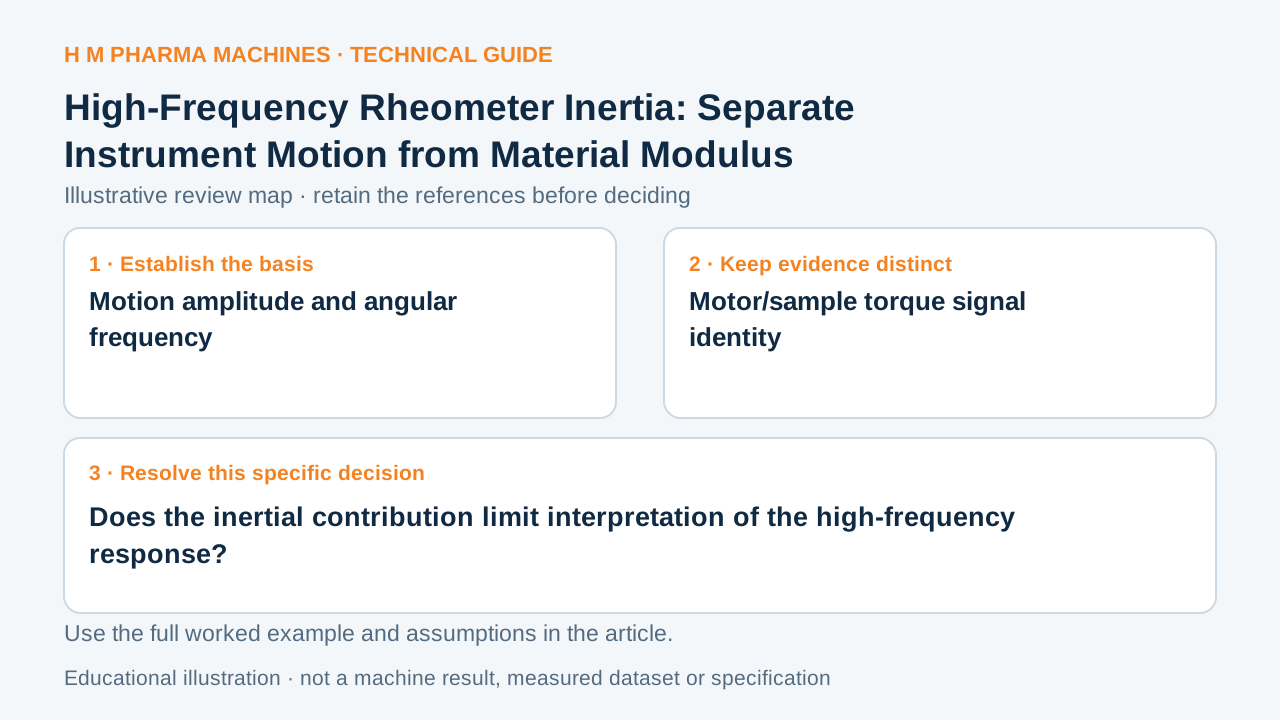
Read Full Article →Ask which part of an oscillatory torque record belongs to accelerated instrument motion before interpreting the entire high-frequency response as material behavior.
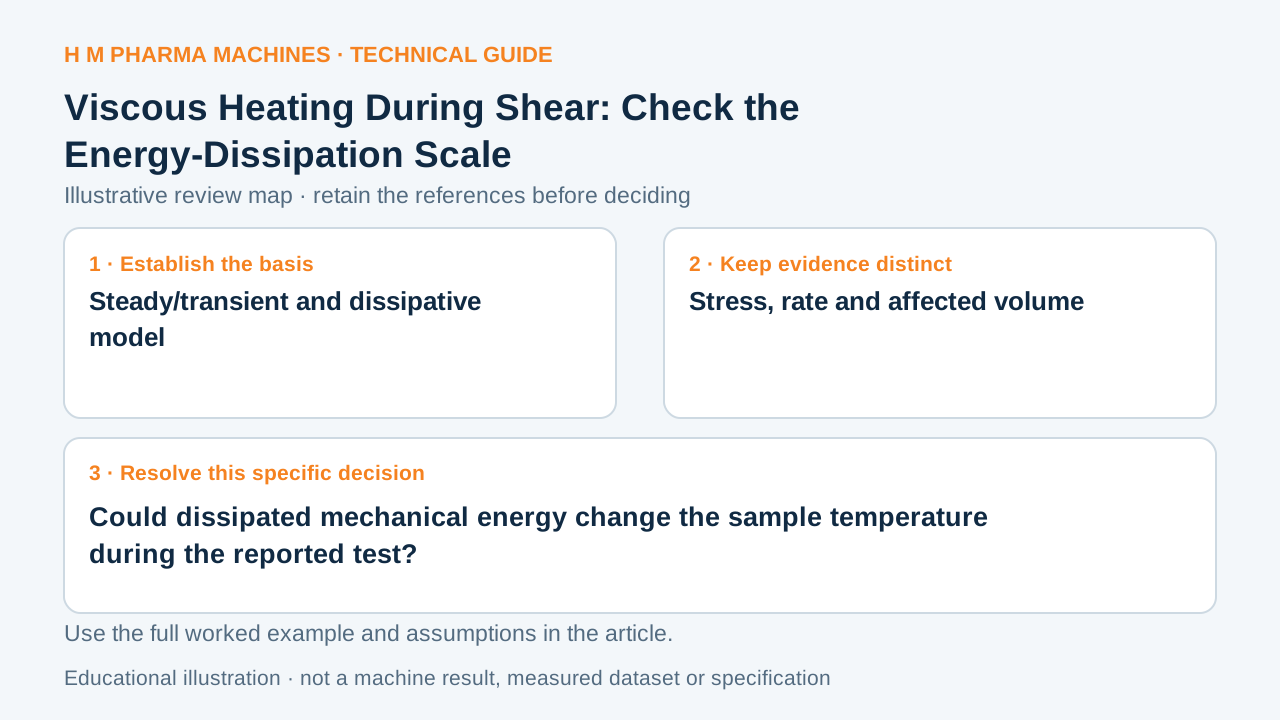
Read Full Article →Check whether the mechanical work dissipated during shear could alter the test condition rather than assuming the requested temperature is the actual sample temperature.
Read Full Article →Prepare an assortment-specific carton-checking enquiry using the kit bill of materials, plausible mistakes and evidence that separates weight from component identity.
Read Full Article →Check whether solvent loss changes the sample during a time-dependent rheology measurement before interpreting the trend as a response of unchanged material.
Read Full Article →Check whether settling changes the concentration within the measured region before comparing a long rheology run with an original bulk formulation.
Read Full Article →Look for particle motion relative to the mixture across a shear gradient, rather than assigning every suspension redistribution to gravitational settling.
Read Full Article →Write the relaxation and excitation timescale definitions before comparing Deborah and Weissenberg values; the names alone do not establish equivalent measures.
Read Full Article →Verify an empirical correspondence before replacing a measured steady-shear curve with complex viscosity from an oscillatory test.
Read Full Article →Bound a viscosity-temperature fit to the material state and measured region before extending it to a new thermal condition.
Read Full Article →Keep the exponent-dependent units of the power-law consistency parameter before comparing two rheology fits with the same numerical coefficient.
Read Full Article →Ask what finite rate limits the chosen model represents before extrapolating a mid-range power-law fit far beyond its measured interval.
Read Full Article →Keep particle association separate from primary-particle size and total solids when interpreting a changed suspension flow curve.
Read Full Article →Check the dilute rigid-sphere assumptions before using a first-order suspension-viscosity expression as a concentration comparison.
Read Full Article →Keep the formulation-dependent packing limit visible when a concentrated-suspension model uses distance from crowding as its main variable.
Read Full Article →Differentiate the imposed sinusoidal strain before calling its amplitude a shear-rate amplitude.
Read Full Article →Identify whether the intended rheology experiment imposes stress or deformation before interpreting the remaining recorded response.
Read Full Article →Request frequency-dependent evidence before treating one storage/loss modulus crossover as a universal gel-point criterion.
Read Full Article →Keep ramp direction, duration and the plotted quantity with a hysteresis-area comparison instead of treating a loop as a timeless material constant.
Read Full Article →Review the size-mixture composition when changing a dense suspension; a median size alone leaves the packing relationship unresolved.
Read Full Article →Compare random diffusive displacement and directed drift on the same time and spatial basis before labeling a particle suspension stable or settling-dominated.
Read Full Article →Keep the perpendicular force channel separate from rotational torque when asking which measured response supports a rheological stress interpretation.
Read Full Article →Use the actual circuit topology to distinguish branch current from the current supplied to the whole network.
Read Full Article →Blog overview · Latest articles · Machine guide library
Application-based guidance for selecting equipment according to product, container, closure and output.
Practical considerations for connecting washing, filling, capping, labeling and conveying machinery.
Useful information for changeovers, cleaning, preventive maintenance and dependable machine performance.
Share your product, container, closure, required output and process details with our engineering team.