Applied engineering reference
Idler Gears: Intermediate Teeth Can Change Direction Without Changing the Overall Ratio
Check cancellation and rotation direction separately in a simple gear train.
Read Full Article →
Applied engineering reading, separated from practical machine selection guides.
Browse by task
Start with the machine or task you are planning. Each topic brings together selection guides, practical checks and relevant engineering references.
Compare container handling, wash access, cleaning utilities and acceptance checks before selecting a washer.
Choose a dosing method and prepare product, container, nozzle and repeatability checks for the machine trial.
Compare cap presentation, closure methods and the evidence needed to approve the finished pack.
Match the container and label format, approve the sample roll, and define coding or inspection evidence.
Define format kits, container references and transfer interfaces for each planned product and pack size.
Prepare the site, utility connections and line interfaces before confirming the machine scope.
Agree trial evidence, dispatch checks, operator training and the spares required for the supplied machine.
Search practical Machine guides first, or choose the separate Engineering reference archive. Use a keyword, a topic, or both.
Search all 737 articles by keyword, topic, or both.
Or browse Machine guides and the Engineering reference archive.
Reference reading
Applied engineering background. These references are separate from machine selection guides.
Engineering references
Background reading is labelled by scope. For practical machine selection, use the separate Machine guides.
Applied engineering reference
Check cancellation and rotation direction separately in a simple gear train.
Read Full Article →Applied engineering reference
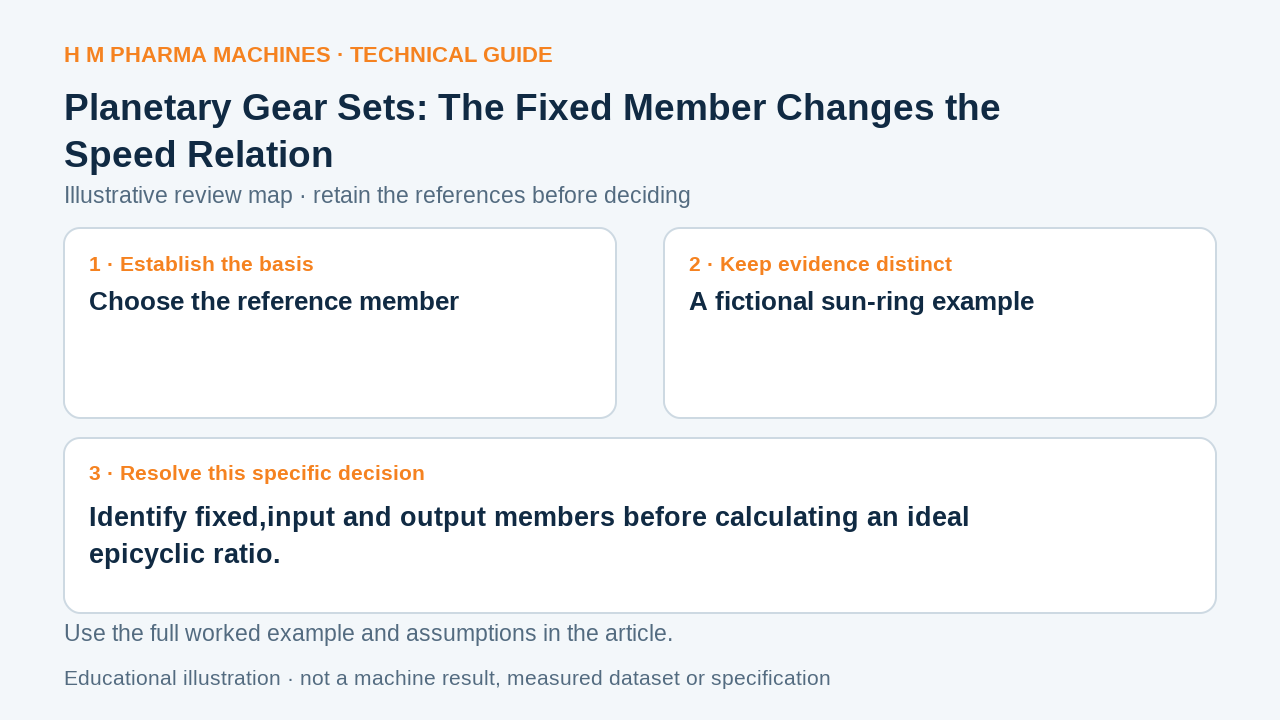
Identify fixed, input and output members before calculating a planetary speed relation.
Read Full Article →Applied engineering reference
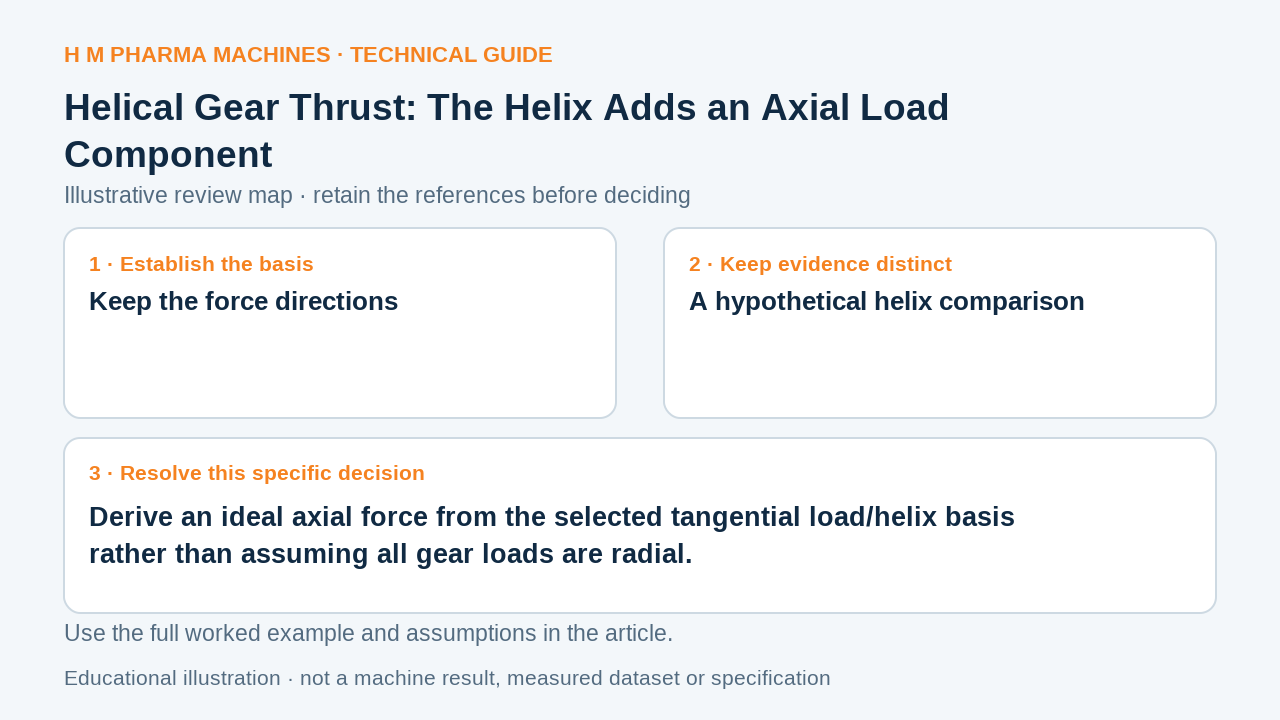
Preserve the axial force component in a parallel-axis helical gear assessment.
Read Full Article →Applied engineering reference
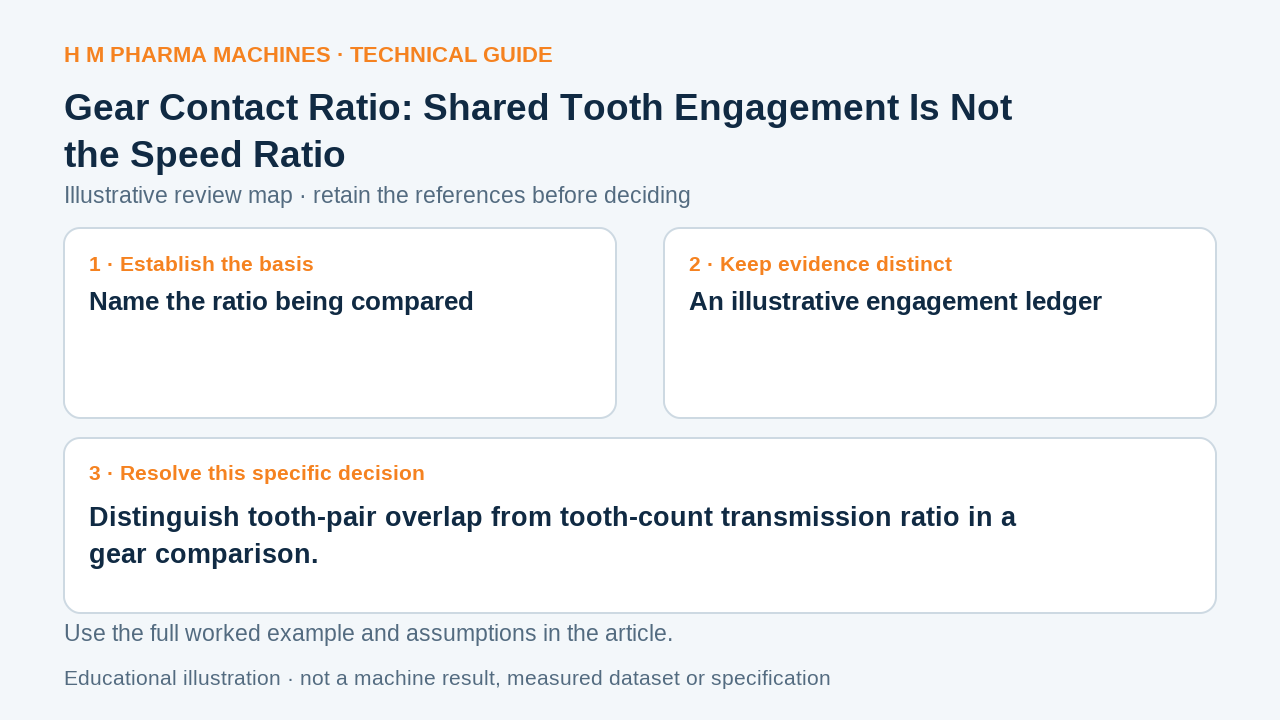
Distinguish tooth-pair engagement overlap from the input-output speed ratio.
Read Full Article →Applied engineering reference
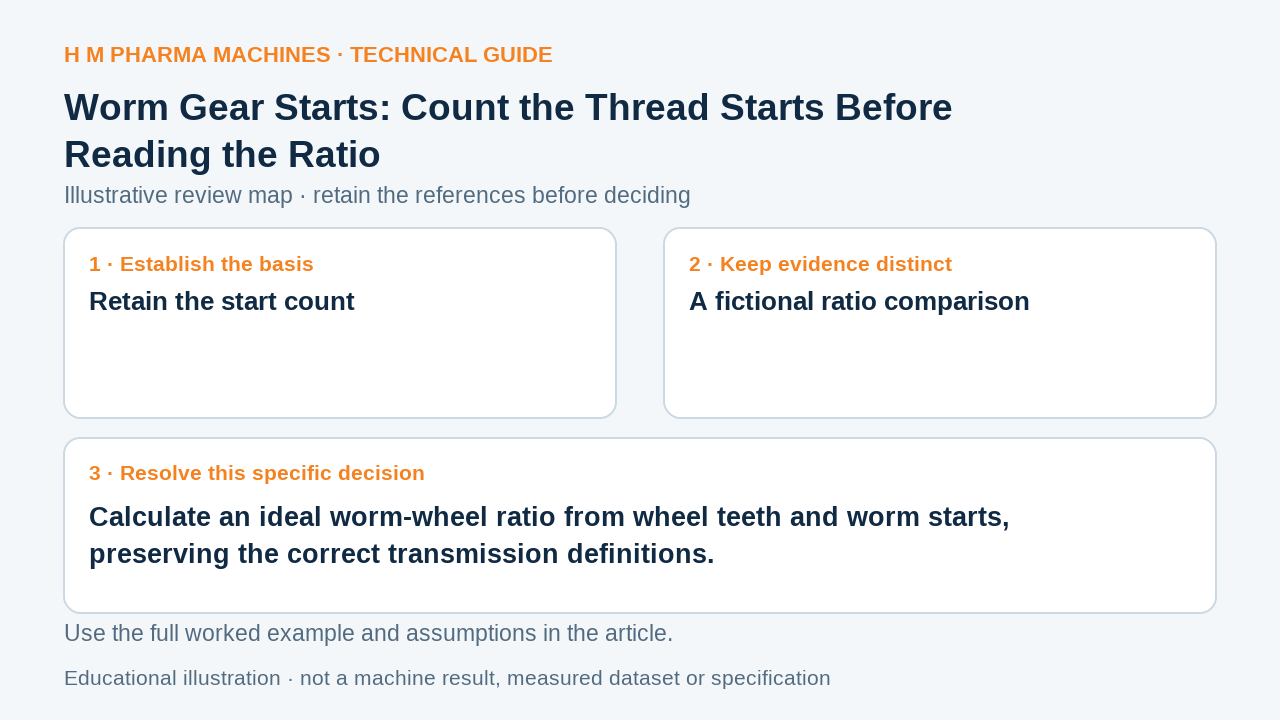
Count worm thread starts as well as wheel teeth before interpreting an ideal reduction ratio.
Read Full Article →Applied engineering reference
Use the defined cam pressure angle to distinguish normal contact force from useful follower force.
Read Full Article →Applied engineering reference
Separate camshaft rotation from follower rise, dwell and return when describing a cycle.
Read Full Article →Applied engineering reference
Convert an explicit follower displacement function into velocity using the stated camshaft speed.
Read Full Article →Applied engineering reference
Identify the contact motion assumed by a sliding or rolling follower model.
Read Full Article →Applied engineering reference
Compare a cyclic work requirement with flywheel energy available between stated speeds.
Read Full Article →Applied engineering reference
Use relative slip speed when estimating a friction clutch’s illustrative heat input.
Read Full Article →Applied engineering reference
Keep energy per stop and repetition timing together when reviewing brake thermal duty.
Read Full Article →Applied engineering reference
Relate average work inventory, flow rate and residence time using one defined system boundary and consistent units.
Read Full Article →Applied engineering reference
Use arrival, service-start and departure events to separate queue waiting from service and total residence time.
Read Full Article →Applied engineering reference
Calculate a resource’s occupied fraction over a defined window without confusing it with its speed while running.
Read Full Article →Applied engineering reference
Check λ < μ and the stochastic assumptions before applying a finite steady-state M/M/1 queue result.
Read Full Article →Applied engineering reference
Calculate M/M/1 average residence and queue waiting under explicit assumptions, and compare fictional capacity margins.
Read Full Article →Applied engineering reference
Compare explicit regular and burst arrival schedules with the same average rate and different FIFO waiting.
Read Full Article →Applied engineering reference
Define the full-buffer response before modeling an upstream station’s ability to release completed work.
Read Full Article →Applied engineering reference
Distinguish summed overlapping state-flag durations from the time during which at least one flag is active.
Read Full Article →Applied engineering reference
Calculate independent parallel service bounds and retain any shared-resource requirement limiting the combined path.
Read Full Article →Applied engineering reference
Use required branch completion events to define a fork-join boundary instead of summing independent parallel durations.
Read Full Article →Applied engineering reference
Trace when individual jobs become available downstream under an explicit batch-release rule.
Read Full Article →Applied engineering reference
Retain the ordered previous-to-next state in a setup-time matrix when comparing schedules.
Read Full Article →Share your product, container, closure, required output and process details with our engineering team.